
Podcast
October 6 2026

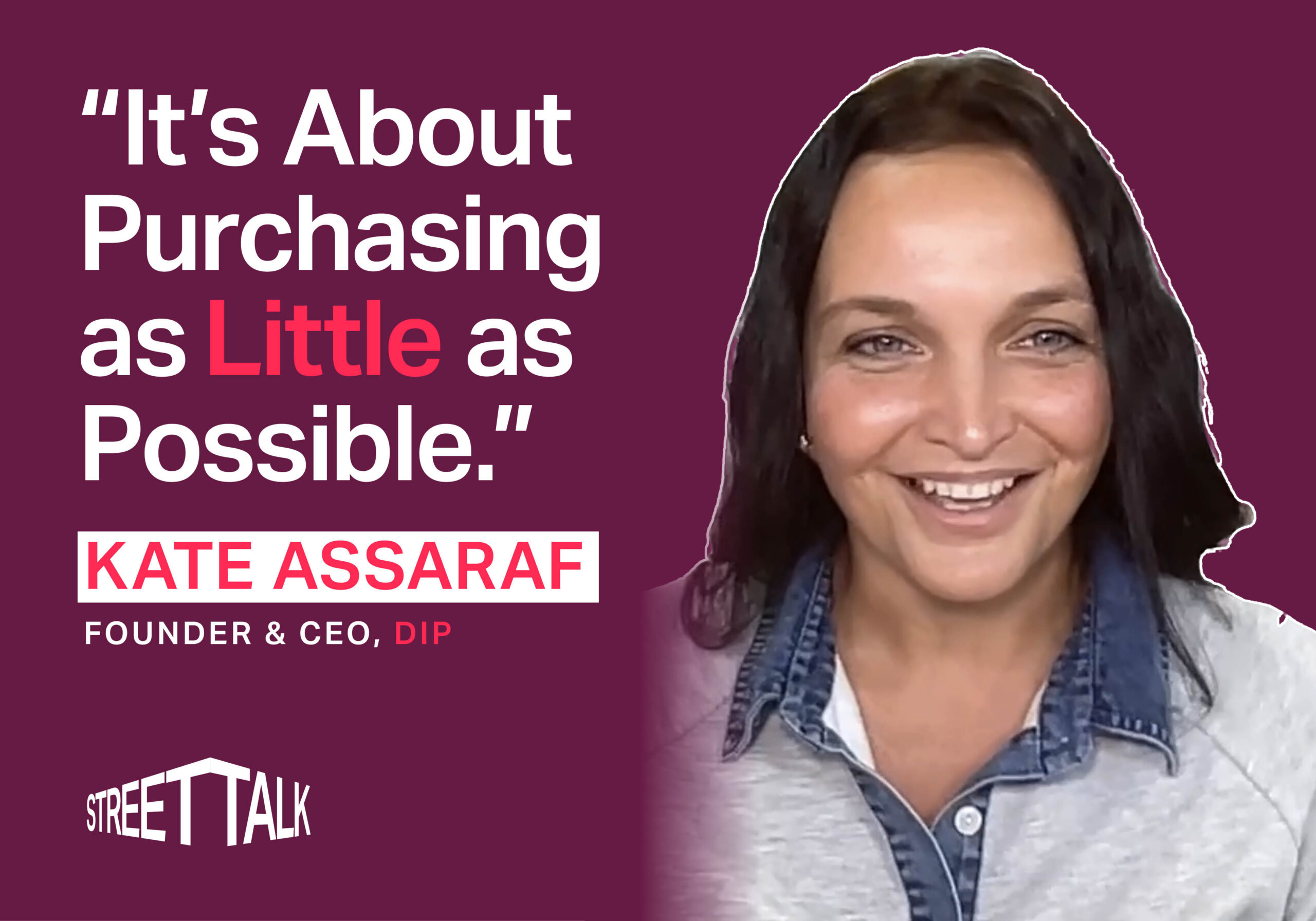
Kate Assaraf, founder and CEO of Dip, explains how a sustainable hair care brand grows by selling less. She covers refill-store distribution, why Dip stays off Amazon, how the K-shaped economy is hitting independent retailers, and the decision to build her own factory after a contract manufacturer went bankrupt. Most brands are built to be bought again as soon as
Cass Spencer

Kate Assaraf, founder and CEO of Dip, explains how a sustainable hair care brand grows by selling less. She covers refill-store distribution, why Dip stays off Amazon, how the K-shaped economy is hitting independent retailers, and the decision to build her own factory after a contract manufacturer went bankrupt.
Most brands are built to be bought again as soon as possible. Kate Assaraf built Dip to be bought as rarely as she can get away with. A single conditioner bar, she says, can replace a year of luxury conditioner and save a shopper more than $500, which is a hard sentence to say in a category designed around repurchase every three to five weeks.
Dip is not on Amazon, Deliberately
The distribution model is the more interesting provocation. Dip is not on Amazon, deliberately: if a refill store loses a customer for two years to a one-click reorder, the independent retailer pays for the brand’s convenience. So Assaraf prioritizes refill stores and salons across the U.S., and uses her website to send shoppers to them. It is a growth strategy that begins by refusing the easiest growth lever.
Then the economy intrudes. Assaraf, an economist by training with roughly 20 years in beauty, describes the K-shaped economy from both sides of her business: independent retailers hungry for deals, shoppers financing groceries, and a wealthier half that is not even having the same conversation. When her contract manufacturer went bankrupt after taking a large down payment, she made a call almost no beauty brand makes and built her own factory, with its own team and a full-time human on customer service.
Arthur Zaczkiewicz asks where this goes in five years. The answer involves running stores, surf shops, national park races and a surprisingly stubborn belief in the independent retailer. Listen to how a brand sells the idea of less.
Arthur Zaczkiewicz [00:01]
Hello, I’m Arthur Zaczkiewicz, and welcome to Street Talk, where we hear from industry executives who share insights in fashion, apparel, beauty, retail and technology. And today we welcome Kate Assaraf, who is the founder and CEO of Dip Sustainable Hair Care. Kate, thank you so much for taking time out today. Before we get started into the gritty stuff, tell us about Dip Sustainable Hair Care.
Kate Assaraf [00:47]
Sure. Sure. So my name is Kate Assaraf. I own Dip, and what we are is really high-end salon quality hair care in bar format for people that feel like they’ve exhausted their options with bar shampoo and conditioner and are giving it one last shot. I find that more often than not, when I tell people we’re a bar shampoo and conditioner brand, they’re already giving me eye rolls because they’ve tried one before. Dip is really, really good. It’s so good that we barely mention being plastic free in our marketing. It’s just great hair care that’s sustainable and lasts a long time.
Arthur Zaczkiewicz [01:25]
What’s the distribution model?
Kate Assaraf [01:29]
So what’s unique about Dip is that it’s not really about just shampoo and conditioner. We really want people to explore their local refill store around the country. So I prioritize distribution in independent retail stores all around the United States. If you know of a refill store, and what that is is you go in and you bring your hand soap, your detergent, or in some cases an empty pasta container, and you can refill whatever. You never have to buy the package again. And I use my website to get people to explore and discover these refill stores near them so that they can make more sustainable choices that are vetted and they never have to be burned by sustainability again.
Arthur Zaczkiewicz [02:15]
I live up in the Hudson Valley, about two hours north of New York City, and we have a couple of refill stores. But I’m guessing it’s not sold on Amazon, right?
Kate Assaraf [02:24]
No, it’s not sold on Amazon and the reason is because the products last so long that if I took business away from a refill store (say you discover Dip in a refill store, and when you need to replenish, you’re like, you know what, I’ll just get it on Amazon), that refill store wouldn’t see you for two years sometimes. So in order to protect these refill stores and also where Dip is in salons all around the country too, it tends to be more eco-friendly or curl-specific salons. You know, I want to protect the independent expert in each town, which is what those retailers and those salon owners provide to consumers.
Arthur Zaczkiewicz [03:05]
What was the moment, the aha moment when you said, you know, I need to launch this company.
Kate Assaraf [03:13]
Well, I was a burned consumer myself. I was so fed up with buying shampoo and conditioner bars that didn’t live up to their promises. And I’ve been in beauty for about 20 years. So I was like, I know I can solve this problem and I know it can do it well. And I know every brand is kind of marketing the same sauce to what they think the sustainable consumer is, but I’m the sustainable consumer and I prioritize hair science in my hair care. I’m not gonna use a shampoo and conditioner that doesn’t make my hair look as great as an Oribe or a Pureology or a Kérastase, one of those.
Arthur Zaczkiewicz [03:49]
So how would you describe your ideal target customer? Is she or he, are they kind of aware of sustainable practices? Is that what they’re trying to do? I mean, up here there’s a lot of, again, we call them like crunchies, who are very much into that and that’s the motivation, but this sounds like it’s different.
Kate Assaraf [04:10]
You know what, because I was a sustainable customer myself and so I walk the walk. I was really tired of paying more for something that really didn’t end up saving me money in the long run. And I think it was across all categories, sustainability is kind of given a bad rap in that way. And so with Dip, when I developed it, I wanted to make sure it saved someone a lot of money that was shopping for really expensive hair care. So you know, a lot of salon hair care that’s great is designed to be repurchased within three to five weeks. And so my conditioner bar can replace one full year of conditioner for someone using luxury conditioner. For me personally, it was my one guilty pleasure was buying like really luxe conditioner. And the one Dip conditioner bar can save you over five hundred dollars a year. Like that’s savings.
Arthur Zaczkiewicz [05:02]
But that’s incredible. So it’s money and good for the environment, saving a lot of money. So.
Kate Assaraf [05:08]
Yeah. But people don’t care about when they’re buying beauty products, they don’t care about the planet saving stuff as much as they think they do. Actually, and I’m like that too. When I was using bar hair care that I really didn’t love, it was almost like this dirty feeling of using really expensive bottled stuff. But I was like, I can make every sacrifice except my hair, which I wear every day, you know? And so I knew that this could be done and I knew that the customer was misunderstood by sustainability.
Arthur Zaczkiewicz [05:42]
I said something and he doesn’t have hair, but what else makes your product kind of distinct from my traditional liquid hair care products?
Kate Assaraf [05:54]
Well, the format’s one, but the other thing is that I built hair care that solves problems for people. So there’s a lot of people out there, you know, the conventional wisdom is to not shower every day because you’ll strip your oils and a lot of shampoos are built with stronger detergents that are meant to take out styling products, because they have to take out styling products in order for the hair to get clean. But there’s a lot of people out there that don’t use styling products that don’t need harsh detergents And for me, I need to be able to shower every day because I run every day. So I’m an endurance runner. So I wanted a shampoo so gentle that someone could use it every day. So whether you’re a runner, or if you work in a hospital or you work with like preschoolers, or if you are working in a kitchen in a restaurant, like those are jobs where you have to shower more often. And I wanted to solve that problem for many women out there. And then the conditioner not only is it an amazing conditioner, but you can also use it to instantly detangle your hair when you come out of the pool or the ocean. And that is a big deal because you don’t need to buy a separate detangling spray that comes in plastic and is fast to consume. The conditioner bar will help you with that too.
Arthur Zaczkiewicz [07:14]
What is your background? Do you have a science background?
Kate Assaraf [07:19]
Yeah, so my actual education, I studied economics and math. And then when I went out into the business world, I went into beauty and beauty marketing. And I really fell in love with and also was repulsed by beauty marketing. You know, I thought like there’s so much to it that’s like if ’cause I as an economist, it’s really like being obsessed with consumer behavior and the why of why people make choices. And I saw over time how businesses kind of led people to purchase, but sustainability’s different. It’s not about purchasing a lot. It’s about purchasing as little as possible. And so I thought that was like a fun challenge to switch over into sustainability. Even like on the on the product side, like how do you convince someone to buy something that you buy less of? Like it’s counterintuitive and how do you have a successful business doing that? And I think it really comes down to understanding how sustainable people behave.
Arthur Zaczkiewicz [08:25]
And that’s how I’ve thought about that often. There’s a whole industry built around sustainability. It doesn’t want to go away because it will lose money. But you’re absolutely right. The goal should be buying as little as possible. That’s the end goal.
Kate Assaraf [08:40]
Yeah. But I make the products so good that we don’t have to advertise. That was my only goal. And we’ve now been in business, at the end of October it’ll be five years. We grow month after month and people are excited about sustainability when they find Dip.
Arthur Zaczkiewicz [09:02]
You know, if you look at other big brands, let’s call them mass market, CPG, I mean, when they say, for example, it’s in the marketing, right? They’ll make a bottle kind of beige looking, they’ll put a green leaf on it, right? that’s just, I mean, do consumers know that? I guess I’m saying, how do you educate the consumers, or is it word of mouth, quality first?
Kate Assaraf [09:22]
Yeah. It’s insulting to the sustainable consumer when they see that. And so I treat the sustainable consumer as if they’re very smart, which they are. Most of them are readers, most of them like deep dive on products. They want to know everything. And so, you know, there’s so many big companies that get sustainability wrong because they still have to kind of get that bottom line of churning out like more products and selling more off the shelf all the time, which is why sustainability never really has done that well at mass. I don’t know. Can you think of any example where sustainability is done well?
Arthur Zaczkiewicz [10:02]
I mean, a power like Patagonia, but that’s in consumer, you know, CPG, I don’t think anybody is really.
Kate Assaraf [10:11]
Yeah. Eventually they all kind of fade because this core sustainable customer, the customer that I service is one that is very deeply in the scene and wants to buy less stuff. So it doesn’t match up with any kind of corporate plans to expand and dominate in a category.
Arthur Zaczkiewicz [10:32]
So you’re an economist so you know what’s going on in the economy right now. I think they call it the K-shaped economy. So what’s your take on that? And how is that affecting how people buy, how they choose to buy, how much they buy?
Kate Assaraf [10:41]
Yeah, it’s exactly that. So the K-shaped economy is a tragedy. And for anyone listening that doesn’t know what that is, it’s basically the people who are already doing well are growing their wealth and they’re investing and they’re able to grow and grow and grow. So their bank accounts are getting bigger. And then the people who are struggling, they’re actually struggling more and more and more and getting more and more in debt and it’s getting more and more difficult to live. That’s the basics of it. You know for me like a bad economy is great for someone who’s making that choice between buying 12 bottles of luxury conditioner or just one bar. So like we help people in a bad economy, but what I see in the retail space, like the independent retailer space is people are so tight and hungry for sales and deals that they’re not shopping small anymore and they’re trying to find the cheapest version of everything and the best deal for everything through avenues like Prime or wherever they can accumulate points.
Arthur Zaczkiewicz [12:02]
I was just reading about consumer debt. It keeps increasing. Shoppers are using buy now pay later to buy food and groceries, which is insane. I mean, that’s just, we’re in a bad place, I think, right?
Kate Assaraf [12:16]
Yeah, that’s indicative of a real broken system, to be honest. It’s not like that. Those are choices that are very difficult for families. Those are choices that are like impossible. I think of the mothers because the mothers are kind of tasked in most families with doing most of the purchasing and they have to figure out where to take this small amount of disposable income and where to allocate it. And when you when your disposable income dries up and you’re having to buy everything, food, groceries, on credit, like that is a frightening place to be. And that’s the K-shape. The current economy is making it worse for people all the time. But the people who are wealthier that are doing better and their money is working for them kind of already, they don’t notice what’s happening with the other side because you don’t have exposure to it. Because I deal with these individual retailers that are really struggling right now. And then I talk to other groups of people that are kind of on that other side of the K, they have no idea what is happening to the other half. It’s crazy. They’re not even having the same conversations.
Arthur Zaczkiewicz [13:27]
Yeah, it’s a bifurcation and it disconnects at the same time.
Kate Assaraf [13:33]
Yeah, yeah. It’s only a matter of time before one side catches up with the other, where it starts to impact the other side. I don’t know. I’m hoping that day doesn’t come, but it seems like it’s gonna creep closer and closer.
Arthur Zaczkiewicz [13:50]
Let’s go back to your business. What were some of the milestones or challenges that you faced over the past few years as the business is expanding?
Kate Assaraf [13:59]
One of the biggest ones was, we initially started with the contract manufacturer where we developed the formulas and we worked with a chemist who is one of the best I’d ever met in the industry. And at one point that contract manufacturer became like less and less responsive. And you know, they took a big down payment for a purchase order. And then suddenly like the phone stopped getting answered and I couldn’t find all the people that we like normally worked with. And it turned out that they were really struggling and they went bankrupt. And so I had this choice. Like I could bring my formulas, which are very they’re custom and very special, and I could bring them to another contract manufacturer. But you never know when you work with a new team, you’re probably not gonna get exclusivity. You’re probably not, you know, they’ll take that formula and change it 5% with marketing ingredients and then sell it to, you know, a L’Oréal or something if they see it’s working. So I made this very difficult decision to start my own factory with my own team. And so now as a business we have our own factory and our own employees. And with that, we’re like, okay, we have our own team making the goods. Like now let’s have a full-time customer service on there because everyone hates AI customer service. Like we got a we got an actual person who’s giving white glove service to our customers. And it’s the best. But that was very scary. I’m breezing over how scary and challenging that was. It was a very scary thing and it’s so not normal in beauty to have your product be vertical.
Arthur Zaczkiewicz [15:40]
Where do you get your ideas from? You go out on a run and then you get a brainstorm and then…
Kate Assaraf [15:46]
Yeah, the best the best ideas happen in the shower. That’s why that’s why the conditioner needs so much slip. You gotta keep thinking. You can’t be thinking, this is like making my hair worse.
Arthur Zaczkiewicz [15:59]
What the, last question, what is the future? How do you see the brand evolving from here? What do the next five years look like for you?
Kate Assaraf [16:07]
So I’m refocusing where we put a lot of our efforts because people are so disenchanted with sustainability and we still have the sustainable customer, but really we’ve branched out into more running and more surf. We’ve always had those customers, but now we’re championing them. Like if some of our customers are running a race, like we’ll reach out and we’ll be like, hey, let us know if you want to run one of the Vacation Races programs we’re doing, and we’ll buy you a bib and you can go run in the national parks and talk about Dip when you’re out there. And so in the next five years I’d love for Dip to be in every running store and every surf shop as well as every refill store. You know, the core of it, supporting individual entrepreneurs and independent retailers and salon owners is the most true thing and one of the most untouchable pillars that we have. And I would love for that to be expanded.
Arthur Zaczkiewicz [17:10]
Okay, thank you so much for your time today. It was fascinating. I will have to have you come back and give us an update.
Kate Assaraf [17:15]
Yeah. Yeah, this is really great. Thank you.
Arthur Zaczkiewicz [17:19]
And thank you for tuning in and we’ll see you next time. Thanks.
Related episode: Ep. #033: ‘Making Resale the Obvious Choice’ — Kate Sanner, Beni
The Street Talk newsletter delivers the sharpest fashion, beauty, and retail analysis every Thursday — straight from Arthur Zaczkiewicz, former Executive Editor at WWD. Subscribe today.