


Retail
April 8 2026
In the high-stakes world of e-commerce, the cost of “going dark” has reached a staggering new milestone. New research reveals that for every minute Amazon’s platform faces an outage, American third-party sellers lose an estimated $36,666 in realized revenue. Ouch. The study, conducted by data-driven SEO agency SeoProfy, underscores a growing dependency risk for retail executives. With national hourly losses
Arthur Zaczkiewicz

In the high-stakes world of e-commerce, the cost of “going dark” has reached a staggering new milestone. New research reveals that for every minute Amazon’s platform faces an outage, American third-party sellers lose an estimated $36,666 in realized revenue. Ouch.
The study, conducted by data-driven SEO agency SeoProfy, underscores a growing dependency risk for retail executives. With national hourly losses totaling $2.2 million, the data provides a granular look at where consumer demand is most concentrated, and where the most significant revenue leaks occur during technical failures.
Which US markets are most exposed to Amazon downtime?
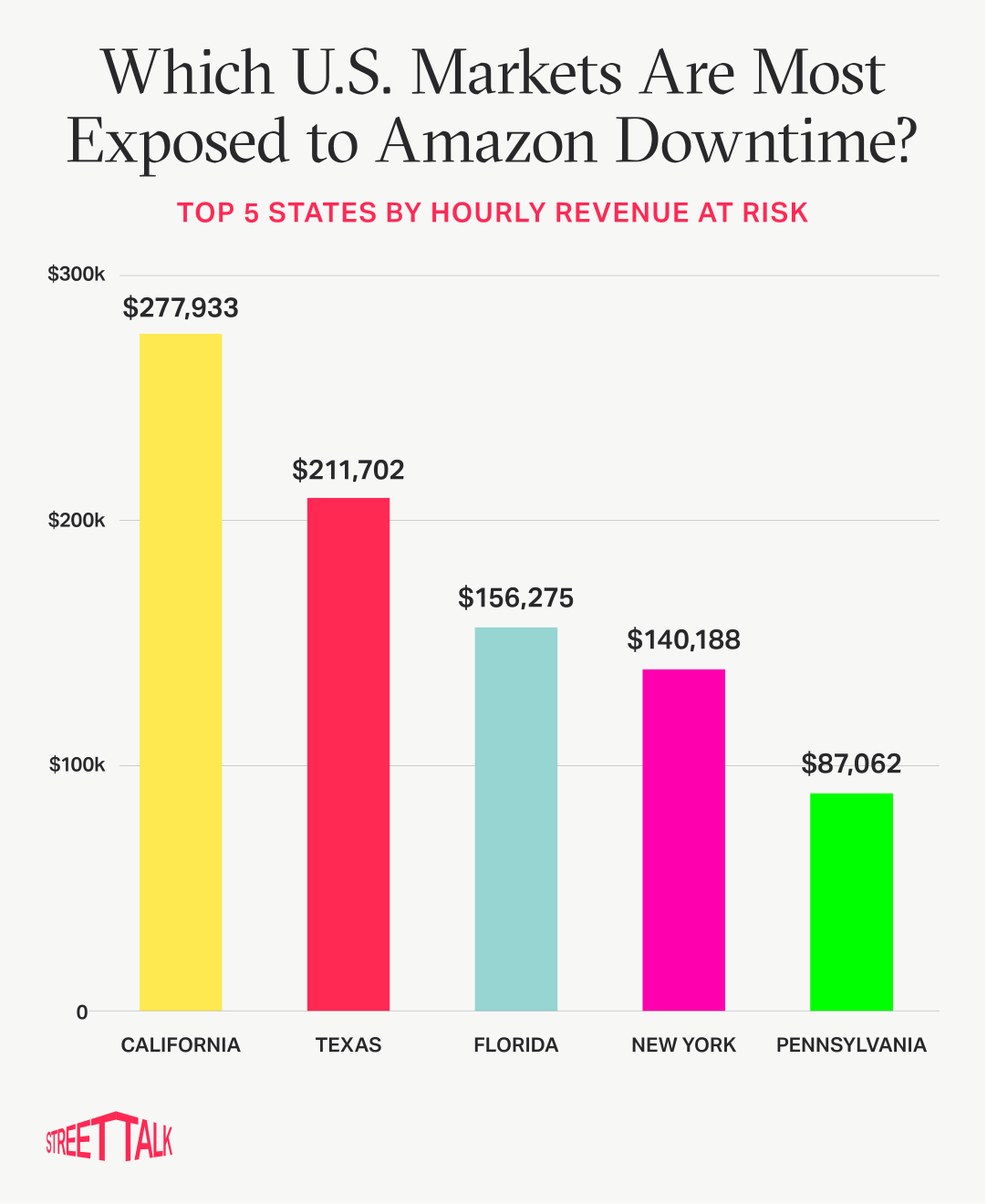
While Amazon’s reach is global, the financial impact of downtime is hyper-concentrated. Nearly 40% of the national financial hit is absorbed by just five states, according to the research report. California leads the pack with $277,933 in estimated hourly losses, which is a figure that exceeds the combined losses of the bottom 10 U.S. states.
For retail strategists, these figures serve as a proxy for digital market maturity. However, the study suggests that looking at absolute volume only tells half the story.
Why do Midwestern states lead Amazon dependency per capita?
One of the most actionable insights for C-suite executives is the unexpected intensity of the Midwest. While states such as Illinois, Michigan, and Ohio do not break the top five for total population, they dominate the rankings for per-capita Amazon dependency.
“What surprised us most was the strength of Midwestern markets,” says Victor Karpenko, CEO of SeoProfy. “States traditionally associated with manufacturing rather than e-commerce demonstrated per-capita Amazon engagement that rivals coastal powerhouses.”
The research showed that Illinois ($666.86 per 100,000 residents) and Michigan ($665.50 per 100,000) both out rank Texas and Florida in terms of relative engagement intensity. This suggests a highly disciplined digital consumer base in the “Rust Belt” that may be underserved by traditional brick-and-mortar footprints.
What does the digital intensity gap mean for retail strategy?
The data also reveals a widening gap between high-intensity digital hubs and rural markets. South Dakota, ranking 50th, faces only two-thirds of the per-capita financial risk seen in California. This $234-per-100,000-resident gap highlights a critical strategic fork for retail executives:
- High-Intensity Markets (CA, NY, IL): Require robust digital “always-on” infrastructure and perhaps localized distribution to mitigate the fallout of platform outages.
- Low-Intensity Markets (MT, WY, SD): Present an opportunity for traditional retail or direct-to-consumer (DTC) channels to capture market share where Amazon’s grip is statistically looser.
What should retail executives do about Amazon platform risk?
As Amazon continues to act as the primary storefront for tens of thousands of American businesses, the “outage tax” is becoming a predictable, albeit expensive, cost of doing business.
For retail leaders, the SeoProfy data serves as a reminder that geographic diversification isn’t just about physical stores — it’s about understanding where your digital revenue is most vulnerable. When 44,300 customers are forced to abandon their carts every hour, the question for executives isn’t just how to get back online, but which markets will be the first to jump to a competitor.
Related articles: The Bionic Retail Era: How AI and ‘Agentic Commerce’ Are Rewriting the Rules
Sign up for the Street Talk newsletter: Retail Intelligence for C-Suite Leaders.