


Analysis
April 8 2026
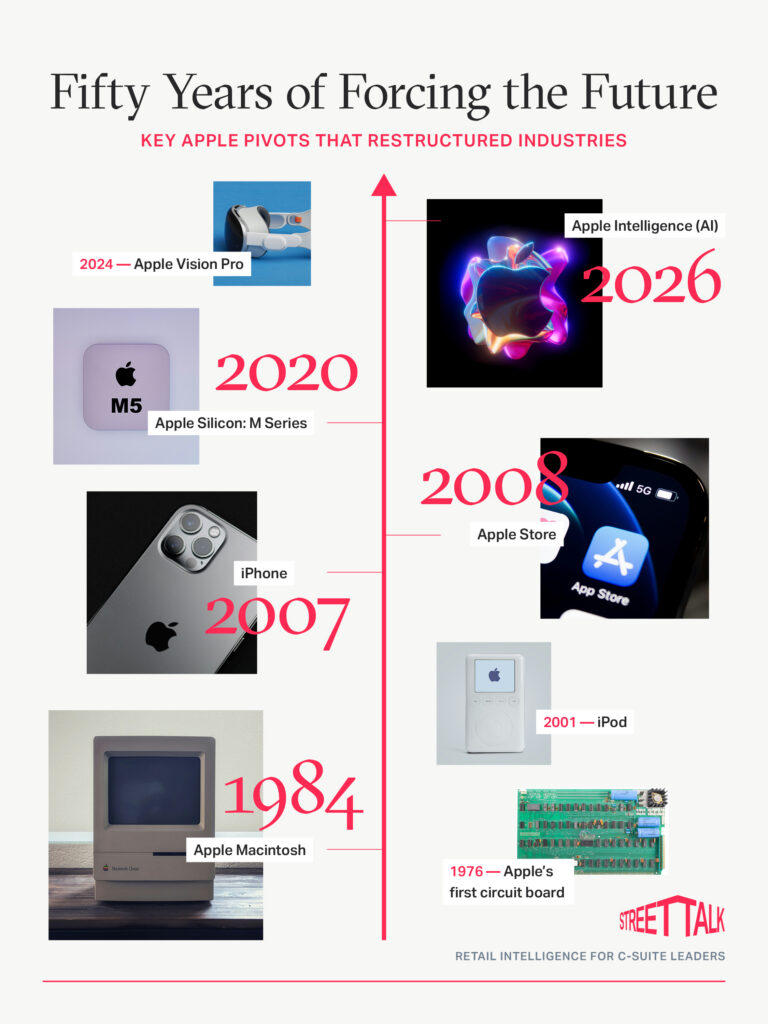
In 1976, a circuit board priced at $666.66 announced that something was different. Fifty years on, Apple has become the gravity well the modern economy orbits — having dismantled the software aisle, forced global retailers to trade inventory for experience, and compelled the semiconductor industry to abandon Intel. Apple’s half-century journey has done more than just sell gadgets, it has
Arthur Zaczkiewicz

In 1976, a circuit board priced at $666.66 announced that something was different. Fifty years on, Apple has become the gravity well the modern economy orbits — having dismantled the software aisle, forced global retailers to trade inventory for experience, and compelled the semiconductor industry to abandon Intel. Apple’s half-century journey has done more than just sell gadgets, it has rewritten the rules for consumers, retailers, and the very fabric of global business.
How did Apple turn customers into a captive ecosystem?
Apple’s primary influence on consumers has been what analysts call the “democratization of complexity.” Before the 1984 Macintosh, computing was a language of code, but Apple turned it into a language of icons and mice, and it was fun to use.
The company’s history reveals a pattern of forced evolution. By removing the floppy drive in 1998, the headphone jack in 2016, and the physical SIM slot in 2022, Apple has consistently pushed consumers into the future, often against their initial will. This ecosystem lock-in (where the iPhone, Apple Watch, and AirPods work in a seamless, invisible symphony), has transformed the consumer relationship from one of utility to one of lifestyle identity.
For the modern consumer, an Apple product is no longer a tool, it is a digital limb.
How did Apple reshape physical retail strategy?
Perhaps no Apple milestone hit retailers harder than the 2008 launch of the App Store. Before this, software was a physical product sold in boxes on shelves. Apple’s digital marketplace bypassed traditional retail entirely, creating a multi-billion dollar economy that forced retailers such as Best Buy and the now-defunct CompUSA to pivot or perish.
Meanwhile, the Apple Store itself — launched in 2001 — upended the retail model. While competitors focused on moving inventory, Apple focused on “experience,” turning stores into town squares. This forced global retailers across all sectors to rethink their physical footprints, moving away from cluttered shelves toward minimalist, high-touch showrooms. And it worked.
How did Apple Silicon redraw the semiconductor industry?
Apple’s influence on other businesses is most visible in its “disrupt-and-dominate” strategy. When Apple launched the iPod, it didn’t just sell a device, it dismantled the music industry’s CD-based revenue model. When it launched the iPhone, it effectively ended the reign of BlackBerry and Nokia, forcing the entire mobile industry to adopt the “black glass slab” aesthetic.
More recently, the 2020 transition to Apple Silicon (M1 chips) sent shockwaves through the semiconductor industry. By proving that ARM-based architecture could outperform traditional Intel processors in speed and battery life, Apple forced rivals such as Microsoft and Google to accelerate their own custom chip development.
What does Apple’s near-collapse teach about business resilience?
Apple’s history isn’t just a string of victories. The 1985 to 1996 “Wilderness Years,” defined by the failure of the 16-pound Macintosh Portable and the mocked Newton MessagePad, serve as a permanent case study for Harvard Business School. These eras taught the corporate world that technical superiority means nothing without price accessibility, and that a company without a clear, singular vision (the post-Jobs era) will inevitably drift toward bankruptcy.
What does Apple Intelligence mean for the decade ahead?
As Apple enters its second half-century, its influence is shifting from the hardware in consumer pockets to the intelligence behind the screen. With “Apple Intelligence” (AI) becoming the backbone of the OS in 2026, the company is attempting to do for artificial intelligence what it did for the PC: make it “insanely great” and invisible.
While the Vision Pro remains a polarizing “spatial” experiment reminiscent of the early Macintosh, Apple’s 50-year track record suggests that betting against their influence is a historical mistake.
From the Homebrew Computer Club to a global lifestyle ecosystem, Apple hasn’t just followed the market, it has been the market.
Related article: The Bionic Retail Era: How AI and ‘Agentic Commerce’ Are Rewriting the Rules
Street Talk is the weekly newsletter for retail and fashion executives who want analysis, not noise. New issues every Thursday. Subscribe today.