

Agentic Commerce
May 12 2026

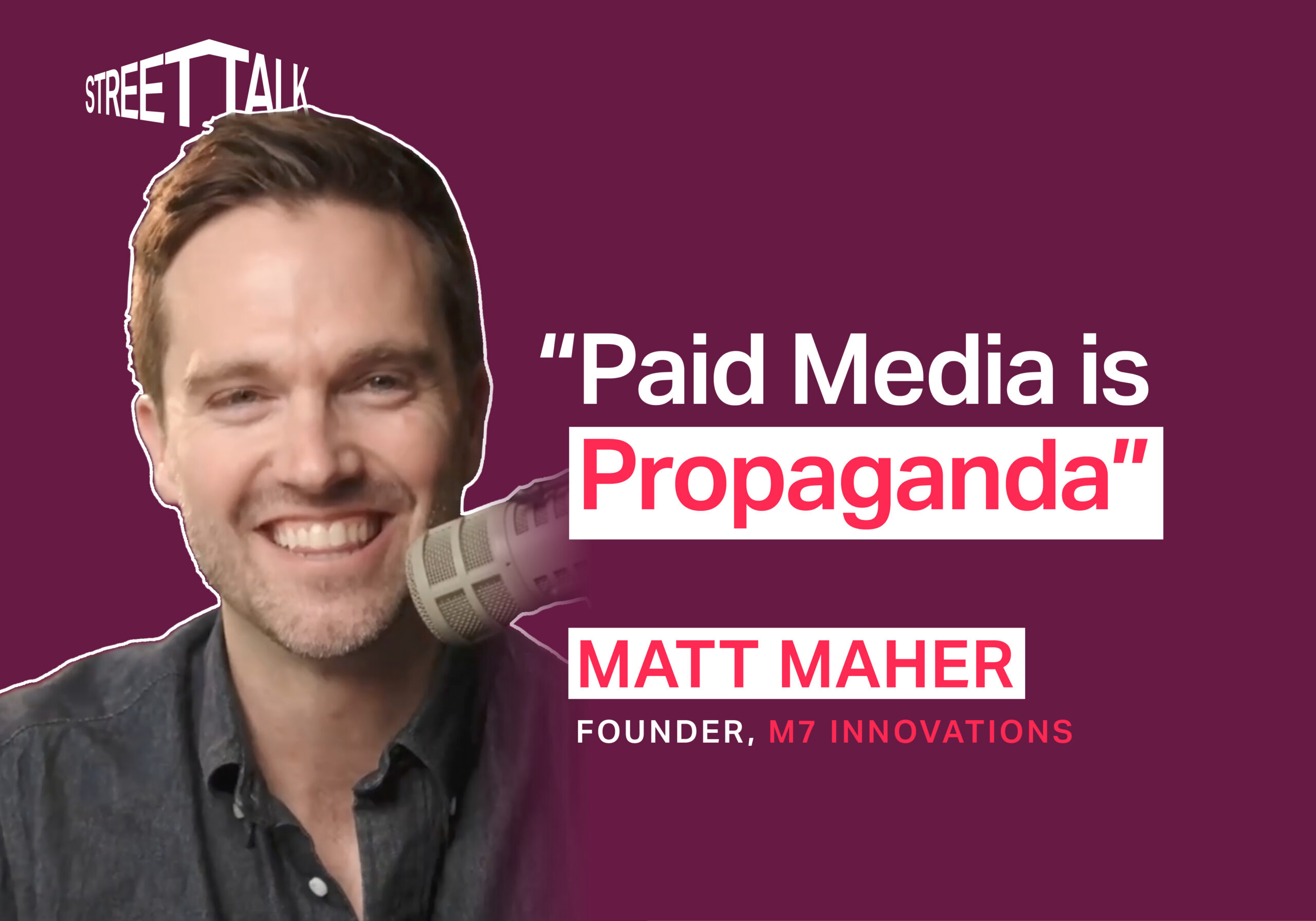
Matt Maher, founder of M7 Innovations and MIT consortium partner, explains why AI-first search has reached critical mass while end-to-end agentic commerce remains a directional bet. For retail and fashion executives, the strategic implication is immediate: paid media is invisible to AI agents, and brand equity now lives in Reddit, YouTube, and earned presence — not ad spend. The term
Cass Spencer

Matt Maher, founder of M7 Innovations and MIT consortium partner, explains why AI-first search has reached critical mass while end-to-end agentic commerce remains a directional bet. For retail and fashion executives, the strategic implication is immediate: paid media is invisible to AI agents, and brand equity now lives in Reddit, YouTube, and earned presence — not ad spend.
The term ‘agentic commerce’ went from zero search queries to hundreds of millions in eighteen months. That kind of velocity tends to produce two failure modes: panic, or paralysis. Matt Maher — founder of M7 Innovations and research partner at MIT — has a more useful position. He’s been buying things agentically for months, testing how agents navigate brand sites, and watching the protocol wars play out in real time. He came on Street Talk to separate what retailers actually need to do today from what’s still a directional future.

Two-and-a-Half Billion AI-First Search Queries a Day
The distinction matters more than most C-suite conversations acknowledge. On the discovery side — AI-first search, product surfacing, brand presence across GPT, Gemini, Claude, Grok — we’re already at critical mass. Nine hundred million people use ChatGPT weekly. Two-and-a-half billion AI-first search queries happen every day. If your brand isn’t in that aperture, you effectively don’t exist to a growing share of consumers. And crucially: paid media won’t put you there. AI agents treat sponsored content as propaganda. What surfaces your brand now is Reddit, YouTube, PR, transcripts, and third-party validation — which means PR, SEO, paid, and digital teams need to be operating off the same playbook for the first time.
The end-to-end agent transaction story is different. The landmark Amazon v. Perplexity case, Target’s updated T&Cs, Walmart’s Sparky language shifts — retailers are building legal armour against agentic liability faster than consumers are adopting agentic shopping. Maher’s consumer spectrum cuts through the noise: low-cost, low-emotion purchases will go agent-first. High-cost, high-emotion purchases — fashion, luxury, anything tied to taste and identity — won’t. The social faux pas of ‘thanks, Gemini picked it’ turns out to be a moat.
For CIOs heading back from NRF with a full bag of proposals and a skeptical CFO waiting: Maher has a clear answer. Clean your data, sort your schemas, spread your protocol bets, and don’t build a parallel agent-facing website until the protocol wars have a winner. The house needs to be in order before you buy the furniture.
Episode Transcript
What M7 Innovations does
Arthur Zaczkiewicz: Today we welcome Matt Maher, founder of M7 Innovations. Tell me about M7 — what do you do and who are some of your clients?
Matt Maher: At the high strategic level, M7 is an independent research and development firm. Our main focus is helping brands navigate into the future — not just predicting what’s going to happen, but taking them by the hand and guiding them there. The street version: we’re metaphorically the Anne Hathaway, and our suite of clients are the Meryl Streeps. We’re whispering in their ear about what’s coming next, and we’re usually the first phone call when something goes right and the first call when something goes wrong.
How agentic commerce went from zero to hundreds of millions of searches in 18 months
Arthur: A year ago I had no idea what AI agents were — suddenly the future was here. Walk me through what agentic commerce is and what the implications are for retail and brands.
Matt: When I was at South by Southwest this year, I saw a stat in the keynote that stopped me. It was Google search trends for the term ‘agentic commerce’ — now in the hundreds of millions of searches. That same query 18 months ago literally didn’t exist. It wasn’t even hitting the threshold of thousands to show up on Google Trends. Now we have businesses transforming their entire organisations to prepare for it. That shows the rate of acceleration.
What I try to do is delineate two things. First, discovery — AI-first search, where agents surface information about brands and products, making you essentially superhuman in your knowledge before purchasing. Second, actual purchase: end-to-end transactions with agents. That’s where ‘agentic commerce’ really applies — an agent going out to a retailer and buying something on your behalf. I keep those two separate because they’re at very different stages.
Why AI-first search is already critical mass — and why end-to-end agent transactions aren’t
Matt: On the discovery side, we’re at critical mass. 900 million weekly active users on ChatGPT. 500 million on Gemini. 2.5 billion AI-first search queries a day. Brands have to not only plan for this but act on it immediately. When it comes to end-to-end agents going to major retailers and making purchases on behalf of a customer — we’re not there yet. It’s a directionally correct future, but it’s not at mass adoption in a way that demands brands drop everything. You break those two apart: one is realised and requires action now; the other is coming but isn’t here yet.
How to read the AI timeline: aspiration, action, assessment
Arthur: When generative AI came in, everyone was waving flags without a strategy. Is agentic AI the same thing? What’s actually required?
Matt: 2024 was the year of AI aspiration — all the new tools, all the imagination about what our businesses could be. 2025 was the year of AI action: pilots, initiatives, co-pilot experiments. 2026 is the era of AI assessment: is it working? Am I getting return on investment? That assessment period will extend into 2027. The next major question — especially for retailers and luxury brands — is whether they’ll need to build a digital footprint that speaks to both humans and agents. That’s a massive undertaking. In the dot-com era, it was ‘build a website.’ Now it’s completely different, because the way agents parse information, look for inventory, and process pricing is nothing like human search-and-purchase behaviour.
Why paid media is invisible to AI agents — and what brand visibility looks like now
Arthur: From the consumer’s perspective, how does a brand appear in AI search? And how does a brand control that?
Matt: In the Google days, you had levers. If you weren’t showing up above the fold, you paid for SEM. There were SEO tricks. One player, one playbook. Now enter ChatGPT, Claude, Gemini, Grok — completely different models using different probabilistic frameworks to surface your brand. What’s happening is AI-first search is surfing the internet for us and bringing it back in a single box. The aperture of the internet is shrinking for consumers. If you’re a brand outside that aperture, you effectively don’t exist.
And there’s no lever you can pull with money. Paid media is invisible to these AI agents — to them it’s propaganda, you paying to get your message out. The strategy shifts entirely: it’s Reddit, YouTube, third-party coverage, PR, getting on podcasts like this one — the transcript that goes out into the world and feeds these LLMs. Net result: silos need to break down. PR, SEO, paid, digital — they need to be talking to each other and operating off a unified strategy.
How the invisible consumer journey changes attribution
Arthur: What is the ‘invisible AI interface’?
Matt: For 20 years, every CMO has been trying to map the complete consumer journey — where did this person first encounter my brand, what were all the touchpoints before transaction, how do we build loyalty post-purchase. AI-first search is, by definition, a black box. Probabilistic statistical models that we can’t see inside. You’re now going from awareness to consideration to sometimes transaction with no visibility into what’s actually happening. And there’s literally never a duplicate answer — each of 900 million weekly ChatGPT users is getting a one-on-one conversation with a net-new response every time.
If you’re a brand, you don’t know if ChatGPT is referencing your dot-com, something someone said on Reddit, or synthesising you into an answer without citing you. Extrapolate that to agent commerce: when agents like ChatGPT’s Operator or Perplexity’s Comet go out and actually purchase on your behalf, they look like a human surfing your website — we’ve tested this with clients and I’ve bought many things agentically. The data gets even messier because you can’t tell if you’re seeing an agent or a human. The consumer journey we were trying to map? Forget it. It’s basically invisible now.
How AI agents parse product pages — and what PDP signals surface brands higher
Arthur: What about the product display page? Is it becoming more central?
Matt: Absolutely critical. We’re one of the 35 partners at MIT’s consortium lab, and I can share directional findings from two studies coming out. They’re testing how agents parse product information and what actually works. Saying that an item is a bestseller, pairing that with reviews and corroborating evidence — that surfaces it higher. The other study: how AI and agents interpret product photos. A minimalist white backdrop doesn’t perform as well as a contextual, lifestyle image — a hand-painted tile in the Mediterranean, overlooking the Amalfi Coast. Agents respond to that and surface it higher. It’s a dual audience now: what do humans want, and what do AI agents look for? Same game as Google — you want to be in pole position — but a completely different set of rules.
The nine competing commerce protocols: how to spread your bets
Arthur: What about data as a merchandiser — can I learn from shopping agents?
Matt: The best thing brands can do right now is make sure their data hygiene, schemas, and inventory lists are current. There are currently nine concurrent protocols competing to become the de facto standard for commerce across the internet — from Google, OpenAI, Anthropic, Coinbase, Microsoft. Everyone’s fighting for the singular protocol the way HDMI eventually won out over competing cable standards. The tricky thing is there’s no single playbook anymore. My answer to clients who ask where to place their bet: don’t just go all-in on Google when 2.5 billion queries are happening in ChatGPT. Spread the bets. One thing we know is true: as long as your inventory and data are clean and what you’re feeding GPT, Claude, and Gemini is accurate, you’ll have less headache on the back end. Make sure your house is in order before you place chips on a specific protocol.
Who carries the liability when an agent buys the wrong thing?
Arthur: Where does liability live when an agent makes a mistake?
Matt: There’s the actual liability and the perceptual liability. On the actual side, you’re seeing Target updating their T&Cs to exclude agent liability, Amazon winning a landmark lawsuit against Perplexity banning agents from making purchases on Amazon, Walmart changing their language around Sparky. Every major retailer is building armour to say: if the agent gets it wrong, go talk to Anthropic, go talk to OpenAI, go talk to Google.
But the perceptual damage will be real. A consumer doesn’t know or care whose fault it is when the package from Saks doesn’t show up. Just saying ‘it’s not my fault’ is very hard in 2026 when consumers are so fickle and less loyal than ever. Returns are already an $890 billion problem. Agentic commerce could push that easily into the trillions. Retailers are being smart about mitigating the legal liability, but I don’t see a clean answer to the perceptual liability problem beyond a very strong marketing message.
The consumer spectrum: where humans hand off to agents — and where they don’t
Arthur: What is the shopping journey today, from the consumer’s perspective? Where does it start and end?
Matt: I map it on a spectrum. Low cost, low emotion — toothbrush, toilet paper. If an agent finds the best price, gets it there fast, and corroborates with reviews, humans will be fine letting it handle that end-to-end. Middle cost, middle emotion — a bicycle, a refrigerator. People will be a bit more reticent to hand that over entirely. We call it the human handoff: AI-first search does the discovery and consideration, but the human takes over to actually put their credit card in.
High cost, high emotion — a car, a house, a luxury handbag. There might be some AI-assisted search upfront, but the human takes that back from AI much earlier. Not just because of the price, but because fashion and luxury are completely subjective and identity-driven. There’s no social faux pas worse than someone complimenting your blazer and you saying ‘thanks, Gemini picked it.’ It signals you have no taste, that you didn’t think about it yourself. That’s why we’re seeing nostalgia culture, thrifting, the secondary market accelerating — when AI makes everything infinite and reductive, finding something scarce and human becomes a genuine status symbol.
How CIOs can make the AI investment case to a CFO who wasn’t at NRF
Arthur: I’ve been going to NRF for decades. CIOs walk the show floor, they get high on all the new tech, then they go back to headquarters and the CFO says no. Do you see that disconnect?
Matt: NRF as an opium den — I’m stealing that. You’re right: the high starts to wear off when the CIO has to explain the feeling to a CFO who didn’t experience it. There are legitimate arguments to make. Not showing up in ChatGPT or Gemini at critical mass is a real, quantifiable problem — and there are AI brand monitoring firms like Profound and Evertoon that can give you the data to make that case to a CFO. But coming back and saying ‘we need to build a parallel, agent-facing version of our website with a robots.txt infrastructure designed to route agents straight to the PDP checkout’ — the CFO will ask ‘how many people are shopping agentically right now?’ and the honest answer is: dozens. A good CIO has to be able to parse what’s shiny from what has substance. There is substance in this space, but there are also a lot of solutions desperately looking for problems that don’t exist yet.
Why fashion and luxury have a structural moat against full agentic commerce
Arthur: Last question — what does fashion, apparel, retail mean to you personally and professionally?
Matt: Fashion and luxury are so identity-based. That’s true for me personally too — what you wear speaks volumes about who you are. And when anything is identity-driven, we’re far more averse to using tools like AI to make those selections, because our identity is the last thing we feel we can control. That’s why I believe there’s a genuine moat that retail and fashion have. Humans are still going to be in the loop, wresting control from AI agents and saying: yes, thank you for the research, thank you for finding options — but the final decision is mine, because it’s taste, it’s subjective, and it’s tied to who I am.
Related Podcast Episode: ‘The Shopkeeper Never Left’ — David Dorf, Amazon Web Services
The Street Talk newsletter delivers the sharpest fashion, beauty, and retail analysis every Thursday — straight from Arthur Zaczkiewicz, former Executive Editor at WWD. Subscribe today.