

Analysis
February 26 2026
In a startling shift that challenges the traditional definition of a “safe haven” asset, a new report from vintage luxury specialist FashioNica reveals that high-end fashion is no longer just a matter of status — it is a formidable investment vehicle. As collectors and investors strategize for the future, many are turning to a Luxury Resale Investment Strategy as a
Arthur Zaczkiewicz

In a startling shift that challenges the traditional definition of a “safe haven” asset, a new report from vintage luxury specialist FashioNica reveals that high-end fashion is no longer just a matter of status — it is a formidable investment vehicle. As collectors and investors strategize for the future, many are turning to a Luxury Resale Investment Strategy as a way to diversify and grow their portfolios.
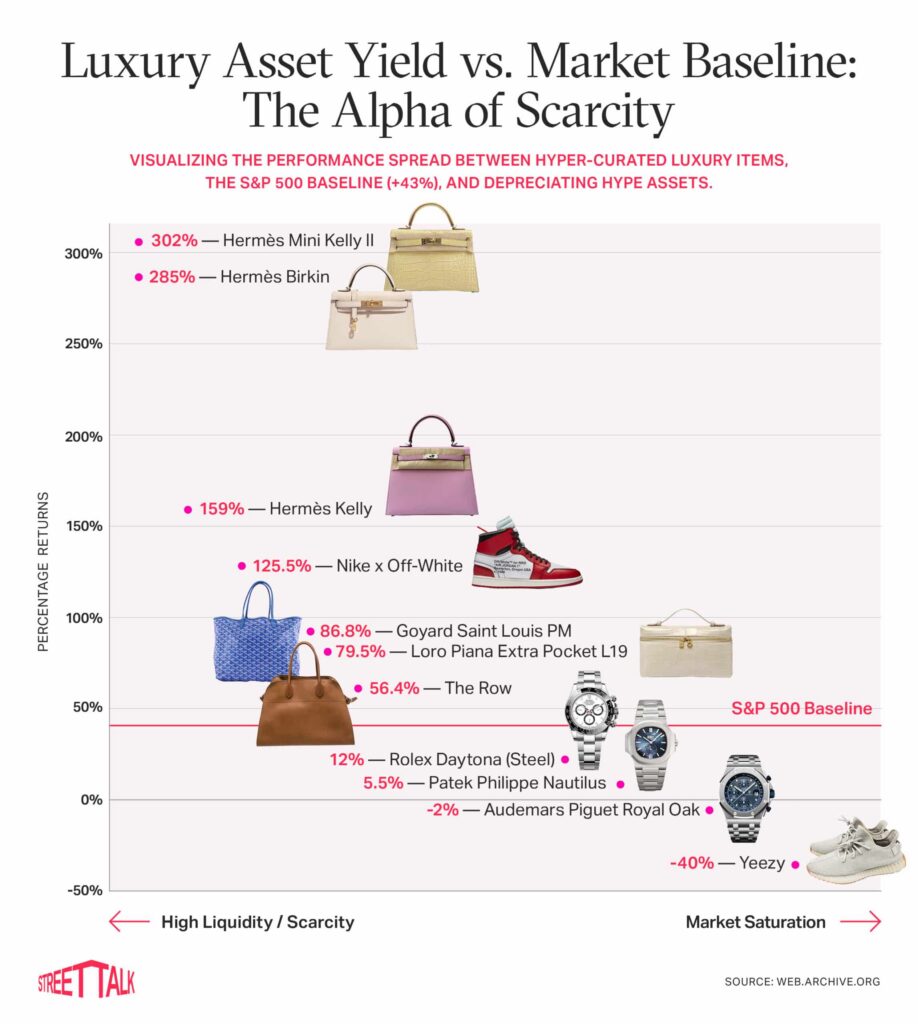
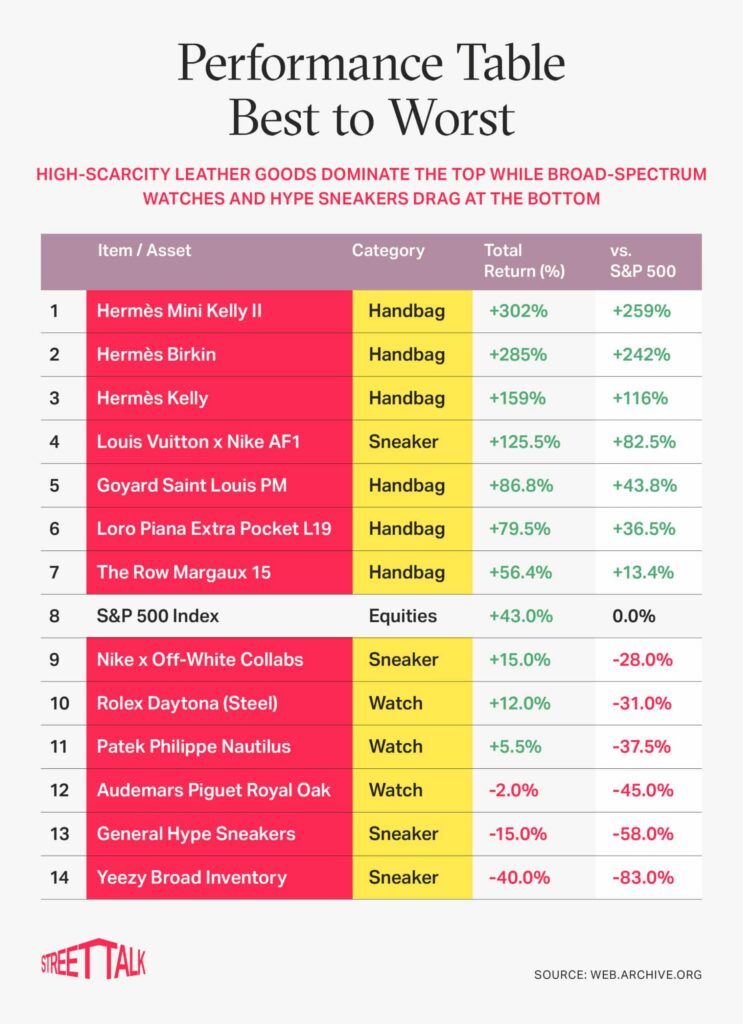
The study, which tracked luxury assets against the S&P 500 from 2022 through early 2026, found that select handbags are not only retaining their value but are outperforming the broader stock market by triple-digit percentages. Leading the charge is the Hermès Mini Kelly II, which has seen a meteoric price rise, dwarfing the 43% total return of the S&P 500 during the same period.
The New Gold Standard: The Mini Kelly II
The data suggests that the “Kelly” is currently the undisputed queen of the secondary market. The Mini Kelly II saw its valuation leap from a starting price of $9,200 to $36,900 — a staggering 302% total return.
[To read the full report, CLICK HERE.]
When compared to the 43% baseline of the S&P 500, the handbag performed 259% better than the stock market. This astronomical growth highlights a “scarcity premium” that traditional equities struggle to match, particularly during cycles of inflation and shifting interest rates, researchers at FashioNica said in their report.
Hermès Dominates the Podium
The top three spots on the FashioNica list belong exclusively to Hermès, reinforcing the brand’s unique “ultra-luxury” insulation from market volatility:
- Hermès Mini Kelly II: +302% Return
- Hermès Birkin: +285% Return (Current price: $115.5K)
- Hermès Kelly: +159% Return
The Birkin remains the most expensive item on the list, climbing from $30,000 to over $115,000. This indicates that while the Mini Kelly II offers a higher percentage growth, the Birkin remains the premier choice for high-capital investors looking to park six figures in a portable asset.
Sneakers and Quiet Luxury Break Into the Top 10
The report also highlights a narrowing field in the footwear and apparel categories. The Louis Vuitton x Nike Air Force 1 Low was the only sneaker to make the top 10, delivering a 125.5% return. Originally priced at $2,750, these rare collaborations now command $6,200, proving that “hype” can still translate to ROI if the pedigree (Louis Vuitton) and rarity (limited production) are sufficient.
Meanwhile, the rise of the “Quiet Luxury” trend is reflected in the performance of the Loro Piana Extra Pocket L19, which secured the fifth spot. With a 79.5% return, it outperformed the S&P 500 by over 36%, signaling that investors are moving toward understated, high-quality leather goods.
The Watch Market Warning: Rolex Underperforms
Perhaps the most surprising finding of the study is the stagnation of the luxury watch market. Despite a decades-long reputation for being “better than money in the bank,” most luxury watch brands, including Rolex, performed worse than traditional stock investments over this period.
Industry analysts attribute this to a difference in buyer demographics and market liquidity.
“A Birkin appeals to fashion collectors, investors, and regular luxury shoppers, while high-end watches mostly attract dedicated enthusiasts,” noted one jewelry market analyst. “That broader buyer pool makes handbags way easier to sell. The handbag secondary market just runs smoother than watches right now.”
Market Outlook: A Shift in Asset Allocation?
The FashioNica study used Compound Annual Growth Rate (CAGR) and Total Return to bridge the gap between illiquid luxury goods and liquid stocks. The results suggest that for the modern investor, “diversification” may now include a temperature-controlled closet.
However, experts caution that while the Hermès “Holy Trinity” (Birkin, Kelly, Constance) continues to soar, the luxury market is hit-driven. Brands like The Row (Margaux 15) and Goyard (Saint Louis PM) showed strong double-digit growth (56.4% and 86.8% respectively), but they remain subject to the whims of fashion cycles in a way that the S&P 500 is not.
What This Means for Executives and Influencers in the Resale Market
For C-level executives and influencers in the resale sector, this data signals a fundamental shift in the luxury landscape: high-end goods are no longer just discretionary spending, they are legitimate alternative asset classes. The 302% return on the Mini Kelly II versus the 43% return of the S&P 500 proves that the resale market is decoupling from traditional economic volatility.
For leadership, this means pivoting business models to prioritize scarcity-driven procurement and authenticated high-capital inventory. The “Birkin Boom” suggests that the secondary market’s value is increasingly tied to “investment grade” status rather than mere fashion trends, necessitating a more sophisticated approach to inventory valuation and risk management that mirrors a financial brokerage more than a retail shop.
To capitalize on these trends, executives should move away from broad-spectrum resale and toward hyper-curation focused on liquidity. The report highlights that while watches are stagnating, handbags thrive due to a broader, more liquid buyer pool. Decision-makers should use this data to reallocate capital into brands with the “Holy Trinity” status (Hermès, select Louis Vuitton collaborations) while carefully monitoring the “Quiet Luxury” segment, such as Loro Piana, which is currently yielding a 79.5% return. By integrating Compound Annual Growth Rate (CAGR) metrics into their appraisal software, platforms can offer “real-time portfolio tracking” for their customers, turning a simple closet into a managed investment account.
Finally, leadership must acknowledge the “hit-driven” nature of the market to avoid over-exposure to fad-based volatility. While the Hermès dominance provides a stable “blue-chip” foundation, the rise of brands such as The Row (+56.4%) and Goyard (+86.8%) indicates a secondary tier of growth that requires agile trend-forecasting tools. The best-informed business decisions in 2026 will involve balancing high-liquidity assets (bags) with high-hype but lower-volume assets (rare sneakers).
Retail executives who successfully bridge the gap between “illiquid luxury” and “liquid stocks” through transparent data and authenticated provenance will capture the growing demographic of investors who prefer leather to ledgers.