

Sustainability
September 10 2025
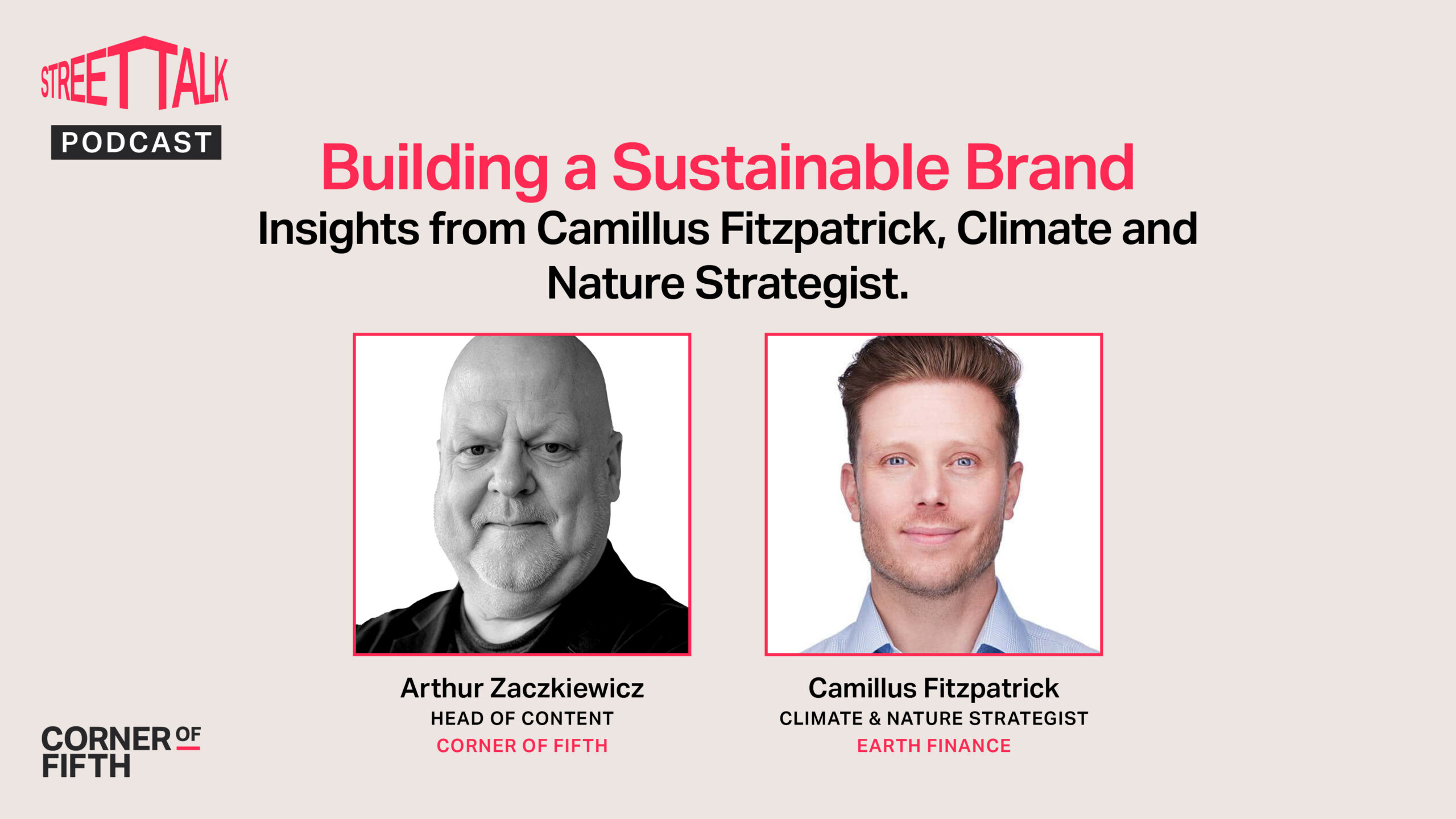
Corner of Fifth’s Street Talk podcast recently featured Camillus Fitzpatrick, a climate and nature strategist at Earth Finance. We talked about sustainability in the fashion, beauty and retail industries as Camillus graciously shared his expertise on building sustainable brands, why sustainability is crucial and where businesses (and their consumers) should start. Here are some of the the highlights from the
By Guest Writer: Arthur Zaczkiewicz

Corner of Fifth’s Street Talk podcast recently featured Camillus Fitzpatrick, a climate and nature strategist at Earth Finance. We talked about sustainability in the fashion, beauty and retail industries as Camillus graciously shared his expertise on building sustainable brands, why sustainability is crucial and where businesses (and their consumers) should start.
Here are some of the the highlights from the episode:
Below, I break down the fascinating highlights from our discussion.
What Is Earth Finance and the Role of Sustainability?
Camillus began by outlining the mission of Earth Finance — a consulting firm that helps corporations achieve their sustainability goals. From health and beauty to agriculture, Earth Finance focuses on understanding how businesses depend on nature and water for their products and advises them on building resilient supply chains while recognizing and quantifying potential risks such as climate change and biodiversity loss.
When asked to define sustainability, Camillus emphasized that it means different things to different people. For him, sustainability is about adopting an integrated systems approach — addressing water, nature, agriculture and carbon as interrelated elements, not as separate silos.
Listen on Spotify. Watch on YouTube.
Gone are the days of solely focusing on carbon emissions (what Camillus refers to as “carbon tunnel vision”). Today’s sustainability solutions use a more holistic lens that combines various aspects for greater business and environmental benefits.
How to Begin: Five Key Principles for Sustainability
When asked where a brand might start on its sustainability journey, Camillus laid out five core principles:
Supply Chain Transparency: Understanding the origins of your product’s components is the first step. From organic cotton in fashion to palm oil in beauty products, sustainability starts with knowing how materials are sourced. Camillus highlighted how deforestation, such as clearing land in the Amazon for cattle often remains hidden at the end of the supply chain due to limited traceability and the number of parties involved.
Modern technology like satellite imagery, drones, and blockchain is helping companies achieve greater transparency. This fosters trust while mitigating risks tied to environmental and ethical issues.
Integrated Systems Thinking: True sustainability happens when companies stop thinking in silos. Water, climate, biodiversity, and agriculture are all interconnected. Addressing these systems together creates compounded benefits. For example, a water conservation project in one region may also protect local biodiversity and ensure long-term agricultural viability, which in turn stabilizes business supply chains.
Quantify Impact: The “fluffy story” approach to sustainability no longer cuts it. Successful companies measure concrete outcomes, such as emissions reductions or water restored, to quantify real progress. Numerical reporting builds transparency, showcases impact, and helps consumers and stakeholders hold companies accountable.
Design for Circularity: Camillus stressed that circularity (the idea of keeping materials in use for as long as possible) must begin at the product design stage. This means using materials that are easy to recycle and avoiding complex components that hinder reuse. The fashion industry, for instance, struggles with low recycling rates for textiles (just 1 percent), but improvements like mono-material fabrics and blockchain-based QR codes for tracking are steps forward.
Invest in Natural Capital Growth: Companies should work to *enhance* the ecosystems they depend on. For example, investing in regenerative agricultural practices or protecting watersheds can ensure a long-term supply of raw materials while supporting local communities. For health and beauty brands, this might mean engaging with farmers producing botanical ingredients like rose oil or shea butter to secure both economic and environmental stability.
Why Europe Leads the Way in Sustainability
Camillus noted that Europe outpaces other regions, including the U.S., in sustainability. He highlighted Europe’s focus on regulatory compliance, such as the upcoming European Deforestation Regulation which requires companies to demonstrate that commodities are not linked to land deforested or degraded beginning in 2021.
In contrast, the political landscape in the U.S. tends to swing wildly, placing the responsibility more on corporations rather than governments to make sustainable choices. Nevertheless, Camillus pointed out that forward-thinking companies recognize that sustainability initiatives are not burdensome but rather exercises in minimizing waste, improving efficiencies, and reducing risk.
The Consumer Dilemma: Driving Behavioral Change
While brands play a critical role, so too does the consumer. Many of us have great intentions, like bringing reusable bags to the grocery store, but sometimes fall short. The good news? Brands can help make sustainability easier and more rewarding for their customers.
Camillus highlighted innovative efforts by companies like L’Occitane and The Body Shop, which incentivize consumers to return empty packaging with programs like in-store recycling bins. Loyalty rewards, financial benefits, and even simplified actions (like QR codes that help consumers locate the nearest recycling point) all encourage better participation.
That said, Camillus emphasized that leaving it entirely to consumers won’t achieve sustainability goals at scale. The bigger responsibility lies with brands to become accessible and transparent about how materials and products can be recycled.
Who’s Doing It Well? Spotlight on Kering Group
When asked which companies are making admirable strides, Camillus called out Kering, the luxury fashion conglomerate behind brands like Gucci and Balenciaga. Kering was an early advocate for biodiversity and regenerative agriculture. They didn’t fall into the trap of “carbon tunnel vision” and instead took a holistic approach, investing in enhancing natural ecosystems as a strategy to improve their products over time.
By combining transparency with action — and openly sharing both successes and challenges — Kering has become a role model for other industries.
The Future of Circularity: Pipe Dream or Reality?
The discussion wrapped with a question on whether circularity — true closed-loop recycling — is feasible. Camillus is optimistic, noting that while some industries (e.g., tech and e-waste) face significant challenges, many others are making strides by designing products for circularity from the outset. It’s about embedding circularity into the R&D process, rather than trying to “fix” an issue later.
The Path Forward
To summarize the conversation, Camillus offered these takeaways for building sustainable brands:
1. Think holistically: Break silos between environmental strategies.
2. Measure impact: Quantify progress, not just storytelling.
3. Start with design: Products need to be circular from Day 1.
4. Know your supply chain: Transparency is non-negotiable.
5. Invest in natural ecosystems: Sustainability is about enhancing, not just extracting.
Together, with smart collaboration among brands, consumers, and policymakers, Camillus said sustainability is not just achievable but vital to the future of business.
So, for any brand thinking about “going green,” the question isn’t why — it’s why not?