


labor market
March 25 2026
As the race for AI dominance across business sectors intensifies, a new report suggests that U.S. workers are paying the price — literally. According to a survey of 866 U.S. business leaders released by ResumeBuilder.com, 54% of companies have already reduced or said they plan to reduce employee compensation this year to free up capital for AI investments. The findings
Arthur Zaczkiewicz

As the race for AI dominance across business sectors intensifies, a new report suggests that U.S. workers are paying the price — literally. According to a survey of 866 U.S. business leaders released by ResumeBuilder.com, 54% of companies have already reduced or said they plan to reduce employee compensation this year to free up capital for AI investments.
The findings reveal a corporate landscape where human payroll is increasingly viewed as a piggy bank for technological advancement.
The financial pivot is wide-reaching. Rather than trimming just one area of spending, companies are slashing across the board. This trend also dovetails with another shift that began in 2019 when executive leadership began reducing headcount as a way to temper salary expectations.
The ResumeBuilder.com research found that of the firms cutting pay to fund AI, 61% are reducing bonuses, 60% are cutting equity or stock awards, and 59% are scaling back raises. Even base salaries (43%) and benefits (53%) are on the chopping block.
“Companies are making a clear calculation: AI investment is the priority, and employee compensation is where the budget will come from,” said Stacie Haller, ResumeBuilder’s chief career advisor. “This is not just layoffs. Bonuses, raises, equity, benefits, and base pay are all being cut simultaneously, across industries.”
The Rise of the “Peanut Butter Raise”
The report also highlights a shift in how companies reward (or fail to reward) performance. About 25% of companies plan to move away from merit-based increases in 2026. Instead, they are opting for “peanut butter raises,” which involves uniform, thin layers of across-the-board increases that disregard individual results, or raises that fall below the rate of inflation.
Haller warns that this strategy could backfire by alienating top talent. “High performers notice when their output is valued the same as everyone else’s, and they have options,” she noted. “Companies that flatten compensation this way risk losing the people they can least afford to.”
Fear of Falling Behind
The aggressive shift toward AI appears to be fueled by corporate anxiety. More than half of respondents (57%) admitted they are afraid of falling behind competitors without significant AI investment, while 56% cited direct pressure from boards or investors to adopt the technology.
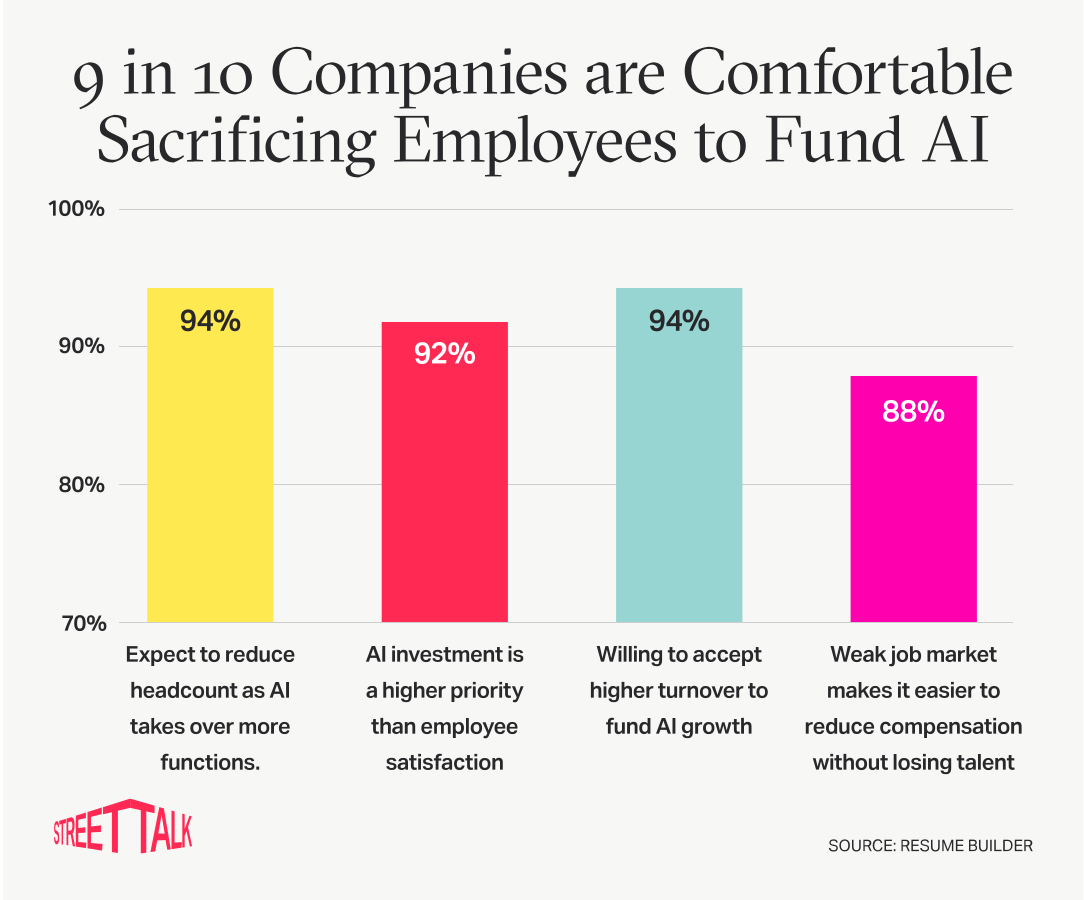
This pressure has led to a striking disregard for worker satisfaction, the report’s authors said. The survey found that 92% of business leaders believe AI investment is a higher priority than employee happiness right now. Furthermore, 88% of leaders admitted that a weak job market makes them feel comfortable reducing compensation without the fear of losing their best workers.
A Short-sighted Trade-off?
While 94% of these companies survived say they are willing to accept higher turnover to fund AI growth, experts caution that the current leverage employers hold over workers is temporary.
“This is not reluctant belt-tightening, and these leaders are not apologetic about the choices they are making,” Haller said. However, she warned that the reputational damage may be long-lasting. “The risk of falling behind is being treated as more urgent than the risk of losing talent. That is a short-sighted trade-off … organizations that have cut compensation to fund those investments may find that history follows them when workers have choices again.”
As AI takes over more functions, 94% of the surveyed leaders expect to eventually reduce their total headcount, signaling that the “human cost” of the AI revolution is only just beginning.
The Great Delayering
The findings of the report comes at a time when a central theme has emerged in the current labor market, often referred to by economists and HR analysts as “The Great Delayering” or “Unbossing.”
While companies rarely state “salary resetting” as their primary goal in press releases, market data and executive surveys suggest that reducing high-cost management layers is indeed a calculated strategy to lower the “per-head” cost of talent.
Middle managers have become a primary target because they represent a high cost-to-output ratio in the eyes of efficiency-minded executives. In 2025, middle managers comprised roughly 32% of all layoffs, despite making up a much smaller percentage of the total workforce.
Companies such as Amazon and UPS have aggressively moved to increase the “span of control.” For many firms, the average number of direct reports per supervisor has doubled, from 3 in 2019 to 6 or more in 2026.
The goal? By removing the “middleman,” companies aren’t just saving on one salary, they are forcing a flatter structure where senior leaders manage more people and entry-level employees are expected to be more self-sufficient.
Resetting Salary Expectations?
There is evidence that these layoffs are being used to “re-price” roles in a cooling market. In the tech and finance sectors, new job postings for mid-level roles are offering salaries 10 to 15% lower than the peaks seen in 2022. By laying off high-tenure managers and rehiring for leaner versions of those roles later, companies effectively reset their baseline compensation.
And by framing the removal of managers as “empowering employees” or “increasing agility,” companies can cut high-salary positions without the negative PR of a “cost-cutting only” move.