

Podcast
September 8 2026

Pickle is a peer-to-peer fashion rental marketplace founded by Julia O’Mara and Brian McMahon, letting users rent and lend clothing directly from personal closets rather than a warehouse. Items typically list at 10-20% of retail value, and top lenders have earned over $50,000 in a single month; the platform now operates in all 50 U.S. states. Ownership is starting to
Cass Spencer

Pickle is a peer-to-peer fashion rental marketplace founded by Julia O’Mara and Brian McMahon, letting users rent and lend clothing directly from personal closets rather than a warehouse. Items typically list at 10-20% of retail value, and top lenders have earned over $50,000 in a single month; the platform now operates in all 50 U.S. states.
Ownership is starting to look like the expensive option. Julia O’Mara, co-founder and COO of Pickle, built a peer-to-peer fashion rental marketplace on the bet that most closets are sitting on unrealized inventory — and that renting a dress for a wedding beats buying one you’ll wear once. The math backs her up: items on Pickle typically list at 10 to 20 percent of retail value, meaning renters save 80 to 90 percent versus buying outright, while a single top lender has pulled in $50,000 in a month simply by listing pieces they already own.
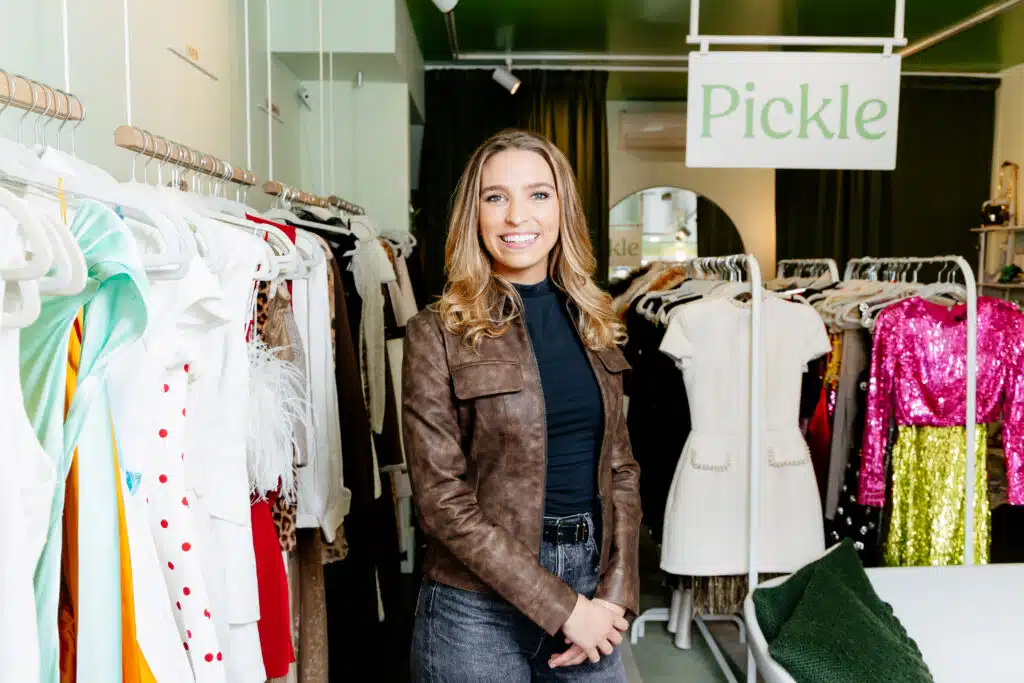
O’Mara and co-founder Brian McMahon didn’t start here. Pickle launched in 2021 as a social polling app for pre-purchase decisions — people crowdsourcing opinions before they bought anything. A year into that business, watching users recommend items from their own closets in the comments, the team spotted the real opportunity: a peer-to-peer rental market for clothing that, unlike cars or homes, had no Airbnb or Turo equivalent. The pivot came in May 2022.
What’s emerged since is a genuinely two-sided marketplace, live in all 50 states, skewing 60 percent Gen Z and 40 percent Millennial, with rentals clustering around weddings, graduations, and what O’Mara calls the ‘Euro summer’ travel wardrobe. Logistics run through local pickup, a DoorDash-style courier network, or a QR-coded shipping label — and an AI autofill tool handles the listing work for anyone opening up their closet for the first time.
O’Mara is candid about why the sustainability pitch alone wouldn’t have been enough: circularity had to be paired with a real financial incentive, not sold as a moral obligation. Hear how that thinking is shaping Pickle’s next five years — including a push into secondhand purchase and international markets — on this episode of Street Talk.
Related episode: Ep. #027: ‘How to Solve a “Really Stupid Problem”’ — Disney Petit, LiquiDonate
Read the full episode transcript
00:00 — Introduction
Arthur Zaczkiewicz: Hi and welcome to Street Talk. This is where we invite executives, CEOs, and industry leaders to discuss fashion, apparel, e-commerce, technology, sustainability, and more. Today we welcome Julia O’Mara, co-founder and COO of Pickle.
Julia O’Mara: Thank you so much for having me, Arthur.
01:13 — Why Is It Called Pickle? Inside a Peer-to-Peer Rental Marketplace
Arthur: Right off the bat — what is Pickle, and how did you come up with the name?
Julia: Pickle is a fashion rental marketplace — kind of like Airbnb, but for your closet. We’re called Pickle because if you’re in a pickle and need a last-minute outfit, you can rent one from someone else in your community, or across the country using two-day shipping.
Arthur: What was the moment you and the founders realized this was a white space that needed filling?
Julia: It was a windy path. My co-founder, Brian McMahon, and I met working at Blackstone. We left in the spring of 2021 to start the first version of Pickle — a social polling app where people crowdsourced opinions on what to wear or buy. About a year in, we noticed people commenting on those polls, recommending items from their own closets — even saying, “you don’t need to buy that, you could just rent it from me.” Other categories already had marketplaces for underused assets, like cars or homes, but nothing existed for closets. We pivoted in May 2022 to the fashion rental marketplace we are today.
02:56 — How Shopping and Listing Actually Works on Pickle
Arthur: What’s the actual experience like shopping on it?
Julia: We have a free app, and a website we’ve been building out that’s nearly fully functional for rentals. You sign up quickly with your phone number, and you’re immediately browsing — you can shop locally in your neighborhood or nationwide. You’ll see trending pieces for common occasions: everybody’s renting for weddings right now, and for “Euro summer” travel. On the flip side, lending is just as easy — you add a few photos, use our AI autofill to generate the description and pricing, and list the item. People rent it, and can also list items for sale.
04:10 — Do Influencers or Everyday Users Drive Pickle’s Growth?
Arthur: Are influencers involved, or do you collaborate with them?
Julia: Yes, some influencers and tastemakers use the platform — their followers are already asking “where did you get that?” so it’s a natural fit, and it can be lucrative: our top lender made $50,000 in one month. But influencers are a small share overall. The large majority are everyday people like me — not influencers, just people who want to keep up with trends, wear something new, and participate in the side hustle.
Arthur: So it’s also a way to try a trend?
Julia: Absolutely. Trends move fast now — in one week and out the next. You might want to try a micro-trend that’s blowing up on TikTok without buying into fast fashion. Most items on Pickle are priced at 10 to 20 percent of retail value, so you’re saving 80 to 90 percent by renting instead of buying.
06:06 — How Rental Logistics Work: Pickup, Delivery, and Shipping
Arthur: What about logistics? If I have a jacket I want to list, do I need to dry clean it first? How does it actually work?
Julia: When you’re renting locally — especially in fast-growing markets like New York, LA, Miami, or Chicago — you have two options: pick up the item directly from the owner, or use our door-to-door delivery service, which is like DoorDash for clothes, where a professional driver delivers it to you. If you’re not renting locally, you generate a shipping label and QR code in the app and drop it off at UPS or FedEx. We had rentals in all 50 states last year.
07:24 — Why Post-COVID Timing Accelerated Peer-to-Peer Rental
Arthur: You launched at an interesting time — post-COVID, with the resale market accelerating and people already comfortable with peer-to-peer platforms. Was timing part of what made this work?
Julia: Definitely. Post-COVID, people were going out more and had more reasons to dress up. There was also a broader shift toward secondhand and rental — it became normalized, even socially shareable, to wear something that wasn’t brand new. People are proud to talk about using Pickle — “pickle” has even become a verb, as in “I pickled it.” It taps into people valuing access over ownership, and wanting to try new styles without a big financial commitment.
09:07 — Is Gen Z Really Driving the Rental Boom?
Arthur: Is this popular with Gen Z specifically?
Julia: Very. Gen Z and Millennials are our top demographics — about 60 percent Gen Z, 40 percent Millennial. We see Pickle show up at major life milestones: prom, graduation, engagement shoots, rehearsal dinners — spanning ages 18 to 40.
11:06 — How Personalization and Culture Power Pickle’s Growth
Arthur: Does the app make recommendations? How does personalization work?
Julia: We’re testing composite scores based on user behavior — a “recommended for you” page based on order history and recent saves, which tells us the brands and price points someone is interested in. We’re A/B testing an updated version of this next week.
Arthur: What’s the culture like at Pickle? It sounds energetic and innovative.
Julia: Very customer-driven and product-led. We recently ran a company offsite where we split into four groups and each built a new feature in a day — regardless of whether someone worked in marketing or finance. By the end, we had working prototypes, and some of that code has already shipped. Our whole team, including people on the ground talking to customers daily, feeds directly into product decisions. We’re upfront in interviews: this isn’t a nine-to-five, but you’ll have real impact and upside from week one.
13:37 — Why Circularity Is Hard for Fashion — and How Pickle Cracked It
Arthur: Let’s talk circularity. The fashion industry as a whole struggles to put sustainable practices into real, lasting action. You seem to have found a niche that’s actually working — what’s your advice for other brands?
Julia: Circularity has been amazing, and it’s something our community talks about constantly — people don’t like wasted closet space, or the feeling of buying something and wearing it once. What’s worked for us is pairing circularity with a real financial incentive: people can both make money and save money on Pickle. If our only value proposition were sustainability, it would be much harder to get people to adopt the platform. The environmental benefit is the cherry on top of an economic case that already works on its own.
17:45 — Where Pickle Is Headed Over the Next Five to Ten Years
Arthur: Last question, one we ask almost everyone: what does fashion and circularity mean to you, both professionally and personally?
Julia: Professionally, fashion has been an incredible connector of community — it’s emotional, it’s how people express themselves, and it was previously less accessible for people who felt priced out of certain styles. When people feel confident in what they’re wearing, they’re happier, and that’s how Pickle grows: someone gets a compliment, says “I rented it on Pickle,” and the next person discovers the platform. Personally, this has been how I’ve discovered my own style — Brian and I came from Blackstone, from finance and data analytics, not fashion, and Pickle has taught me more about style and trends than I ever expected.
Arthur: How do you see Pickle evolving over the next five to ten years?
Julia: We want to go deeper into the U.S. markets we’re already in, and expand internationally. Longer-term, we’re thinking about unifying discovery across renting, buying new, and buying secondhand — right now those are three separate journeys, but there’s no reason they can’t converge, letting someone decide at the end of the process whether they want to rent, buy new, or buy secondhand.
Arthur: Well, we’re out of time — thank you so much, it was a pleasure.
Julia: Thanks, Arthur, I really appreciate it.
The Street Talk newsletter delivers the sharpest fashion, beauty, and retail analysis every Thursday — straight from Arthur Zaczkiewicz, former Executive Editor at WWD. Subscribe today.