

Retail Real Estate
November 10 2026

R.J. Hottovy, Head of Analytical Research at Placer.ai, joins Street Talk to examine what foot traffic data says about malls, off-price and the 2026 holiday season, and what it means for retailers heading into 2027. Retail has spent the better part of a decade writing the mall’s obituary. The shoppers, inconveniently, keep turning up. R.J. Hottovy runs analytical research at
Cass Spencer

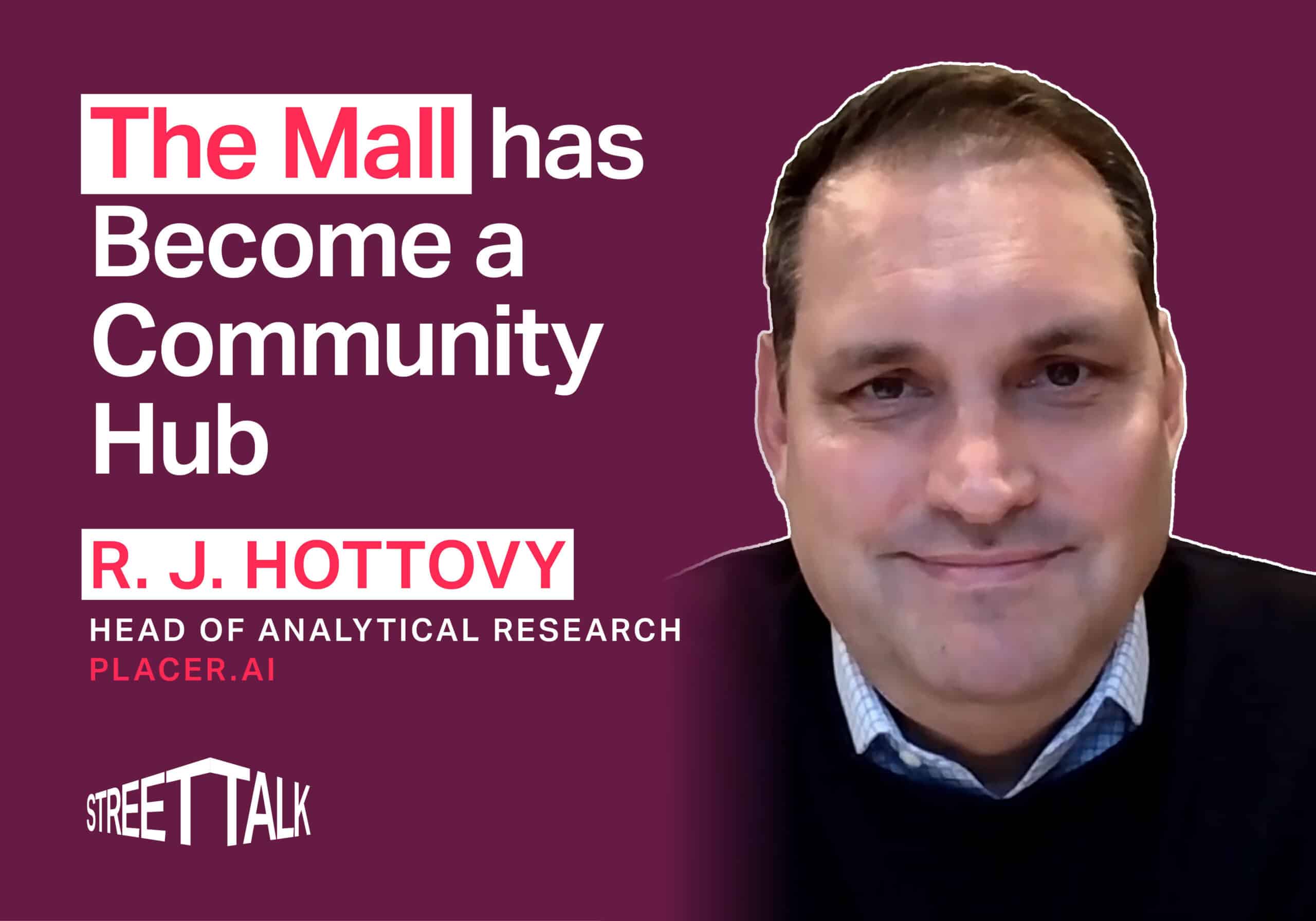
R.J. Hottovy, Head of Analytical Research at Placer.ai, joins Street Talk to examine what foot traffic data says about malls, off-price and the 2026 holiday season, and what it means for retailers heading into 2027.
Retail has spent the better part of a decade writing the mall’s obituary. The shoppers, inconveniently, keep turning up. R.J. Hottovy runs analytical research at Placer.ai, which means he spends his days counting who actually walks through the door, and what the counts show is a more interesting story than the funeral notices suggest.
The mall has become a third place: more gyms, med spas and local food, fewer racks of apparel, and a visit pattern that now runs from the morning workout to the afternoon coffee. The holiday season is behaving differently too. It started in September, October came in soft with gas hovering around the point where shoppers push back, and the shape of the next six weeks, a Black Friday spike, a lull, then a late rush of procrastinators, is one every retailer should be planning against.
Off-price is moving into malls. Niche players like Five Below and Bass Pro Shops are winning on products you cannot get elsewhere. Even the delivery truck has stopped mattering much, as long as the box arrives on time. Underneath it all runs one idea Hottovy borrows from Steve Dennis: the undifferentiated middle is a lonely place to be.
With diesel at a record and 2027 pricing decisions looming, the question is no longer whether people will shop. It is where they will go, and how long they will stay once they get there. Listen to the full conversation with Arthur Zaczkiewicz.
Arthur Zaczkiewicz [00:01]
Hi, I’m Arthur Zaczkiewicz and welcome to Street Talk. This is where we hear from industry leaders in retail, fashion apparel, technology, sustainability, and more. Today we have R.J. Hottovy, who’s the head of analytical research at Placer.ai. RJ, welcome. Thanks for spending the time today.
R.J. Hottovy [00:19]
Yeah, thanks for having me.
Arthur Zaczkiewicz [00:21]
I think before we went live we were talking about shopping malls and I have—she’s twenty-one now, but she spent the most of her teens in malls. And it’s the place to go. What’s going on? You know, I see all these distressed retailers and people they’re splitting apart A, B, and C tiers. They’re trying to repurpose malls, but the malls, why Gen Z? Why are they attracted to malls and keeping it alive?
R.J. Hottovy [00:47]
Yeah, it’s a great question to be asking, and I think honestly, the whole narrative around malls being dead honestly couldn’t be further from the truth. I do think the last, you know, several years and really since the pandemic, the way people have interacted with malls has changed. You know, in a lot of cases these malls have become that third place away from home or office, or second place if your home happens to be your office. But it really in a lot of ways become a community hub, and I think a lot of that can be traced back to the efforts of you know some of the owner operators. I think it started with the more open-air malls, creating more space for events and attractions and you know reasons to get together, and maybe it’s a you know a theme park ride or something else just to create excitement and get people in there. And you know, as that started to happen too, they started to change the mix of the tenants who are there, less reliance on apparel, which is you know kind of a mainstay of you know malls in the past, but instead now we get a lot more gyms and health and wellness and med spa and a shift towards food and beverage, in a lot of cases unique food and beverage, you know, more regional or local type chains that you can’t find really anywhere else. And what that does is change the frequency of people coming in. They’re coming in a lot more, a lot more frequent. They’re coming at different parts of the day. You’re going to that gym visit early in the morning, but coming back for coffee in that afternoon. And I think that really does have a lot of appeal for kind of that younger generation right now. Honestly, this is a generation that doesn’t have a lot of options like that. So they’re really you know embracing it and you know that the mall visit is fully back here. I mean I’m basically on autopilot to you know the malls in the Chicago area with my teenage daughters at this point. So I get it and it’s been exciting to see. Now to your question about A B C most is taking place at the A malls but even B, we’re seeing a reinvention there too. And typically it’s going to be a non-traditional anchor, maybe that regional department store which is mismatched for the audience in that market. Maybe it’s somebody else something different. Maybe it’s the Wayfair location maybe it’s a Bass Pro Shop, maybe it’s something unique there that drives a kind of a different audience, almost maybe a complimentary audience to what it probably had done in the past. So we’re seeing some excitement there. You know C malls are struggling, but I think a lot of that is just because we’ve seen people move away from a lot of those markets and maybe they just don’t fit anymore. But I think yeah overall you know the state of malls is pretty healthy today.
Arthur Zaczkiewicz [03:09]
You know, growing up on Long Island, our local mall. It was, I guess, the early seventies. It was the Sunrise Mall, the Smith Haven Mall, and it was an Orange Julius, you know, and four anchor stores. That’s what’s changed. You’re talking about something that’s you know, kind of dynamic and evolving, right? So you know, there’s compelling reasons to go back to the mall because, you know, Five Below, they have a new drop this week and what’s going on? Let’s check it out. Let’s go back for dinner, but there’s a new restaurant. So it has to be always evolving, always changing, right? It can’t just be static, right?
R.J. Hottovy [03:43]
No, I think that’s a big part of it too. I mean, you gotta give customers a reason to come to your mall, and a lot of times that could be changed. But I do think these events and attraction spaces do allow for that. It’s something where you don’t have necessarily a long-term lease in place for that. And so you do have the opportunity to kind of switch it up and bring in things that create excitement. And so I think that’s a big part of it. To your point, too, the kinds of retailers that are working in this environment are kind of your treasure hunt type players, where you don’t necessarily have a plan when you go in, but you know you’re gonna find something unique and different. Those include off-price retailers, Five Below certainly fits that. Even some cases like your like a Trader Joe’s where maybe there’s a unique product you know that you can’t get anywhere else that this flavor that you really like. Those have started to find their way into some of these mall locations too. A little bit different that you can’t get anywhere else. And so I think that’s a big part of it too. And the mall owner operators that are winning are the ones that are staying ahead of that.
Arthur Zaczkiewicz [04:39]
What are you seeing? What’s the patterns you’re seeing, you know, with holiday or anticipate for holiday? Like, what’s in store to expect?
R.J. Hottovy [04:45]
Yeah, it’s a fun question. And it’s something, you know, I think we see a couple different trends, and you probably see it in your own day-to-day life too. I think we’re seeing holiday shopping start earlier than it’s ever done before. I mean, I don’t know about you, I was getting mailers in September this year for different products. So we definitely see that. It makes sense because, you know, we’ve got retailers who are looking to book that, you know, customer transaction earlier than ever, you know, particularly for big ticket items. That customer is very much a deal seeking, value focused consumer. If they can get a deal early on, they’re gonna jump at that too. But what that does is that really has stretched out the overall holiday period, and you are gonna get periods of weakness. Honestly, October was only kind of a from a visitation standpoint. Some of that were lapping, some pretty strong numbers in October 2025. Some of that was clearly macro related with gas prices, retail gas prices, you know, kind of hovering around $4.50, which seems to be kind of the point that consumers push back on when we look at our visitation data. So October wasn’t great. I do think yeah we saw a little bit of excitement that first week when we did see the deal days that were out there and the competing sales, but it’s been fairly soft and I don’t think that’s gonna change. I do think as we kind of get closer to Black Friday, we typically have seen that, even though we do see it stretching out, consumers do still see that as a time to get a deal. And so we do usually see pretty strong visits on Black Friday weekend, and I expect that to be the same. But then we’re probably gonna go back into a lull. And I think what we’re gonna see is probably a late push of procrastinators, a lot of you know consumers who wait to the last minute. So I think that’s probably the other period to look at is we’ll probably see a big spike right before the actual holiday events. Now, what’s interesting too is that we look at the type of visitors and what chains are doing well typically earlier in the cycle we see it’s the big ticket categories people want to get that deal get that out of the way make sure you know especially with rising diesel gas prices and potentially supply chain issues let’s get that big ticket item taken care of let’s knock that off the list at the same time, we’re in an environment where clearly consumers are feeling a little pressure. I would say lower and middle income consumers, really any anybody up to the $200,000 in household income is seeing some pressure. You don’t want to leave everybody off your list, you want to make sure you get something. So later in the season, we typically see it’s the smaller ticket, more value-oriented visits that really pick up. So things like off-price retail, we see it with you know, beauty and wellness, we see it with you know, categories like that, that’s typically what we’re gonna see where the strength is coming in later in the season. So I think at the end of the day, you know, people are going to continue to shop. We’re going to see pretty healthy holiday visits, probably not quite to the same level that we did last year. And I do think we’re going to see people maybe trading away from super big ticket items into you know more smaller ticket items to make sure they get everybody on the list. But I do think ultimately we’re going to see some pretty healthy visits at the end of the day.
Arthur Zaczkiewicz [07:35]
Visa had just come out at the time of this recording, for their holiday you know, expectations. Everybody’s calling for four to five percent year gains. And they were brave enough to put on an adjusted for inflation number of like 1.1%, which is less than last year. So it’s you know, and the thing I mean it’s inflation is actually playing you know a role. So but people are still shopping. I remember Joe Otori [verify spelling], this old CEO of Ames Department Store, he would say, you know, Christmas comes every year when people ask you about the holiday. And it’s true, it’s like people
R.J. Hottovy [08:14]
It is. It really is. It’s something that it’s that time of the year people don’t want to feel left out. And I mean that’s something that behavior that we are seeing. I mean, I think, you know, middle income consumers in particular, coming out of the pandemic, they got used to a certain lifestyle. They had a you know, they certain pattern of life and things that they did. And as inflation has crept up and you know, maybe they are feeling pressure, they don’t wanna feel like they’re pressured. And the holiday is a perfect example for them. I don’t wanna feel like I’m under pressure. I’m gonna continue to shop, I’m gonna buy something for everybody on my list. It may not be the same dollar amount, but I’m gonna get something for everybody on my list. And it’s interesting too because what we see with our data is those categories that are kind of more status symbol or more consumption, you know, consumption-based type things or conspicuous consumption type categories, those are the ones holding up. I mean, you know, for maybe more of a staples category like a grocery visit, you’re going to substitute that visit from a you know high-end grocer to maybe an Aldi or Trader Joe’s, but that daily cup of coffee, that Starbucks coffee, not getting that out. Coffee is one of the stronger categories right now. If there’s a chance that I can get a brand name at a competitive price at a TJ Maxx or Ross Stores, I’m gonna do that too. And that’s gonna be some way that I can help stretch my household budget, but do in a way that looks like I’m not under pressure. So I do think that we’re gonna see that. You know, again, the holidays is you know, nobody wants to feel left out there, so I think we’re gonna see pretty strong results. And to the Visa survey, you know, that would imply still you know positive growth year over year from a transaction standpoint, and that would dovetail nicely what we’re expecting from a visitation standpoint.
Arthur Zaczkiewicz [09:46]
So yeah, we’ll have to keep an eye on foot traffic and see how that plays out. Let’s talk about the off-price for a second. They’ve had a great run and they’re doing really well. A lot of them are you know, in a position of kind of repositioning themselves. TJX is just continuing its growth. Burlington, they’re looking at like smaller footprints, they’re trying to get more, you know, sales productivity, sales per square foot. Ross is continuing to open stores, but they think they’re being more strategic where they just, you know, kind of more thoughtful. And the thing that lingers in my mind is that you know as the feed of apparel diminishes, right? So we have less store closures. Is that gonna dry out? Is the source of apparel gonna kinda dry out as people become more efficient with their inventory levels like Macy’s or
R.J. Hottovy [10:40]
It’s a great question to ask. And I think ultimately because we have seen a shifting away from in store to online still gives an opportunity. There’s probably you know I don’t think it’s net, but I do think, you know, with the rise of a lot of direct to consumer brands, a lot of kind of influencer type lifestyle brands that have popped up, you know, they still need an outlet too. They don’t have the capital, they don’t have the balance sheets to open up, you know, you know, their own outlet stores, their own ways of liquidating. So I think that, you know, honestly that becomes another avenue for the off-price channels that they could start to tap into some of these newer brands. And they know that the brand name at a competitor price is you know kind of the lifeblood of what they do to drive people in the store. And so I suspect that they’ll you know jump on that earlier than a lot of the other ones. I mean, we’re starting to see that even a little bit at Rack at this point. So I think that’s something to keep in mind. But it’ll be interesting to see too. I think you’re right, it’s a question worth asking as we start to see more apparel retailers you know close stores or optimize their store footprint, which doesn’t does make sense and to your point about kind of where we’re seeing you know growth in off price it has been really interesting to watch because we have seen them start to you know adopt more mall based openings which is something that you know was really not something that we’ve seen up until very recently with migration we’ve seen people move away from urban to more suburban and rural locations it’s changed the unit economics on some of the smaller market you know kind of sub-150,000 in population all of a sudden with
Arthur Zaczkiewicz [11:52]
That’s interesting.
R.J. Hottovy [12:10]
Increase in population and a lot of cases higher income population, It might be more viable for a store there too. So I think some of the store-based optimization that we’ve seen is just a natural progression of where those chains were headed, anyways. But really interesting to see. And I think they’ll continue to be when we are starting to see visit trends on a year-over-year basis slow for most of the group, you know, kind of Ross being the outlier they’re continuing to open stores in pretty big numbers. But the other guys, you know, seeing a little bit of slowdown, but I think you know, largely it’s just because it’s been you know such a good run they’ve really been you know three four years of momentum here yeah I think partly and then combined with kind of a macro backdrop that’s a little bit uneven yeah that’s probably you know consumer just taking little bit of a pause right now
Arthur Zaczkiewicz [12:53]
The so off price, you know, solid for the holidays moving forward into next year. We have you know juggernauts, obviously Amazon and you know, Target Walmart kind of maintaining. And then you mentioned something in like Five Below, kind of like niche players, Five Below, Bass Pro Shops, maybe Cabela’s, you know, kind of specialty you know, apparel retailers who are really niche. They’re succeeding because they’re filling a space, right? That’s not
R.J. Hottovy [13:21]
They are. Yeah.
Arthur Zaczkiewicz [13:23]
I mean so what’s the secret sauce there? Is that how are they doing that and why is it working?
R.J. Hottovy [13:28]
I think it’s just partially because of just differentiation on the product side. I mean, that’s something that, you know, those are products that for like for kind of you know, Bass Pro and st on that side. I mean, that’s something you typically want to see before you go in. And so that drives the visit. You may make that final purchase somewhere else, but it’s something you want to see. It’s products that you really can’t get anywhere else. And so I think that’s a big part of it too. And the a lot of times, I mean, yes, there are, you know, a lot of big ticket items in there too, but there are some small ticket stuff that actually works really well and kinda shows as a you know as a yeah somebody who’s buying presents for somebody else. I put a lot of thought into this too and not just picking up something else there. So I think that uniqueness is a big part of it and often overlooked. I mean I think everyone talks about value being so important to this environment and it clearly is. But I mean I think you know what happens if everybody cuts prices? I mean it’s something, you know, there’s still winners and losers and I think the ones that really have a difference product is where we see it. And it’s something we mean we see across the grocery space. I mean you know On one side we do see strength in the value-oriented players and I’d argue that it’s not just low prices, but it’s kind of the private label guys, you can be more nimble. And also we talked about with malls and evolve their product mix on kind of an ongoing basis. Every time I go in there, that’s something new I didn’t know. Maybe I’m not doing that for every grocery trip, but I’m certainly using that as my regular fill-in trip. You know, at the same time high-end grocers are doing pretty well too. And I think, that’s where because I can’t there’s unique products that I can’t get anywhere else, Fresh Market, Whole Foods, places like this. You know, coming out of the pandemic, will more and more people learn to cook for themselves, you know, started following you know the Food Channel and doing things like that. I think that’s been a big dream for it and it’s the companies in the middle that you know don’t really win on value and don’t really win on differentiation, that’s where you’re kind of stuck. And I think that’s gonna be kind of the message here for the holidays is don’t be in the middle. Steve Dennis you know is great about you know promoting this idea of the undifferentiated middle, and I think that spot on you know for this environment and really you know one or both that value and differentiation equation is really what drives success in this market.
Arthur Zaczkiewicz [15:35]
What do you think? You know, we years ago we talked about the halo effect, you know, somebody would open up a store, they would see the data showing their online sales. Is that still relevant or is you know, like mobile e-commerce, mobile-commerce and other technologies changing that dynamic?
R.J. Hottovy [15:50]
Yeah, it’s still an important part of it. I mean, I think, you know, the idea of omnichannel kind of combination of in-store, you know, online and you know, mobile, I think that’s extremely incredible. They all have to kind of work in harmony with one another. And it’s interesting too. I mean, what we have seen this year, most people think Placer.ai is just looking at foot traffic data for restaurants and retailers and malls. But we also track fulfillment centers. We can look at visitation of fulfillment centers. So we built an index of I think six hundred e-commerce fulfillment centers across multiple brands, and it’s been a pretty big year for e-commerce visits and I think partially because of you know gas prices I think some people hey if gas prices are here maybe I can just get an Amazon order to substitute that in-store visit but same-day grocery for Amazon’s also had a big impact on that too. But I think it all kind of works together. I think that you know you can’t really be a retailer in this environment which is kind of one or the other. It really has to be kind of all together. If you’re traditionally an online or an online native retailer you still need that store presence to kind of showcase your brand and what you’re all about and give people a chance to kind of see what their product assortment looks like. At the same time, if you’re kind of at traditionally in-store, physical stores, you do need an online presence. There’s a convenience aspect, there’s you know inventory management aspect to it all. I think these are things that just still need to work in harmony with one another.
Arthur Zaczkiewicz [17:11]
I ordered some stuff from I don’t even know why. I didn’t do Amazon. I did Walmart for some reason, like office supplies. And one thing was kind of delayed and when it showed up it was some more models, pens, big pens, but it was delivered by Staples. And I was like confused. I’m like what’s going on? So I’m thinking about the whole shopping experience and the branding. It’s really not relevant anymore, is it? It’s the experience like getting the customer what they want, putting them truly in the center of your business model and making sure that you know they’re getting what they need, right? Is that
R.J. Hottovy [17:46]
Yeah, I think that’s the important part is that I mean Walmart’s done a really good job building on its whole marketplace business and its you know, retailer fulfillment capabilities as well. You know, and if you know you can leverage somebody else’s infrastructure and supply chain and distribution channel to make it work, that’s fine. As long as that product gets there within you know, usually two days is kind of the threshold I think most have trained on at this point. As long as it’s there, as long as you are communicated when it’s gonna show up and you know, if there’s any delays when it’s gonna be show up. I think most people are pretty good. And at this point I don’t think the logo on that delivery truck really matters. It’s just a matter of you know that product getting there on time. So
Arthur Zaczkiewicz [18:26]
Yeah. We’re just about out of time. Anything else you think yeah, we need to be considering like heading into the holidays and looking at 2027?
R.J. Hottovy [18:35]
Yeah, it’s a good question. And we’ve been starting to think about that. What are the things that are you know important to look at? I mean, I think right now, gas prices, there’s still a lot of ways gas prices could go between now and the end of the year. So that certainly is a wild card in terms of what we see in terms of consumer spending. And not just retail gas prices too. The other big one kind of lurking right now is the diesel gas prices that’s sitting at an all-time high and what impact that might have on supply chain costs. My guess is that most retailers know consumers are under pressure, they don’t want to raise prices because of that. They’ll take the margin hit for the time being. Now, 2027, you know, bets are off. That could start to creep in and start to creep price increases as well. So that’s one thing to keep an eye on there. Yeah, I think that’s a big one. You know, the other things, I mean, you know, we’ll start to lap some of the gas price increases that we saw really starting to creep in March. So potentially there’s some easing at that point. But ultimately, I mean, I think where we’re at, and I think this is more so than anything else. I think. Consumer behavior just in general towards shopping has really changed a lot the last couple of years. People have kind of started to shop around, particularly in food retail, but I think it’s other categories too. People are shopping around a wider number of locations than they ever have before. You know, it’s kind of like, hey, I know I can get this one product here, I can get this other product here. It’s a little bit what we talked about differentiation. What that does is actually put downward pressure on the amount spent per visit, because you’re only going in, you’re filling in more trips and less time spent in the store. So you’re almost across the board with a few exceptions, dwell time in the store has gone down the last couple years. And I think that’s something that continues to play out. So as a retailer, you’re in an environment where people are shopping at a wider number of locations, they’re spending less time in their stores. How do you capture that person? And again, I think it really comes back to that combination of value but also something compelling. And if you can make that work together, those are the things that really work. I don’t think everybody has to necessarily do a treasure hunt environment, but the ones that are really doing kind of a you know something different something that I you know I can offer that nobody else can but also keeping prices competitive that’s the message that works right now
Arthur Zaczkiewicz [20:45]
We’re out of time. RJ, thank you so much. It was really insightful. We’ll have to have you come back Yeah, after the holidays and see how things played out. But thanks again. Thanks for spending time with us and thank you for tuning in.
R.J. Hottovy [20:50]
Well, love to appreciate it. Thank you.
Related episode: Experiential Retail is Key to Attracting Younger Consumers with Bruce Findlay at Landsec
Sign up for the Street Talk newsletter: Retail Intelligence for C-Suite Leaders.


SHARE: