

Podcast
September 1 2026

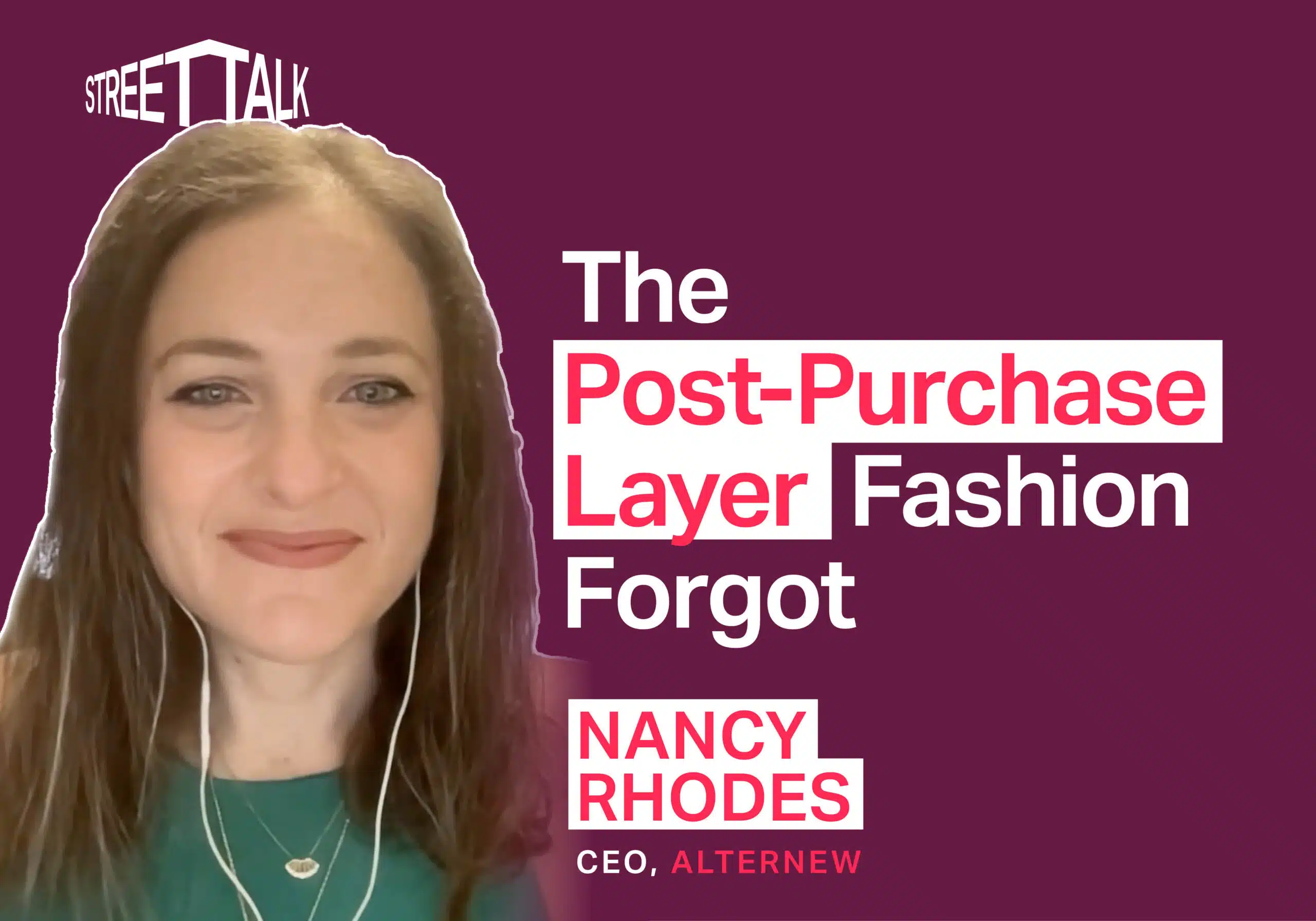
Nancy Rhodes, founder and CEO of Alternew, explains how brands can capture value after a sale rather than only at checkout. Alternew operationalizes tailoring, repair, and care services as a post-purchase layer — similar to AppleCare — helping fashion brands reduce returns, extend customer lifetime value, and meet emerging Extended Producer Responsibility regulations. Building the Layers Brands Don’t Fashion will
Cass Spencer

Nancy Rhodes, founder and CEO of Alternew, explains how brands can capture value after a sale rather than only at checkout. Alternew operationalizes tailoring, repair, and care services as a post-purchase layer — similar to AppleCare — helping fashion brands reduce returns, extend customer lifetime value, and meet emerging Extended Producer Responsibility regulations.
Building the Layers Brands Don’t
Fashion will spend up to $160 to get a customer to the register — then, by Nancy Rhodes‘s account, walk away the moment the sale closes. Rhodes, founder and CEO of Alternew, thinks that’s the industry’s most expensive blind spot. Her company builds the layer brands don’t: the decisioning and quality-control infrastructure that turns tailoring, repair, and care into a managed, monetizable part of the customer relationship, the same way Apple built AppleCare for hardware.
The case studies are already running. Primark has completed more than 500 sewing workshops across nine markets and is expanding the program into the U.S. with Alternew’s help. Piper & Sky, an exotic-leather handbag house, is operationalizing its one-year repair warranty into a seamless post-purchase workflow. Rhodes argues the value isn’t in the price point — Alternew works from Primark to accessible luxury to true luxury — it’s in the workflow underneath it.
Policy Versus Shifting Consumer Behavior
Regulation is closing the gap between what’s optional and what’s required. The EU’s Extended Producer Responsibility rules and the U.S.’s SB707 are the first textile-specific laws with real teeth on repair and reuse, and Rhodes reads them as the second half of a two-sided push — policy on one side, shifting consumer behavior on the other. It’s a case she’s built from both directions: two decades as a footwear design director for brands from Kenneth Cole to Target before a master’s in sustainability sent her looking for the gap in product ownership no one else was solving.
Rhodes also unpacks the Ownership Intelligence Lab, her nonprofit-adjacent effort to build systems-level thinking around circularity — and why she thinks it’s the only corner of the circular economy without its own conference. Full conversation below.
Related episodes: Ep. #027: ‘How to Solve a “Really Stupid Problem”’ — Disney Petit, LiquiDonate
Read the full transcript
Arthur Zaczkiewicz: Hello, I'm Arthur Zaczkiewicz, and welcome to Street Talk. This is where we connect with industry leaders and executives who share insights into fashion, apparel, retail, luxury goods, sustainability, technology, and more. Today we welcome Nancy Rhodes, founder and CEO of Alternew. Nancy, welcome.
Nancy Rhodes: Thank you for having me.
Arthur Zaczkiewicz: Let's start with your career path — I was reading up on you and it's fascinating. What's the impetus behind founding the company, and how does it work? What is it, and what do you do?
Nancy Rhodes: We'll start with what Alternew is. In effect, we help brands embed tailoring services, care guidance, and repair workflows into the shopping experience. You know AppleCare as the post-purchase layer for Apple products — Alternew is the post-purchase layer for the fashion industry. People tend to land with that pretty quickly. We're the decisioning and quality-control layer, so a brand is no longer just doing repair as an activity — they're operationalizing the business case to get more profit from these different pieces of the post-purchase layer.
For me, I came from the design side. I spent about two decades as a design director in footwear, building for icons like Beyoncé and Kenneth Cole, and working with Costco, Target, Marshall's, TJ Maxx. I ended up getting my master's in sustainability and found this gap in ownership — like, we spend so much getting a customer to purchase a product, up to $160 just to get them to the register, and then we lose them after the sale. It's about creating a better opportunity for customers, having sat on both the building side and, in my master's, the "how do we create better circular models" side — and finding this opportunity to support customers after the sale.
Arthur Zaczkiewicz: Speaking of circularity, what do you think is the challenge? Apparel especially seems challenged in deploying sustainable practices as fast and efficiently as it could. What do you think the issues are?
Nancy Rhodes: That's a podcast — or a thesis — for another day. But a couple of things: I write a Substack called The Repair Era, about the idea that we've always put "repair" into one category, when it can mean so many different things — tailoring, care guidance, actual repairs, or just knowing how to wash something so it lasts longer.
With circularity, I think the real first problem came from greenwashing. There's a long history here — first Earth Day in the '70s, then brands wanting to participate, a lot of failures. In any other industry, a failure is an opportunity to improve. In fashion, it continues to deplete brand reputation. It started forward-facing — repair, rental, resale — then moved into internally-facing materials work. But it's two-sided: on one side you have legal, regulation, policy; on the other, consumer behavior. And consumer behavior is that it's effectively easier and cheaper to buy less-expensive things.
There's a term, "buy better, wear longer," that I kind of hate, because what does "better" mean? Right now, every brand is fast fashion — every brand is working on faster cycles, faster speed to market. So how do you create better consumer behavior where people are willing to spend more because they know it'll last longer? The number one problem is that it is still cheaper to make new than it is to keep something in use. People say if you help brands not overproduce, you save them money — but if you actually look at margins and what they need to sell to hit their goals, it's still cheaper to overproduce than to repair.
Arthur Zaczkiewicz: I was thinking about that the other day — I'm guilty of this too. I'd say luxury items are an investment, but you're right, it's the connection to the brand and the product, how it fits, that's more important than the idea that a handbag is going to pay you back. That's the wrong approach, I think.
Nancy Rhodes: Yeah — you have Hermès, which is genuinely an investment; there were times it could be traded and you'd get money out of it. But for most brands, every step through the product journey depletes value the same way a car depreciates by half the second it leaves the lot. Apparel depreciates by half, if not more, for both the brand and the consumer.
At its most basic, the question is how do we create a better experience with the things we have — and it's not just apparel, it's our phones, the things in our houses. There's a woman, Liza Lessig, who runs a series called The Crisis of Stuff, about how the more stuff we have, the less power any of it holds. My grandparents passed down china to my parents, who passed it to me, and it's sitting at my parents' house because I'm in a New York apartment and I don't need or want a fine set of china. Experiences have become our version of value now — so how do you turn an experience into the things we own, versus the vacations and things we do?
Arthur Zaczkiewicz: What are some of the partners you work with?
Nancy Rhodes: We're cross-industry — we work with everyone from Primark to accessible luxury brands. We're about to launch with Piper & Sky, an exotic luxury handbag brand with items from $500 to $1,500, and also with an accessible luxury fashion brand in the $200 to $1,200 range. It's less about price point than about the workflow. For Primark, that looks like sewing workshops — they've run over 500 across nine markets, and we're helping expand that into the U.S. as they grow, aggregating their "Love It For Longer" site and making it discoverable and accessible to consumers, which also generates more consumer insight. For Piper & Sky, it's a repair workflow — they have a one-year repair warranty, and we help them operationalize it, make it seamless for the consumer, and build better marketing campaigns around it.
Marketing has a stigma, but marketing done well, for the right thing, matters — we all want to keep buying things, there's nothing wrong with consumerism. It's more about caring for what you buy than just buying it. How do we buy something and love it? And if we don't love it, how do we get to the next best use — that's where resale, rental, and better recycling infrastructure come in. Tailoring, care, and repair are the through-line. We touch every part of the value chain, from manufacturing into purchase, into post-purchase, into whatever comes next.
Arthur Zaczkiewicz: Up near where I am, near Woodstock, there's a lot of — let's call them crunchy — people, and they have something called Repair Café. Have you heard of it?
Nancy Rhodes: It's actually an international thing, and it's a great service — one use case. I've always said, how do we make the word "repair" sound less granola? You have outdoor-gear repair cafes, and it's very Woodstock, but repair is something the next generation actually wants — it's an experience.
Arthur Zaczkiewicz: I went to one last month — the biggest thing people bring in is probably zippers. But people bring lamps, things they love, get their tools sharpened. I'm noticing younger and younger people, my daughter's age, twenty-one, bringing their stuff in to be repaired. It's wonderful — an experience for them, they get to socialize, there's milk and cookies. It's just a fun thing to do.
Nancy Rhodes: For Alternew, our thesis is really around workforce development — creating a better pathway to work for the next generation of service providers, whether that's a tailor, a cobbler, a jewelry-care specialist. There are clear pathways into trades like HVAC and plumbing, but in fashion it's wildly underserved and undervalued — not because it isn't lucrative or a real career path, but because of accessibility. What we're building is an AI-powered, agentic decisioning and quality-control platform.
If brands offer post-purchase services, that turns into consumer engagement — it becomes as cool to talk about your fashion care as your fashion haul. "I went to the cobbler" becomes a TikTok, instead of "I bought a thousand items for ten dollars on Shein." That creates predictable demand for service providers, which means they get more work, know what to expect, get access to new customers — and that draws new entrants into the industry. The best analogy is OpenTable: OpenTable didn't create chefs, it created predictable demand for restaurants. Airbnb didn't create hotel rooms, it created viable participation. That's what we're doing for fashion.
Arthur Zaczkiewicz: And you're also increasing customer lifetime value, right? When I hit the buy button, I'm not expecting anything more than that — what you're doing is capturing them afterward and stretching out the value of that customer.
Nancy Rhodes: A hundred percent — customer lifetime value is more important than ever. We've focused so much on acquisition, and now the big focus is retention, and you're seeing real tailwinds. Coach, Levi's, Primark — brands we work with — all offer post-purchase experiences, and their revenue has gone up. You also see brands struggling without it. The signals are on both the push and pull side. On the push side, there's regulation: EPR — Extended Producer Responsibility — in the EU, which holds brands responsible for the waste they create, and in the U.S., SB707 and other packaging regulation. These are the first textile-specific regulations with real language on repair and reuse.
So we support customer lifetime value, reduce returns, and support acquisition — because if a brand offers tailoring and a customer is about to return something, a "find a tailor" button connects them locally, and the brand pays for that tailoring because it's cheaper than absorbing the return. And in post-purchase marketing: "You've had your $1,500 coat for a year — summer's coming, let us send it to a local dry cleaner, store it for you, and it'll be ready to pull out for winter." Alternew is simply the connector, and the use cases become limitless the more you build out the network.
Arthur Zaczkiewicz: Let's step back for a minute and talk about the consumer. What do consumers expect when they're shopping for apparel or luxury goods? What kind of experience do they want?
Nancy Rhodes: It depends on the consumer. There are so many statistics about people wanting sustainability — I speak on sustainability panels all the time, and the first question I ask is, does everyone know what circularity actually is? We've overcomplicated so much. Right now we have a linear economy: make it, take it, waste it — you buy it, then throw it away or donate it hoping it goes somewhere, and if one thing's wrong with it, it ends up in a landfill. The circular economy just closes that loop: make it, take it, then remake it, reuse it, resell it, rent it, repair it — whatever keeps it in use as long as possible. It's not complicated. Consumers have been led to believe circularity means buying more expensive things made "fairly" — that's one piece of the puzzle, and it leads to a lot of shaming, and I'm over the shame part.
Some people think success means everyone gets everything tailored — that's not what I want. If you buy a size eight and should be a size six, let the fit tech tell you that. We're the last mile to a perfect fit — one avenue of services that creates a better value chain. Maybe a consumer wants to do it themselves, or something rips and they just resell it and let the next person deal with it. It's about creating a better, more seamless experience.
Going back to systems economics versus unit economics — think AppleCare, Prime, even Starbucks loyalty, where you pay in and build a habit. That becomes a better long-term habit for consumers and more profit for brands. Consumers are all different and fickle — some only buy luxury and go straight to the tailor, petite women who say "I get everything tailored, that's my job, not the brand's," tall people who can only get bespoke. It's less about "how are consumers today" and more about understanding that personalization and individualization matter more than ever, because while customers fit into boxes, they're all looking for different ways to participate in the circular economy.
Arthur Zaczkiewicz: We have just a few minutes left, but I want to ask about the Ownership Intelligence Lab — you also founded that. What is it?
Nancy Rhodes: If you look at what Alternew does, we're a B2B-to-C AI implementation supporting brands, built out of that workforce-development idea. A lot of people look at repair purely as a cost center, through a unit-economics lens — fair enough. The OI Lab looks at it through the system instead of just the B2B-to-C relationship. It's a grassroots network of brands, providers, and technology looking at the problem itself. We like to say it's the only part of the circular economy that doesn't have its own conference yet.
Brands spent almost a trillion dollars last year dealing with returns — again, all that spend optimized for the sale. Ownership is the point where the brand has the customer's ear, the customer has the product in use and is most engaged with it, and that's where we can help brands stay top of mind through post-purchase experience. The OI Lab builds the systems thinking — Alternew is the for-profit business helping with that, but looking above it, building the nonprofit-adjacent white papers and connections that make the business case for the system, not just the product. It's harder to build systems thinking when you're a company selling SaaS, so the OI Lab does that work separately.
Arthur Zaczkiewicz: Nancy, we're out of time, but thank you — we'll have to have you back for a part two at some point. It's been a pleasure. Thank you for tuning in.
Nancy Rhodes: This has been great. Thank you so much, Arthur.
The Street Talk newsletter delivers the sharpest fashion, beauty, and retail analysis every Thursday — straight from Arthur Zaczkiewicz, former Executive Editor at WWD. Subscribe today.