

Retail
April 21 2026
For years, the retail industry has been searching for a “return to normal” following the pandemic. But the latest data is revealing a starker reality: the old normal is dead, and it has been replaced by a permanent bifurcation and decoupling of the American consumer. As I’ve discussed before, if you want to find the winners in 2026, you have
By Guest Writer: Antony Karabus

For years, the retail industry has been searching for a “return to normal” following the pandemic. But the latest data is revealing a starker reality: the old normal is dead, and it has been replaced by a permanent bifurcation and decoupling of the American consumer.
As I’ve discussed before, if you want to find the winners in 2026, you have to look well beyond the middle of the mall. Look at the two ends of the spectrum — the high-end luxury emporiums and the deep value giants.
Why are luxury mono-brand stores taking share from department stores?
Fifteen years ago, chains such as Neiman Marcus and Saks were large, profitable multi-billion dollar powerhouses and the primary gatekeeper for luxury merchandise in America. Today, significant market share has been shifted to mono-branded stores operated and owned by the key luxury brands directly. These luxury brands (the LVMHs, Richemonts, and Chanels of the world) have increased their own physical footprint in the U.S. by nearly sixfold in the same period.
The reason for the massive shift in luxury market share is clear: If you are an Hermès, Chanel or Gucci collector, you now have a clear choice in virtually every affluent city in America between: a curated corner in a department store or a flagship mono-brand store that offers the full expression of the brand (the full assortment, the right, aligned brand environment and curated service befitting the brand). Increasingly, affluent consumers are picking the latter, which has significantly accelerated the decline in the luxury department store economic sector performance.
The bottom line is that luxury today is defined by infinite choice and flexibility, with an increasing shift from merchandise to experiences. For the ultra-wealthy, it isn’t just about apparel; it’s a lifestyle spanning luxury travel, multiple homes, luxury home goods and cars, Michelin-starred tasting menus and other unique experiences.
Which department stores are surviving the luxury shift — and how?
While legacy names such as Saks and Neiman Marcus have struggled through restructuring and loss of market share, two champions have emerged: Nordstrom and Bloomingdale’s.
Nordstrom has hit record numbers (climbing toward $16 billion in revenue) by playing a different game. Instead of competing exclusively with the mono-brand stores of the leading luxury houses, they’ve also leaned into numerous bridge and aspirational brands — many of which don’t have their own standalone stores — becoming the essential hub for the next generation of luxury shoppers, while setting the standard for top-notch customer service.
Meanwhile, Bloomingdale’s has mastered the intersection of entertainment and art. By turning shopping into a cultural event rather than simply a transaction, they’ve grown market share and achieved significantly greater positive comparable sales than the traditional competitors.

Why do luxury shoppers also buy from Walmart and Costco?
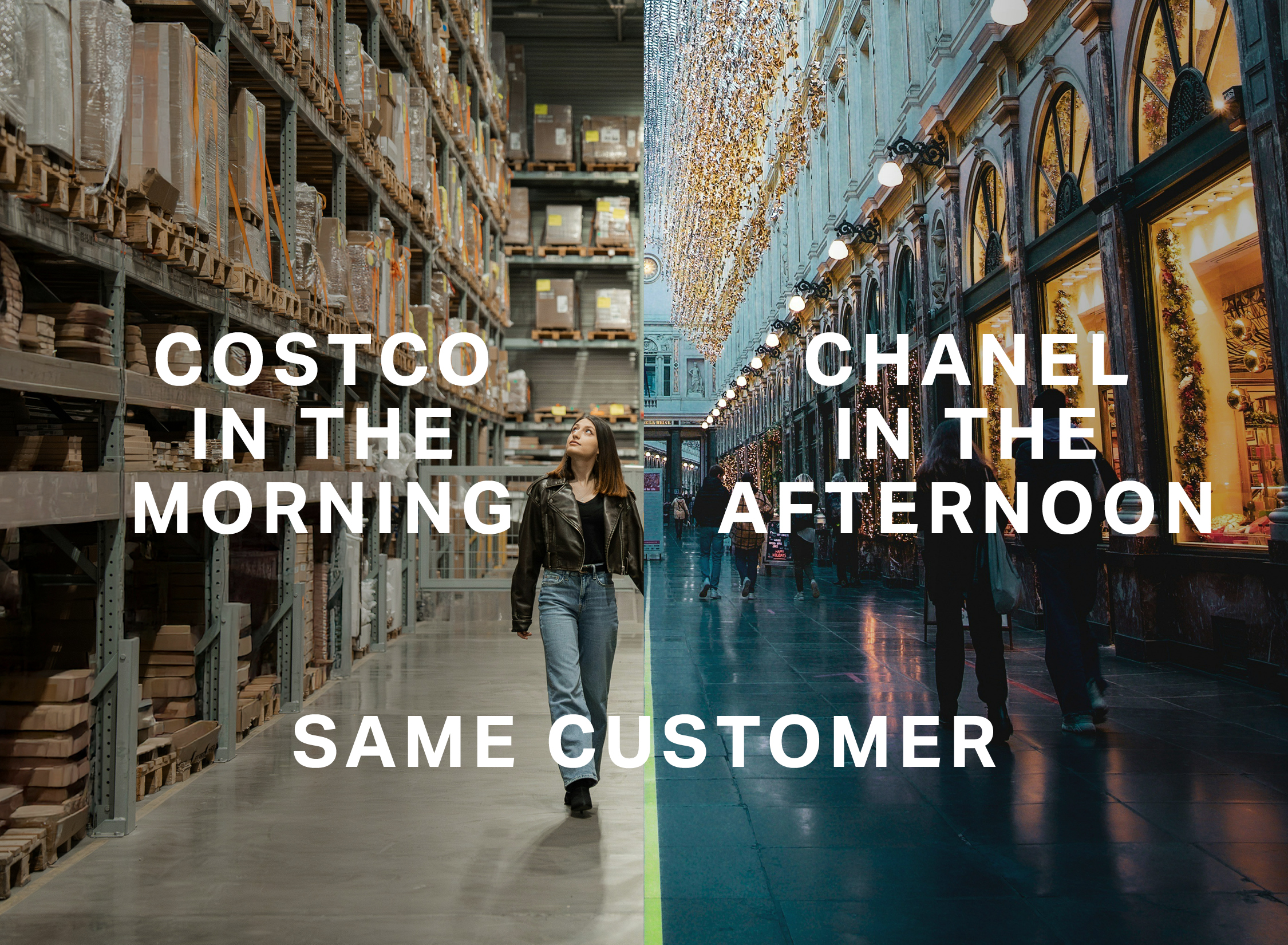
Perhaps the most significant trend is the “Sophisticated Consumer.” Today’s luxury shopper is more discerning than ever, leading to a strange retail irony: the same person buying a $4,000 handbag is also looking for real value on “ everyday” essentials.
This is why Walmart, Costco, and Amazon have seen their share of total retail merchandise revenue skyrocket over the last two decades, including among consumers earning over $100,000 annually. Shoppers frequent luxury flagships or curated emporiums, while also shopping at the deep-value brands such as Walmart, Costco, TJX, Burlington, and Ross Stores.
How is the value retail segment breaking down in 2026?
The market has also bifurcated even within the value segment. We are seeing a distinct value tier as a result:
- The Sophisticated Value: Costco, TJX, Burlington, and Ross Stores (where the wealthy hunt for deals).
- The Deep Value: Five Below, Dollar General, and Dollar Tree (serving the budget-constrained).
- The Differentiated Value: Niche players like Citi Trends, which thrive by having a deep connection and understanding of specific demographics.
Walmart, meanwhile, successfully plays into each of these value tiers. And so does Amazon, but I’ll save that for another column.
So, the “winners” are no longer those with the most stores, but those with the deepest understanding of their consumers’ psychology. Whether it’s the “infinite flexibility” of the luxury traveler or the calculated frugality of the Walmart shopper or Costco member, the middle ground has increasingly become a dangerous place to be, with only the specialists winning.
As a result, you either provide an incomparable experience or an unbeatable price. Beyond those key attributes, profitably serving the middle ground is becoming increasingly elusive.
Related Article, Anthony Karabus: The $850 Billion Hangover: Why Retail’s ‘Free Returns’ Era Must End
The Street Talk newsletter delivers the sharpest fashion, beauty, and retail analysis every Thursday — straight from Arthur Zaczkiewicz, former Executive Editor at WWD. Subscribe today.