

Retail
April 21 2026
The online vs. offline retail war is over, and leading developers say it was never the right frame. In 2026, the most successful physical retail strategies treat stores and shopping centres as high-curation content platforms — designed around the guest journey, powered by digitally native brands, and measured by eyeballs and dwell time as much as footfall. Unified commerce, not
Arthur Zaczkiewicz

The online vs. offline retail war is over, and leading developers say it was never the right frame. In 2026, the most successful physical retail strategies treat stores and shopping centres as high-curation content platforms — designed around the guest journey, powered by digitally native brands, and measured by eyeballs and dwell time as much as footfall. Unified commerce, not channel separation, is the new operating system.
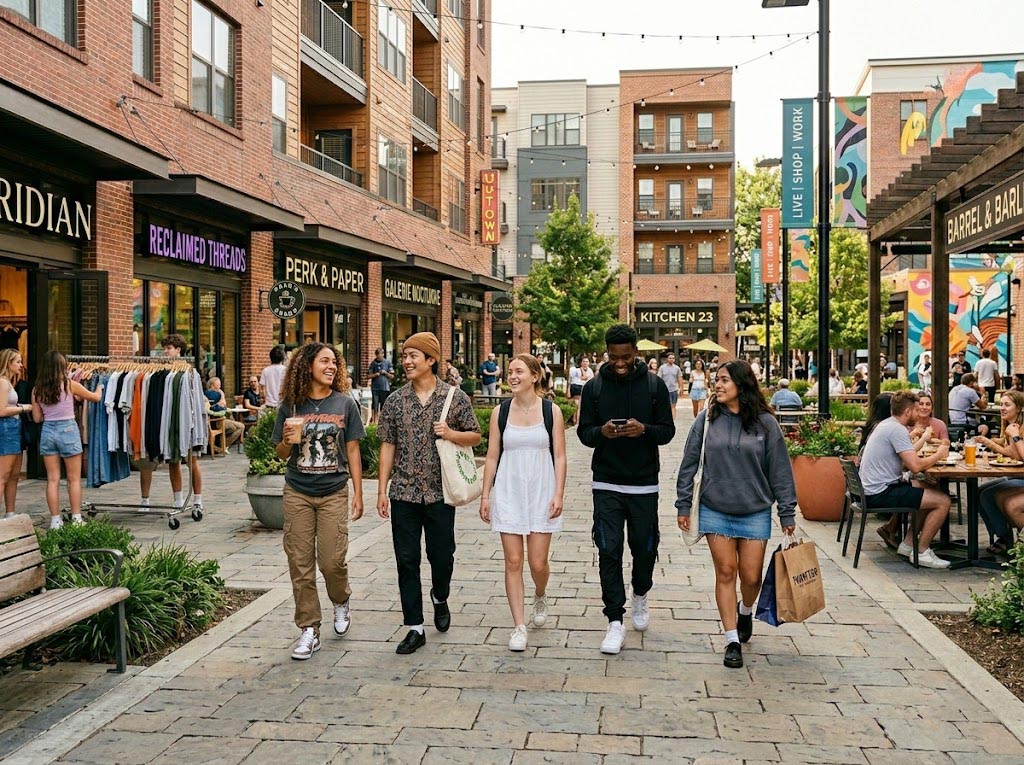
The traditional American mall, once a monolithic fortress of suburban commerce anchored by department store giants, is undergoing a radical transformation. As the industry moves further into 2026, the conversation among top retail executives has shifted away from the existential threat of e-commerce and toward a more sophisticated philosophy where retail serves as high-curation content.
“Coming to a property side, the first things I had to tell my board members is there was not a war to be waged between online and offline,” said Bruce Findlay, managing director of retail at LandSec. “Getting people to see that e-commerce wasn’t a threat, and, instead, was a way that retailers and great brands could connect to the market was essential.”
Findlay said guests visiting their shopping centers “are looking online before they come to make physical purchases. They’re dropping off packages they’ve received at home or in their office to click and collect and return. It’s about unified commerce.”
Listen to Bruce Findlay’s episode on Street Talk with Arthur Z
Ward Kampf, president of Northwood Retail, echoed this sentiment, noting that the physical layout of shopping centers must now reflect a digital-first reality. “Configuration’s becoming a really big deal. Just the configuration of the center — and there’s a lot of trends that go with that, whether it’s e-commerce, Uber, or driverless cars — it’s really starting to register. We look at legacy tenants and ask: can we bring our special sauce?”
Listen to Ward Kamp’s episode on Street Talk with Arthur Z
Why Did the Suburban Mall Model Stop Working?
For decades, the retail blueprint was simple: duplicate the same suburban mall every five miles. According to Kampf, this led to a “commoditized trap” that no longer resonates with modern shoppers who value their time above all else.
“I think today, time is the new currency,” Kampf said. “We built 1,200 to 1,400 malls and just kept going out, and we commoditized it. That’s not what shoppers are looking for today. They’re looking for newness. Your phones the first thing you look at in the morning and the last thing you look at at night. There’s a real shift and a real disruption that’s happened.”
Findlay agreed that the modern currency of a retail space isn’t just the square footage, but the people it attracts. “The footfall that the retailers and hospitality businesses are coming for is our currency. And even more than that, I’ve said eyeballs actually today are as important as footfall because we’re also looking at commercial income from media and commercialization activities.”
How are Developers Attracting Gen Z to Physical Retail?
To capture those “eyeballs,” developers are ditching the old anchor-heavy model in favor of a “full collection” of retail, often led by digitally native brands and lifestyle drivers. This is particularly true when courting Gen Z, a demographic that views the mall as a backdrop for social media storytelling.
“The young love to go there,” Kampf said, pointing to the success of TikTok-born brands. “I do think they make a day of it with their phones. They are very enamored with TikTok and Instagram. There’s this sticky part of newness. You look at some of these tenants — it’s insane the volumes, but they were born on TikTok. We put a lot of emphasis on founder businesses. Can you pick up the concept really quick? It’s not all about the rent. It’s about can you find the right tenancy, and the rest of the tenants will start to show up.”
Findlay said this shift requires a customer-centric approach where the end-user’s journey is mapped out across the day. “My guests on any given moment have different experience expectations. Their guest journeys will be different possibly even during the day — from ‘I’m in a hurry to grab my click and collect’ to ‘I’ve got all evening to wine and dine, watch a movie, and pick up something from the Apple store.’”
Which Markets are Leading the Retail Reinvention — and Why?
The geographic focus of retail investment is also shifting. Kampf highlights South Florida and Austin as major hubs where quality of life and massive wealth transfers are creating new retail anomalies. In Austin’s Domain Northside, Kampf’s team created a “city within a city,” managing a 20-hour-a-day cycle that includes office, residential, and hotel components alongside retail.
“The complexity of running a small city is super complicated,” Kampf said. “If people think it’s clean and it’s safe, they’ll live there, they’ll shop there, they’ll eat there. You’ve got to be able to layer the day. You want her there in the morning for coffee, someone there at lunch, and then there for dinner. You want the whole day experience.”
As for the future, both executives see technology continuing to disrupt the physical space in ways that were once science fiction. Kampf points to autonomous driving as the next major hurdle for developers to clear. “Something we’re tackling right now is autonomous driving down in Austin. It’s not just delivery — it’s people in Nordstrom bringing four or five bags out and just putting them in a driverless car because we have Waymo and Robo taxis. Those are things that are even catching us by surprise.”
How has the Retail Developer’s Role Changed in the Digital Era?
The role of the retail executive has evolved from a one-way relationship focused on collecting rent to a partnership centered on shared success and community impact. Findlay, who transitioned from the brand side (Gap, Levi’s, Tommy Hilfiger) to real estate, believes the industry has become more scientific.
“I started to see more and more about the science behind retail, everything from the shop construction to the science of fit,” Findlay said. “Retail became much more scientific thanks to technology and allocation systems.”
Kampf’s advice for the next generation of developers is to embrace this constant state of flux. “Everything that you thought you knew, something new comes up,” he said. “Be open-minded. You can be the smartest guy in the room, but there is real stuff starting to happen. Be thoughtful about what you’re going to leave to the community instead of just profit. You’ve got to be a giver and a taker. It can’t be all one way.”
Ultimately, for these leaders, retail remains a deeply personal “love affair” with the consumer. As Findlay puts it: “It’s a love affair with consumers and brands ultimately at the heart of it.” For Kampf, the responsibility is broader: “I think about how can we make the community better, deliver a great product, but also what role do we play in consumption and the macroeconomics of the U.S. economy.”
Street Talk is the weekly newsletter for retail and fashion executives who want analysis, not noise. New issues every Thursday. Subscribe today.