

Sustainability
September 29 2026

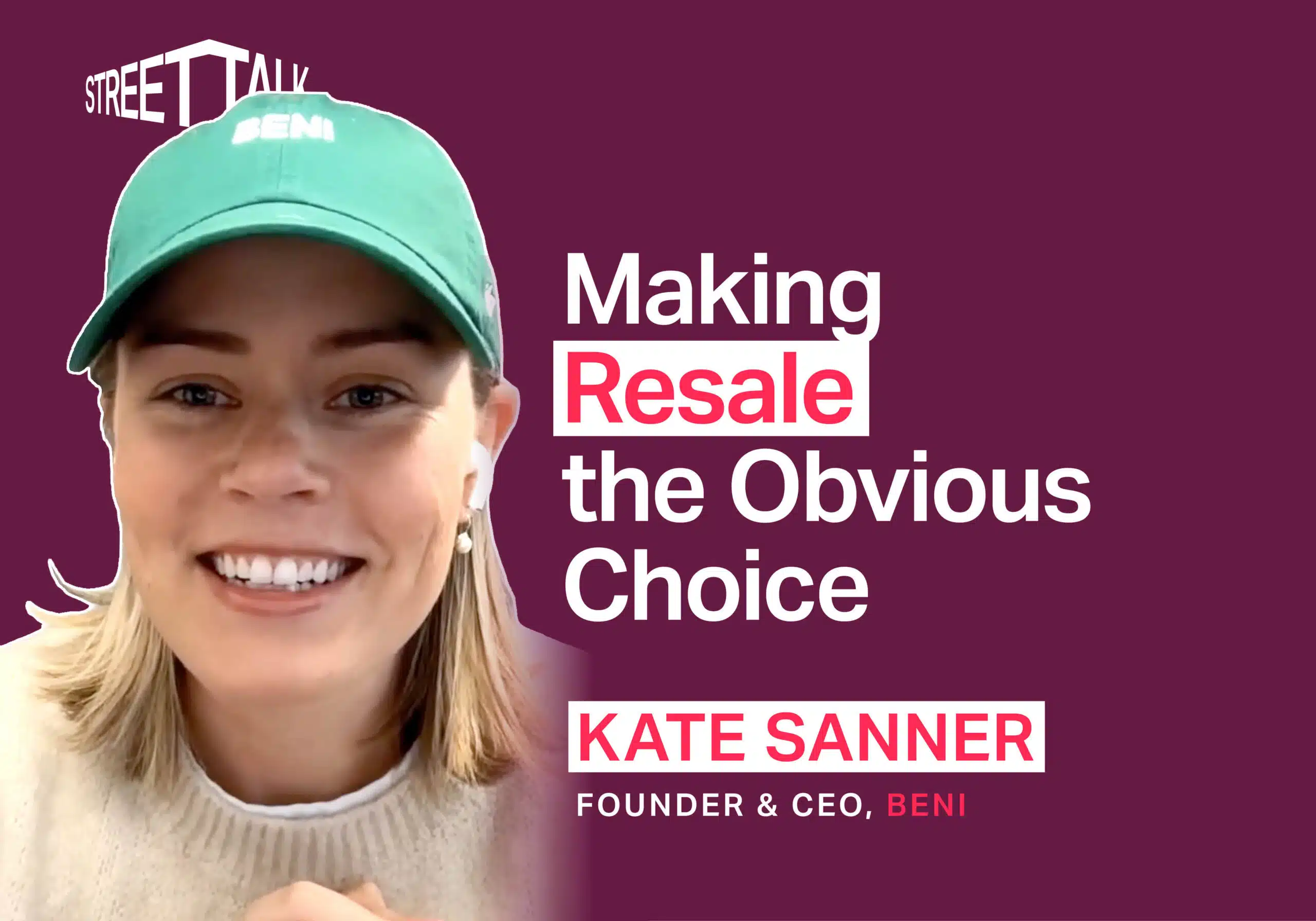
Beni founder and CEO Kate Sanner explains how an AI-powered browser extension surfaces secondhand alternatives at the exact moment shoppers are about to buy new, ingesting and normalizing over a million resale listings an hour across Poshmark, eBay, The RealReal, Depop and ThredUp. The approach reframes resale from a deliberate search into the default, higher-value choice. Resale has a discovery
Cass Spencer

Beni founder and CEO Kate Sanner explains how an AI-powered browser extension surfaces secondhand alternatives at the exact moment shoppers are about to buy new, ingesting and normalizing over a million resale listings an hour across Poshmark, eBay, The RealReal, Depop and ThredUp. The approach reframes resale from a deliberate search into the default, higher-value choice.
Resale has a discovery problem. There are hundreds of millions of pieces of inventory sitting on the secondary market — often better made, sometimes half the price — and almost none of it reaches you before the algorithm has already sold you something new. Beni exists to fix the timing.

How Does an AI Resale Browser Extension Work?
Kate Sanner, founder and CEO of Beni, built the company as a browser extension first: you’re shopping on Columbia’s site as normal, and before you check out, a small green button surfaces the identical jacket on Poshmark or eBay, often at half the price. No behavior change required — just a better option, inserted at the one moment that actually matters. Since Kellogg, and through more than one iteration to get here, Sanner has built what she calls an ingestion engine that normalizes over a million secondhand listings an hour across Poshmark, eBay, The RealReal, Depop and ThredUp — solving a problem that looks simple from the outside and is, by her own account, “the wild west” underneath: no SKUs, no consistent sizing, no two listings described the same way.
What You Want For Less
The timing is good for reasons beyond sustainability. As household budgets bifurcate and shoppers increasingly distrust anything that smells like paid influence, Sanner is betting that a platform built on “pull” — you tell it what you want, it goes and finds it — will outlast one built on “push.” It’s a quietly contrarian read on where AI-era retail is heading: less content generated to convince you, more infrastructure built to simply get you what you already wanted, for less.
On this episode, Sanner tells Arthur Zaczkiewicz how Beni holds a real-time catalog of 300 million listings, why she thinks the resale opportunity looks the same whether you shop Zara or Theory, and what she means when she says Beni wants to become your “home for style discovery.”
[00:01] Kate Sanner
Sorry — go for it, Arthur.
[00:01] Arthur Zaczkiewicz
Hello, I’m Arthur Zaczkiewicz, and welcome to Street Talk — where we hear from industry executives sharing insights into fashion, apparel, beauty, retail and technology. Today we welcome Kate Sanner, founder and CEO of Beni, an AI-powered search engine for secondhand. First off — how did you come up with the name? It’s a great one.
[00:29] Kate Sanner
Beni is inspired by the Latin root for “good” — we like to say we’re kind of your sidekick, helping you find the good stuff.
[00:34] Arthur Zaczkiewicz
I write about the resale market and circularity almost daily, and it’s grown remarkably just in the past few years — it seems to be inching up even further by the month. Going back to the start: what was the original idea, and what inspired you to launch as a browser extension? That’s a brilliant move.
[01:11] Kate Sanner
The idea really sparked from a mismatch between what we’re all seeking and what we’re being fed by the algorithm. What we’re seeking is high quality at affordable prices — unique finds. The reality is there are hundreds of millions of amazing pieces of inventory sitting on the secondary market. Yet when we go on Instagram, Pinterest or TikTok, what’s being fed to us is all new — and frankly, new from the top hundred brands who can afford to be there.
The browser extension was the natural place to start: instead of waiting for people to have the time and energy to go seeking out hundreds of millions of unique listings, what if we brought the world of resale to them while they shop? So as they’re shopping in their normal way — they click an Instagram ad, land on a site — in that moment, we pop up and say: before you pay full price, this exact item, or something very similar, is sitting on the secondary market, often better quality and almost always at a much better price.
That’s a big technological hurdle to overcome, but the behavior is simple — inserting resale into the moment you’re deciding where to spend your money was a natural place to start. As we’ve expanded, we’ve realized people also want to search directly, so we’ve since built an app and a website where you can upload an image or type something in, and we’ll help you source it across the world of resale.
[03:03] Arthur Zaczkiewicz
How does that work under the hood — how do you find that inventory?
[03:09] Kate Sanner
We have amazing partners — Poshmark, eBay, The RealReal, Depop, ThredUp, plus a long tail of vintage, consignment and smaller specialized secondhand marketplaces. We integrate directly with those partners to access their live product feeds, and on our end we’ve built an ingestion engine that can ingest, enrich and normalize a million listings every hour, so we hold a real-time catalog of all the available inventory.
That took time to build because the inventory moves so fast. People assume we’re just scraping the internet, but that doesn’t work for resale — millions of things are added and sold every week. Holding a real-time catalog is the unlock that makes search that much more powerful. There’s nothing worse than finally finding the thing you’re after and clicking through to find it’s gone. It still happens occasionally, but my goal is that it never happens to you — it really is like a dagger to the heart.
[04:29] Arthur Zaczkiewicz
So you have all these partners and all this inventory, but for the user it’s very simple — they don’t really see that process, right?
[04:38] Kate Sanner
Right, the goal is for it to feel completely seamless. With the browser extension, in particular — what’s your favorite brand, Arthur?
[04:49] Arthur Zaczkiewicz
Probably Keen shoes, or Columbia.
[04:54] Kate Sanner
Okay — imagine you’re on Columbia’s site and you find a jacket you like. With Beni, you click the little green button on the side, and it pops up: “You were looking at this Columbia jacket — the same jacket is listed on Poshmark or eBay for 50% off,” and in one click we route you to that listing. What we’ve found is that people who don’t normally think about secondhand land on that and decide whether to buy it — but they weren’t going to go check every site themselves for the different ways to get it. We do that work for them, and people say, “I was going to buy this at full price — it’s a no-brainer if the same thing is sitting on the secondary market.”
We started with a goal around sustainability, but I think the way to drive real behavior change — and a more sustainable fashion industry — is to make the sustainable option the obvious, higher-value one. When you put both choices side by side, choosing the secondhand Columbia coat becomes easy: you weren’t going to do all that legwork yourself, but since we’ve done it for you, you’re happy to make the purchase — and over time, that compounds in its impact.
[06:25] Arthur Zaczkiewicz
We had another guest on the show talking about the K-shaped economy — a bifurcation where a lot of households are strapped for cash and living paycheck to paycheck. [LIX partners — unconfirmed, verify against audio] just put out a report on people turning to off-price and resale as alternatives. Is that part of the equation — people coming to resale not because it’s more sustainable, but because times are tough?
[06:59] Kate Sanner
I think it happens at every price tier — everyone’s coming in at a different level. Sadly, the industry right now is in a race to the bottom: you see a piece of inspiration, and it’s easy to find a dupe, because Shein, Temu and Amazon rip those ideas and produce them at lower quality, flooding the market. You could continue that race to the bottom. But what we see across the board is that it doesn’t matter where you’re starting — resale is your tool to level up. For the same price, get something of better quality: rather than settling for Zara, get the Theory jacket at the Zara price. Wherever you are in the tier, the goal is the best value at the lowest price for you. Over time, that lets everyone level up across the board, and our hope is that demand for the dupes and the stuff at the bottom starts to go away, because you can find affordable things of better quality than what’s currently on offer.
[08:17] Arthur Zaczkiewicz
How would you describe the target customer for your platform?
[08:22] Kate Sanner
Resale is fun in that we have 300 million listings in our database — pretty much anyone can shop Beni: me, you, my mom, my grandma. But really, it’s the person who cares about what they put on their body — they care about style, but don’t have the time to go hunting. We’re saving people a lot of money, but the other thing we consistently hear from users is that we’re saving them a lot of time.
What you realize as you start shopping is that you pay for convenience, and new is very convenient right now. If you don’t have time to thrift, set alerts and track listings, you default to buying new because it’s easy — and you pay a premium for that. With Beni, we hope to make the secondhand experience as accessible as the new one. So really, anyone with taste who doesn’t have time to hunt for the deal is our target audience. Right now that tends to be women between 25 and 40 — young kids, budding careers, a lot on their plate. They care about how they show up in the world and want a great outfit, but don’t have endless hours to spend on the process.
[09:50] Arthur Zaczkiewicz
What was the biggest hurdle in aggregating inventory from multiple sources while keeping the experience seamless for the user?
[10:00] Kate Sanner
We would not exist without AI. We’re dealing with hundreds of millions of unstructured, messy data points, and in the last couple of years AI has let us normalize and enrich that information — to make sense of a listing that says “runs small, fits like a medium,” figure out it’s actually a Reformation dress in a size six or eight, and so on.
One of the perennial challenges with secondhand is that two people can list the same item with completely different descriptions and completely different photos. You need real technology to look at those listings and recognize they’re the same thing, so that when someone searches, both are surfaced as relevant results. It’s the wild west out there — no SKU numbers, no organization. That’s really where we’ve spent the most time from a tech perspective.
[11:14] Arthur Zaczkiewicz
When did you found the company?
[11:18] Kate Sanner
We’ve been around since 2021. We started out of business school at Kellogg, and it’s taken a lot of iterations to get here. It’s been a long journey.
[11:43] Arthur Zaczkiewicz
So it’s been a long journey since 2021 — what were some of the challenges? Were there any milestone moments you could share?
[11:59] Kate Sanner
No, this is good — my co-founder and I have had a whole lot of fun along the way.
[12:12] Arthur Zaczkiewicz
I’ll ask another way: what was the moment you knew it was working — that it had meaning and impact, and was going to make a difference in people’s lives? Because that’s what you’re doing — helping millions of people save money and do right by the climate.
[12:39] Kate Sanner
We all know what it feels like to wake up, put on a great outfit and feel like yourself. Everyone — whether they consider themselves stylish or not — knows that feeling of “okay, I’m ready to go.” But the reality is that a lot of people feel like shopping isn’t fun anymore. It feels like everyone is screaming at you all the time to buy this, buy that.
[13:08] Kate Sanner
Our goal with Beni is to support people rather than sell to them. The best way to do that is to say: I’m not in the business of telling you what your style should be — you get inspiration from everywhere, and you decide what you want. But once you have that nugget of inspiration, send it to us and we’ll help you execute. You get to do the fun part of shopping — imagining what you’ll wear, thinking about who you want to be, building your own taste. Let us be your execution arm for the mundane, monotonous work of checking every site.
That frees people up, and the industry will be a lot healthier if people spend more time thinking about what they actually want, and we find it for them — rather than being shouted at and impulse-buying things you don’t really want, then having to return them. We wreak a lot of havoc as an industry by selling so much through advertising. What Beni is flipping is that script: rather than making something and convincing you that you want it, we say, tell me what you want and I’ll go source it for you. That “pull” versus “push” is a much more powerful place to be — we get to play a supportive role rather than the salesperson. It creates a calmer, nicer environment.
[14:54] Arthur Zaczkiewicz
What you’re describing is empowering the consumer — putting the decision back in their hands, and taking off a lot of pressure. We’re bombarded with thousands of marketing messages a day, and you’re wiping that away, making shopping a pleasurable experience instead of a stressful one.
[15:19] Kate Sanner
That’s the hope. What’s really helpful about the secondhand market is that I’m just trying to help you find the thing you want and bring it to life in a way that makes sense for you. I think the influencer economy and creator economy have real benefits, but the reality is it’s people saying, “here’s my style, here’s the link to buy exactly what I bought.” What’s more interesting than how people shop now is: I don’t need to buy exactly what you bought — I got inspired by your style, or the vibe, or how you put things together — and I want to bring that to life at my budget, for my body, in the materials and cuts that make sense for me.
The business model supports the consumption and the linking, but what people actually want — and go to great lengths to do in their own way — is take that inspiration and make it make sense in their own context, with their own constraints. Resale is a wonderful place to do that, because you have all the options: you’re not constrained to what’s being sold new today, but to everything that’s been sold for the last fifty years. If it’s not on the secondhand market today, it likely will be within six months, because the inventory is always changing.
[17:02] Kate Sanner
I’m still thinking about a dress from three seasons ago that I meant to buy and didn’t, and I’m regretting it. That dress exists — someone bought it, and someone’s going to resell it. Let us get you the best possible thing you’re going to love and wear and enjoy, rather than funneling you more stuff.
[17:21] Arthur Zaczkiewicz
It’s funny you mention influencers — PacSun just held a summit talking to Gen Z and Gen Alpha, and they’re changing: they don’t like influencers, they don’t like AI, and they listen to family and friends instead, because it’s a more personalized experience and they trust family and friends more. I think resale plays right into that — you’re well positioned for this coming generation.
[17:54] Kate Sanner
It’s interesting — separate from Beni, just looking at the landscape — when everything is AI, you suddenly don’t know what to trust. So who I trust is: my sister buys a pair of pants and says she loves them, and I’ll buy those sight unseen, because I trust her and she gave me a direct recommendation. An influencer feels bought and paid for, and everyone has their guard up now because it doesn’t feel authentic.
I think that leads to a resurgence of in-person shopping, which I’m excited about — because when you can’t trust what’s happening online, you go to the store, feel it with your hands, try it on, talk to someone. You can’t fake that experience. It’ll be interesting to see that mix of digital and physical.
[18:53] Arthur Zaczkiewicz
Last question — how do you see the company and the platform evolving from here?
[18:59] Kate Sanner
We want to be your home for style discovery. Part of that means building a space where you save your inspiration, so we can learn about you — what you’re in the market for, what’s catching your eye, what you’re getting excited about — and curate a shop for you that feels like walking into a thrift store where everything’s in your size, curated to your style, organized by your needs.
If we can deliver that experience for secondhand inventory specifically, that becomes your favorite place to shop — everything curated for you, at the best possible prices, and more interesting than what’s being fed through the algorithms. Search is the base for that — you have to be able to search the catalog — but as we shift into discovery, there’s a lot of exciting things we’re working on that I can’t wait to roll out.
[20:04] Arthur Zaczkiewicz
We’ll have to have you back to tell us about those. Kate, thank you so much for taking the time today. And thanks for tuning in.
[20:07] Kate Sanner
Definitely — we’ll launch it here first.
[20:17] Kate Sanner
Thanks so much, this was fun.
Related episode: Ep. #027: ‘‘How to Solve a “Really Stupid Problem”’— Disney Petit, LiquiDonate
The Street Talk newsletter delivers the sharpest fashion, beauty, and retail analysis every Thursday — straight from Arthur Zaczkiewicz, former Executive Editor at WWD. Subscribe today.