

Podcast
August 11 2026

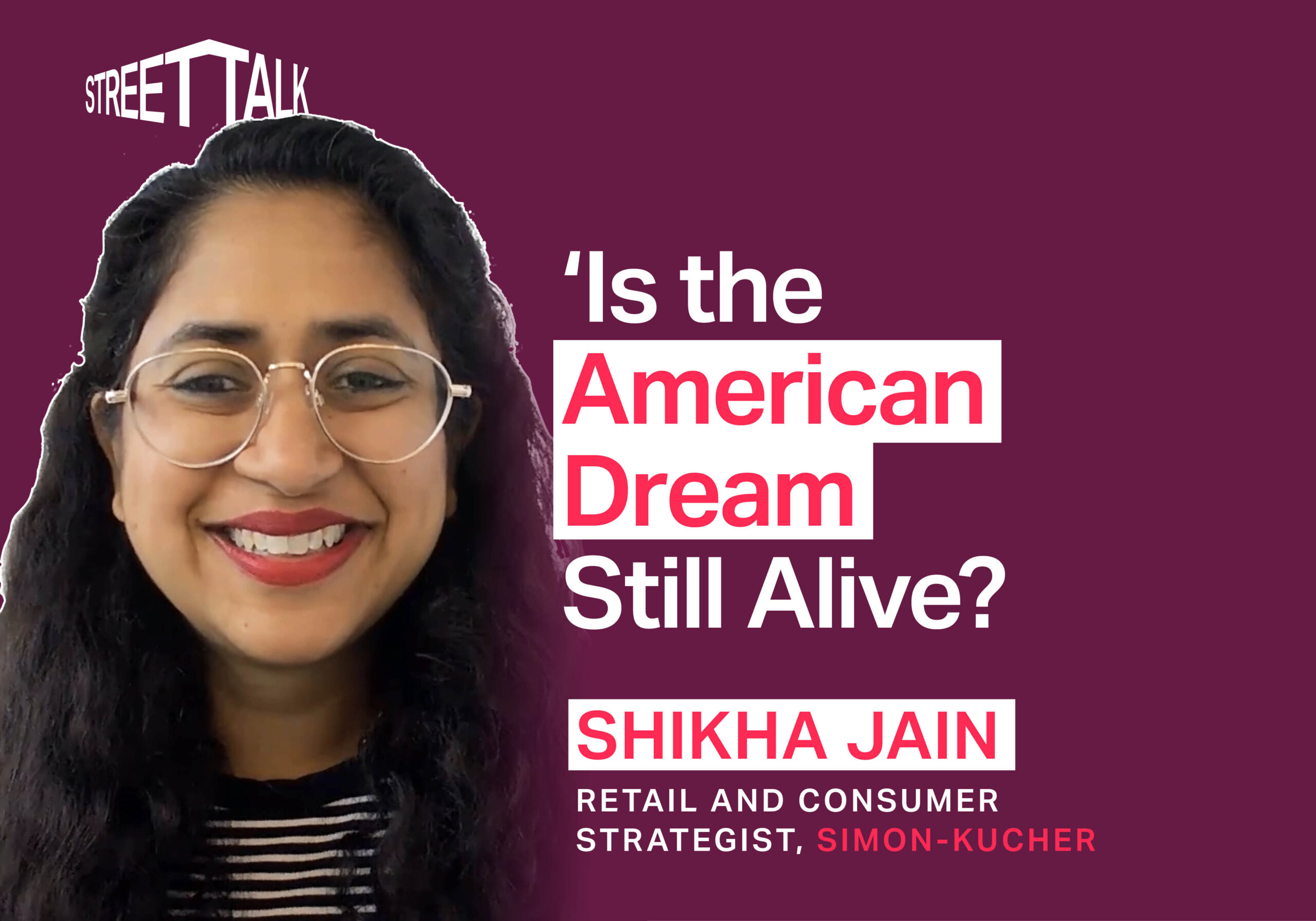
Simon-Kucher’s New American Dream Study — 5,000 respondents, surveyed in America’s 250th year — finds the dream is alive across every generation, but harder to reach than ever before. Shikha Jain, Lead Partner Consumer and Retail at Simon-Kucher, explains what high cost of living, debt-financed lifestyles, and shifting generational priorities mean for retail strategy in 2026. The American Dream has
Cass Spencer

Simon-Kucher’s New American Dream Study — 5,000 respondents, surveyed in America’s 250th year — finds the dream is alive across every generation, but harder to reach than ever before. Shikha Jain, Lead Partner Consumer and Retail at Simon-Kucher, explains what high cost of living, debt-financed lifestyles, and shifting generational priorities mean for retail strategy in 2026.
The American Dream has been declared dead so many times it’s practically its own media genre. What’s harder to argue with is a 5,000-person study commissioned in America’s 250th year that says it isn’t — not even close. Shikha Jain, Lead Partner for Consumer and Retail at Simon-Kucher, spent 2026 asking Americans what the dream actually means to them, how they expect to get there, and what’s standing in the way. The answers are more nuanced than the commentary suggests.
The American Consumer in Three Parts
The study surfaces three findings that should recalibrate how you think about the American consumer right now. First: the dream is alive across every cohort — Gen Z, millennials, Gen X, boomers — not in an aspirational marketing sense, but as something that genuinely guides life decisions. Second: every generation rates its own cohort as having the best shot at achieving it. That coexistence of optimism and economic anxiety is a signal about consumer confidence that tends to get buried in the doom data. Third: there is no single path — college, corporate ladder, entrepreneurship, vocational trade, none stood out. The consumer is writing their own roadmap, and that matters.
How is the Consumer Changing Their Behavior?
It matters for retail because it shapes the spending logic underneath everything else. With cost of living as the number one barrier across age groups, geographies, and income brackets, the consumer isn’t abandoning the dream — they’re financing it differently. Ninety percent say they’re changing their behavior because of inflation: hunting promotions, trading down where the brand premium doesn’t justify the gap, leaning into dupe culture and private label where quality is close enough. Arthur and Shikha work through what that means for promotional strategy, assortment, and the physical retail experience that still earns its square footage when it’s done right.
This is one of those episodes where the macro data connects directly to the store floor. If you’re making decisions about pricing, promotion, or where physical retail earns its keep, Shikha’s read on where the consumer’s head is right now is worth the listen.
▶ Read the transcript
Arthur Zaczkiewicz: Hello, hello. I’m Arthur Zaczkiewicz, and welcome to Street Talk. This is where we feature industry leaders and experts who share their knowledge and insights about retail, fashion, apparel, luxury goods, sustainability, and technology. Today we welcome Shikha Jain, who is the author of a new study called the New American Dream Study. You’re also lead partner for consumer and retail in North America at Simon-Kucher. Is that correct?
Shikha Jain: Almost all of it — I gave up head of the Boston office last year. But everything else is right.
Arthur Zaczkiewicz: Fair enough. Before we get into the study, could you describe your career path? How did you end up at Simon-Kucher?
Shikha Jain: My whole family is in the world of finance, so I thought that was the chosen path for me. After undergrad I worked in investment banking in New York City, right before the financial crisis. I had a couple of good years, then the crisis hit. I’d come into the office and entire floors were empty because people had been made redundant overnight. Business school was where I started to explore consulting. For me, the consumer side was always fascinating — I’m a consumer, you’re a consumer, everyone in the world is a consumer. The behavioral economics, the psychology of it, the fact that I can engage all my senses — that was what got me excited. Putting the problem-solving aspect of consulting together with the consumer world is how I ended up at Simon-Kucher. I’ve been with the firm for fourteen years now.
Shikha Jain: I continue to find ways to help clients with commercial strategy, using pricing as a profit lever, thinking through how retail businesses go to market with their assortment, how consumer businesses should approach segmentation — and with a lot of my clients right now, how AI is going to disrupt their businesses, in good ways and bad, and how they should respond.
Arthur Zaczkiewicz: Tell us about the New American Dream Study. What was the impetus behind it?
Shikha Jain: Late last year we were thinking about what to do in 2026 that is fresh and trend-based. Every year we pick a topic to understand consumer behavior — to get a real pulse on what Americans are thinking. Last year, with all the tariff announcements and back and forth, we surveyed consumers on whether they understood tariffs, how they expected them to impact inflation and the cost of goods, how that would affect their daily living. Then as we were planning for 2026, we started shaping around this idea that the American consumer has gone through so much in the last five, six years — COVID, stimulus checks, high inflation, supply chain shocks, debt as a way to finance lifestyle, geopolitical challenges, fuel crises, tariffs. There’s always something going on, but the last five years felt like a lot had changed. And when you look at different data sources, it’s hard to find something that pulls everything impacting the consumer into one report. You can get good insights on housing separately, or labor and the workforce, or the role of AI — but nothing was tying it all together. So we decided to do something around the New American Dream — how has it changed generation to generation, and how do young Americans today think about their future? We also realized along the way that America is turning 250 in 2026. What a perfect moment to ask: what does the American Dream mean now? Is it alive? Is it different? The survey gathered feedback from a representative sample of Americans by age, region, gender, and household income — five thousand respondents in total.
Arthur Zaczkiewicz: The old American Dream, as I understand it, really gained speed after World War Two. Veterans came back, there was an explosion of suburban housing, everyone had their own home, their own car. Is that roughly right?
Shikha Jain: Exactly right. When I think of the American Dream, I think of a suburban house, white picket fence, two kids, a dog, a backyard. That’s the image that comes to mind. People will have variations, but that’s how I’ve always viewed the traditional American Dream.
Arthur Zaczkiewicz: So what were some of the key findings from the study?
Shikha Jain: Let’s start with the American Dream itself. Everyone recognized it as something multi-layered — still something that anchors Americans. Owning a home, raising a family, achieving success through hard work, stable employment, financial stability, retiring comfortably, safety and security — those are the core things that matter. Then there’s a longer tail: access to quality education, personal freedom and independence, equal opportunity, symbols of success through material possessions, being better off than one’s parents, strong community, entrepreneurship. The American Dream isn’t just a few things — there are things that are definitely core, and then a long tail of other things people care about.
Arthur Zaczkiewicz: You looked at different generational cohorts in the report. What did that show? Is it because each generation has its own set of values?
Shikha Jain: When you ask people about the traditional American Dream, it’s what I just described. But when you ask what the American Dream means specifically to them, it gets a lot more curated, a lot more specific. Financial stability, retiring comfortably, personal independence and freedom — those have risen to the top. But different generations place different importance on different aspects. Baby boomers, who are at or near retirement age, want stability to retire comfortably. Younger Americans — millennials and Gen Z — care a lot more about stable and long-term employment, safety and security, personal independence and freedom. There is generational shift, but the core foundations — those top five priorities — continue to be important no matter who you speak to.
Arthur Zaczkiewicz: Were there any results that surprised you? Any standout findings?
Shikha Jain: Three things really stood out. Number one: the American Dream is still very much alive. No matter what generation you are, you associate with it — either strongly or somewhat — and it guides life decisions. We tend to assume younger generations are more jaded, that they’re struggling with so many headwinds. But the optimism is still there. It’s in our cultural DNA.
Shikha Jain: The second thing: everyone gave their own generation the best chance at achieving the American Dream. We asked which generation has the strongest shot — and baby boomers said baby boomers, Gen X said Gen X, millennials said millennials, Gen Z said Gen Z. That was fascinating. It’s in our DNA to believe that if we do the right things, work hard, and pull ourselves up, we can get there.
Shikha Jain: The third finding: there is no single pathway to achieving the American Dream. A four-year college degree, a master’s degree, a vocational career, technology, climbing the corporate ladder, entrepreneurship, public service — not a single one stood out as the clear route. Everyone says there isn’t a clear path. And I find that fascinating too.
Arthur Zaczkiewicz: What are the challenges in achieving the American Dream today versus twenty or thirty years ago?
Shikha Jain: High cost of living is number one — that’s universal. Older generations say it is much harder today to achieve the American Dream than it used to be because of this. Insufficient income or savings, job insecurity, uncertainty about the future — those are the other main barriers. And there are pockets of Americans that struggle more than their peers: people living in remote or small towns, first-generation immigrants to the country, those with less education. They feel the headwinds a lot more than those in more urban areas with a long heritage in the US and advanced degrees.
Shikha Jain: So how do people still feel like they’re achieving the dream? One way is by prioritizing today and trading off the future — the buy-now, live-now, worry-later mentality. A lot of young people continue to take on debt or live beyond their means because it finances the lifestyle and the goals they have for today. That’s something I do worry about — what happens to future generations if they don’t build retirement savings.
Arthur Zaczkiewicz: Let’s change subjects. What are you seeing in retail and consumer goods right now? What trends should we be paying attention to?
Shikha Jain: Inflation is still the dominant force. When the cost of daily living keeps going up, that changes consumer behavior. Ninety percent of Americans say they’re going to do something different because of high inflation — waiting for sales or discounts, looking for cheaper alternatives. You see this clearly in dupe culture and the rise of less expensive similar products, where you still get that dopamine hit from retail therapy but it doesn’t break the bank. People are also looking at promotions as a way to stock up. For retailers, it’s critical to have a solid promotional playbook. But promotions are only effective if they’re marketed properly and if they’re both top-line and bottom-line accretive or incremental. Running the same playbook from past years isn’t right — you have to think about what objective you’re trying to drive and what’s the best event to accomplish that.
Arthur Zaczkiewicz: You mentioned something interesting — what about private label? If I’m a retailer, should I be leaning into that?
Shikha Jain: Many already are — leaning into private brands or store brands as a way to offer less expensive alternatives to national goods. Those assortments are getting bigger. A lot of consumers aren’t seeing the differences as much, or they’re thinking: there are some things I just have to have. Nutella has to be Nutella. But for a lot of other products, I’m indifferent. Thinking about where to protect the branded products that really matter to consumers, and where you can increase shelf space for private label — which for many retailers is also better for margins — that’s the strategic question right now.
Arthur Zaczkiewicz: Final question: what’s driving physical retail? It seems like consumers are going back — especially Gen Z. Why is physical retail still important?
Shikha Jain: Physical retail is always going to be important for many categories. A lot of times, physical retail acts as a showroom — if you need to touch, feel, or try a product before you buy it. Many retailers are also getting much better at creating store experiences that are exciting and fresh and make people want to come in. It’s no longer just about in-and-out or getting a specific item quickly — e-commerce wins on convenience. But retailers that are succeeding today are leaning into how their planograms are set up, the experiences in the store, how people get comfortable enough to buy more than they originally planned through impulse purchases. That physical aspect is always going to matter, no matter how good augmented reality gets. You’re still going to want your senses to tell you whether a product is right for you.
Arthur Zaczkiewicz: We’re out of time. Thank you so much, Shikha. We’ll have to have you back before the holidays to talk about this year’s holiday shopping season. Thanks for tuning in.
Shikha Jain: Thanks for having me, Arthur. Really had a great time.
Related Article: Is the American Dream Still Mathematically Possible?
Related Episode: Ep. #027: ‘How to Solve a “Really Stupid Problem”‘ — Disney Petit, LiquiDonate
The Street Talk newsletter delivers the sharpest fashion, beauty, and retail analysis every Thursday — straight from Arthur Zaczkiewicz, former Executive Editor at WWD. Subscribe today.