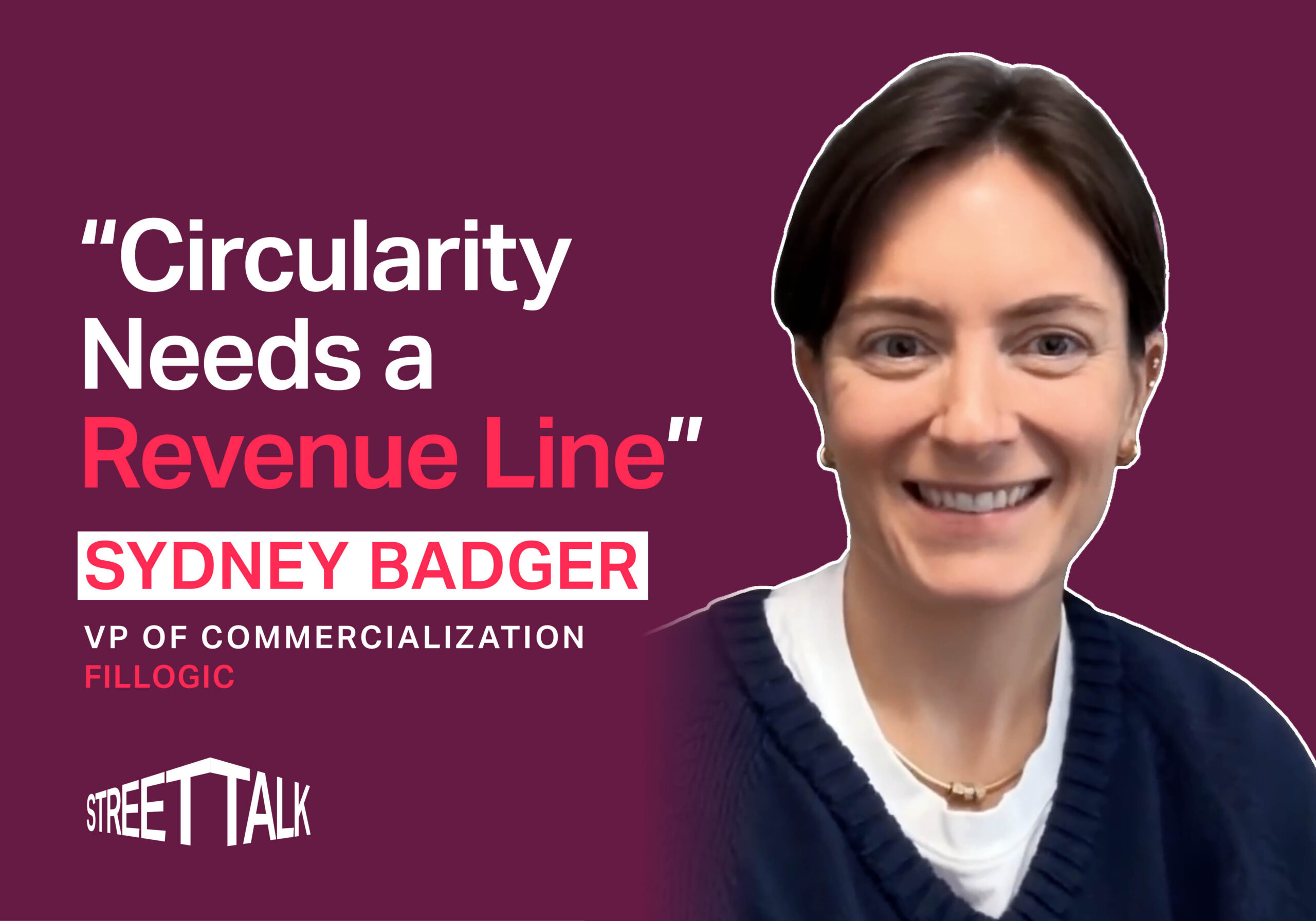
Circularity has been on the horizon for as long as anyone in fashion can remember. Every year brings more data, more programs, more panels. And every year, as Sydney Badger puts it, brands ask the same thing of all of it: where’s the revenue line?
Badger would know. Twenty years in fashion, from buying at Ralph Lauren and American Eagle to Amazon’s fashion team in the early 2010s, then a made-to-order knitwear brand built on on-demand supply chains. She’s now VP of commercialization and circular strategy at Fillogic, the New York reverse logistics company that processes returns and resale inventory from hubs co-located with shopping centers. Her read of the problem is practical: the industry is drowning in supply, yet nobody can find and identify the good stuff fast enough to make touching it worthwhile.
Sitting down with Arthur Zaczkiewicz, just after Climate Week in New York, she takes on the parts that rarely make the panel. Who sorts a $6 dress? What happens now that exporting textile waste is no longer the easy answer? How is AI starting to identify items with no tag and 20 washes behind them? Arthur floats a utopian thought experiment (shut the factories for two months and let scarcity do the work), and she answers the bigger question underneath it: can fashion ever be circular inside a model that rewards newness and growth at all costs?
They finish on the K-shaped consumer and the off-price squeeze, and why secondhand has a branding advantage that off-price has never had. It’s a short listen with a long to-do list for anyone who owns a returns P&L. Press play.
and our lives with things that we never actually needed.
Arthur Zaczkiewicz [00:00]
Hello and welcome to Street Talk. I’m Arthur Zaczkiewicz, and this is where we garner insights from leading executives in fashion, apparel, retail, beauty, technology, and sustainability. And speaking of sustainability, today we welcome Sydney Badger, VP of commercialization and circular strategy at Fillogic. Sydney, welcome. Great to have you here.
Sydney Badger [00:38]
Thanks, great to be here.
Arthur Zaczkiewicz [00:40]
So before we start, tell us about the company. Tell us what you guys do.
Sydney Badger [00:47]
Sure, absolutely, and my fairly weird title. Fillogic is a reverse logistics infrastructure and technology company out of New York. A lot of our founding team came from the off-price retail sector over the past 30 to 40 years, so there’ll be a whole other conversation about what they’ve seen in the last several decades. Effectively, it was born out of this opportunity to leverage underutilized spaces in retail malls throughout the country for reverse logistics operations. So we handle returns processing, refulfillment, and recommerce enablement, mostly for apparel, footwear, and fashion brands and retailers. One of the insights that came out of it was that the traditional infrastructure for logistics is what hurts inventory, especially in reverse flows. The traditional logistics infrastructure really undervalues and ignores returns in the traditional flow. Everyone in every warehouse has a pile of stuff sitting at the back of it. You ask what that is, those are returns. So the opportunity was to shorten those distances by being closer to more densely populated consumer centers, closer to the retail. We’ve really been able to cut down on those return-to-stock lead times, as well as some of the damage that just happens as a result of the logistics network. So we built this reverse logistics infrastructure on top of real estate inside of where we wanted to be. We operate about six hubs today, mostly on the East Coast of the US, handling brands at scale as well as growing brands in the apparel space for returns processing and recommerce enablement.
Arthur Zaczkiewicz [02:46]
Yeah, I think I read on your LinkedIn you also founded your own company. Tell us about that.
Sydney Badger [02:51]
I sure did. I’ve had a really fun and weird journey to Fillogic. I’m 20 years into the fashion industry. I started my career as a buyer at Ralph Lauren, like so many others. And honestly, my story is so silly because I didn’t know what I wanted to do. I had an interesting college career where I’d studied Chinese and lived in Asia my junior year, and then I moved to Shanghai straight after I graduated. My very first job was actually in research and consumer insights for CPG brands that were trying to go into the Asian marketplace. So I spent a lot of time trying to understand different parts of the Chinese consumer base across different tiered cities. When I moved back to the States, I was one of the few Western-educated people who had really interesting firsthand insights into what was happening in Asia in the late 2000s. Ralph Lauren had just bought their license back for Asia Pacific, and the timing was right. I said, Ralph Lauren, I know this brand, this is cool. And I fell in love with the function: merchandising, the creative, the analytical. It was a really good fit. I went from there, spent some time at American Eagle, and then I moved out to Amazon, which was at the other end of the spectrum of fast-growing retailers in the early 2010s. I joined the Amazon fashion team as they were really trying to build out what it was going to be, and really enjoyed my time there. It’s not for every fashion buyer, but it was for me. It was an amazing opportunity for P&L ownership and exposure to how marketplace models work, how wholesale works, but also the emergence of third-party selling online. And at some point I got kind of fed up and tired of being part of that machine. I felt like I could have been operating in screws and nails or shoes and dress shirts. It really didn’t matter. It was just numbers on a page. I felt really removed from product. I missed that. So I took a bit of a leap. This is 2018. I moved back to China and started what became Public Habit, my first business. Public Habit was a knitwear brand that was all founded on the premise of on-demand supply chains. The future of the industry, you need more demand-driven production to shorten lead times, and also really minimize overproduction. My very naive experience of trying to understand the beginning of the supply chain, when I went back out to Asia in the late 2010s, was, I just want to make a hundred T-shirts and see if I can sell them. And you start meeting with factories, you start understanding MOQs, the cash-flow model of how the industry works, and then you start seeing all the buildup of excess in the system. You start seeing the extra rolls of fabric. You start seeing the canceled orders. You start seeing the gray markets of product that exist all around Asia, just trying to absorb all this excess everywhere. And you can’t look away. Once you start really seeing it and you start looking under the hood, you just recognize this industry needs some massive overhauls of thinking how we operate to minimize impact. And it’s just so unregulated compared to any other industry. So I became really passionate about the impact of the industry. I built this business to try and prove that on-demand, made-to-order models could, financially, sustain your business when you’re small, because you effectively always have cash flow positive: you receive your order before you make it. And I was thinking that, fast-forward 10, 15 years, the whole industry would be operating on demand. That hasn’t quite panned out. But what’s been interesting about what I’ve witnessed in the last 10 years, with the rise of Shein and ultra-fast fashion, is that this model is winning for the players that can deliver it both technologically and with the infrastructure that companies like Shein have. But it’s not solving the problem of overproduction and impact and waste reduction and water issues within the industry. I’ve continued to be curious about where I want to help. Around post-pandemic, I became really interested in these new circular business models that were emerging and really taking hold, and marketplaces like eBay getting a second wind and becoming the place to be, and recognizing that there was a customer who was really adopting secondhand as primary. I was really excited about that. Resale has become a really viable business, where a lot of the other sustainability topics, whether it’s textile recycling or on-demand production, have been much harder to gain traction at scale. So I followed, I guess, the money. I saw that there was real business behind the circularity models within fashion, but that the infrastructure required to make it work, the actual receiving, sorting, grading, moving, was really overlooked and often the bottleneck in how we route inventory effectively post-sale. And that’s where Fillogic came in. It was a super interesting start-up with a pretty wacky team that I love, that was just doing the work. They’re physically touching the inventory, they’re grading it, and they’ve built their own tech on top of this to effectively route inventory more efficiently to the next best use.
Arthur Zaczkiewicz [09:35]
I think we have a mutual friend, Eddie Hertzman. Years ago he said the problem with the industry is that everybody’s solely focused on their lane and they don’t see the other lanes. But it sounds like you’ve stepped into each of those different lanes. Of course it’s a value chain, so kudos for doing that. And I guess, what happens next? I’ll give you an example. Just so people listening know, we’re post Climate Week here in New York while we’re recording this, and I often think this time of year that circularity is always on the horizon, but we never quite get there. And then we get to the horizon, and there’s always another horizon down the road, and it’s challenging. What are the challenges in circularity? People have been talking about it for a while, but what is it going to take to really move the needle?
Sydney Badger [10:41]
So first, aligning on a definition of what circularity means for this industry. If you’re a bit of a purist, and I have my master’s in sustainability and my professor of circularity would have a very strict lens of what it means for this to be truly circular, it’s moving away from a take-make-waste model to something where your inputs stay in use as long as possible, and your inputs become your inputs back at the beginning of the cycle again. Meaning that you are maintaining everything at its highest value, you are reusing, you are refurbishing, you are remanufacturing, and nothing becomes waste. That is really hard for this industry to execute and practice, because the second that first order has gone out, it’s kind of like a car loses 50% of its value once it goes off the lot. It is the same issue, and it is really hard for us to assess the value of the vast majority of fashion merchandise at scale. I think that’s changing really quickly, but what I mean by that is we start bouncing this product around over and over again into these secondary markets and tertiary markets, and it becomes worthless very, very quickly. So the idea of… Yeah, go ahead.
Arthur Zaczkiewicz [12:10]
No, I just thought of something I haven’t thought about in a while. What about scarcity? I have this wacky idea, and it’s very utopian. What if all the factories shut down for, like, two months? Or rotated. So you have a bunch of factories, [unclear] they shut down, and then you let that product cycle through all those different places that you just mentioned. There’s going to be a scarcity of product, so wouldn’t the value go up?
Sydney Badger [12:40]
I think you’re tapping into something that’s underlying the crux of this industry, which is: can fashion ever be truly circular and truly sustainable within a capitalist model where we reward newness and growth at all costs? Degrowth is a very scary word for the industry. But the concept of production caps, or taxes on material usage, some of what France has brought in with its anti-fast-fashion [legislation], or [unclear], there is the emergence of what would actually start to shift the level of the floor of the industry. But there are issues with all of the proposed legislation. There is no silver bullet here. Just to answer that previous question about why circularity is so hard to scale, I think the primary bottleneck is really the sorting infrastructure for post-consumer waste. Who’s going to do it? Who’s going to sort for effective reuse streams to maintain everything at its highest value? How is there enough value in a $6 dress to be able to do that? Historically we were able to just export that waste back to China or somewhere else. The burden is now domestic to actually solve some of these problems, and these EPR mechanisms will require that we think through a lot of this and build the markets for it. But my takeaway from last week is still, from a brand lens, unless it comes with a revenue line, it’s not interesting and it’s not a priority.
Arthur Zaczkiewicz [14:54]
What other lessons or key takeaways from Climate Week? Was there something where you said, this is interesting, or I haven’t thought about that?
Sydney Badger [15:04]
Yeah. My week this past week was very focused on the circular economy space, as opposed to more broadly on materials and carbon impact or social impact within the industry. So I had a very narrow lens, to a degree. On the positive side, there was so much more data to point to from these different circular business models, especially the advent of resale businesses, whether it’s marketplace-driven or a brand doing their own branded program of vintage wear, or the upcycling programs that brands have been launching. There’s so much more to point to and to measure, and adoption across the board that brands have made even just in the last year. The interesting part, then, the tension I still see in circularity, is that everyone’s looking for quality supply. What is quality supply to one person versus another? But whether you’re a reseller, a brand who wants to run a take-back scheme, a resale platform that wants access to quality, or a Fillogic that wants access to quality supply that has enough value to warrant touching and photographing and grading and repackaging and relabeling and shipping, and yet we know that we are all drowning in supply, more broadly. So there’s this very weird tension: the stuff is all there. And I think it’s both an unstructured data problem, in that we don’t know what’s out there and we don’t know how to find it and identify it really quickly at scale to be able to say, okay, this is worth X, Y, Z. And we’re not really connecting still with the decision makers who are still operating in the business as usual. It’s the same people talking to the same people.
Arthur Zaczkiewicz [17:17]
Same people, yeah. A change of mindset is going to be needed. But what about AI? Can AI technology help in this area?
Sydney Badger [17:26]
For sure. Some of the exciting stuff we’re working on is absolutely in that identification step. One of the biggest gaps for warehouses, for 3PLs, for logistics providers, for sorters dealing with end-of-life merchandise is: what is this thing? How do I attach a value, an item ID, to this thing when it doesn’t have a tag or a UPC code or anything, and it’s been through the wash 20 times? We are starting to build some logic that will allow us to use photo and image generation, plus mapping of the e-commerce landscape, to actually identify what stuff is and what the value of it is across different channels, so that we can much more quickly decide: touch it, don’t touch it, this has value in XYZ channel or not. That would bring a significant amount more value to these brands than they’re getting today, when currently the solution is, let’s just donate it, let’s just get rid of it, we just need to move it. So that part’s exciting, solving some of those data gaps. I think there’s a lot happening in AI sortation and how it’s being applied to sortation hardware out there that we’re not really looking at at Fillogic at scale. But I think the Goodwills and the WMs are looking at it, whether that’s companies like Sortile and Refiberd that are doing some really interesting work to help with true post-consumer textile sortation. So how do we sort for high poly-cotton content so that it can go to this kind of recycler versus that kind of recycler? And that’s all being sped up exponentially in the past year in terms of their capabilities. Those are the two big ones I see right now.
Arthur Zaczkiewicz [19:33]
We just have a few minutes left, but since you mentioned off-price, I was just reading AlixPartners’ report on the holiday and consumers. You’ve probably heard about the K-shaped economy. There’s a certain percentage of high-end consumers who are doing well and are going to continue to buy, but the middle and lower are becoming strapped, they’re overburdened with debt, and they’re becoming more value-focused. So from AlixPartners’ perspective, off-price, resale, and consignment are going to be key areas of demand and growth because of the value-minded consumer. But I have a friend who’s a retail advisor, Antony Karabus. He says off-price is going to have to change some things in the future, because where they got their inventory, like from department stores, there were fewer department stores closing. And companies and department stores like Macy’s just announced that they’re going to use AI to better manage their inventory. So you have technology that’s going to have better inventory management. It’s going to be less inventory for the off-price sector. So it’s an exciting time to be in off-price, but I think there’s a kind of concern there. What do you have to say?
Sydney Badger [20:44]
Where does that go? That’s really interesting. As an anecdote in that space, I think one of the reasons you’re seeing players like Fillogic, where the founding team has history in off-price, or the CEO of Trove, who came from off-price, is that there are a lot of similarities between the recommerce market and off-price. There are swaths of unknown inventory from a quality and categorization standpoint. You have to build a lot of data clarity very quickly and at scale, and you’ve got to figure out a market value for it quickly to move it. It’s all about turn. So I think there’s a branding issue, maybe, for off-price that recommerce has been able to pick up on: it’s very sexy to buy secondhand, it’s less sexy to buy off-price. So I think they’re both probably going to live on in their own way and form, but there’s a value equation, and more of a premium being placed on secondhand and how that’s been labeled, versus where off-price has been historically.
Arthur Zaczkiewicz [22:07]
We’re out of time. Sydney, thank you so much. That was a great conversation. [Unclear] happy to come back? ‘Cause there’s more to talk about, right?
Sydney Badger [22:13]
I’d love to. Yeah, no, there’s a lot more to talk about. I appreciate the time. Anytime.
Arthur Zaczkiewicz [22:19]
And thanks for tuning in. We’ll see you next time. Thank you.