

Analysis
August 11 2026
Retail store technology losses are rising because retailers are sequencing investments backward — funding downstream tools like pricing software (43% of retailers) ahead of foundational shelf digitization (33%). Retailers in scaled deployment now lose 7.6% of gross sales to store execution failures, more than pilot-stage retailers at 5.6%, because algorithms built on incomplete shelf data compound rather than resolve operational
Corner of Fifth

Retail store technology losses are rising because retailers are sequencing investments backward — funding downstream tools like pricing software (43% of retailers) ahead of foundational shelf digitization (33%). Retailers in scaled deployment now lose 7.6% of gross sales to store execution failures, more than pilot-stage retailers at 5.6%, because algorithms built on incomplete shelf data compound rather than resolve operational errors.
According to an industry analysis by Coresight Research, in partnership with Simbe and RELEX, retail executives are accelerating investments in store intelligence technologies faster than ever before.
But despite moving decisively beyond pilot testing into scaled deployment, physical store operations remain burdened by compounding operational friction and surging mispricing errors as well as expanding top-line revenue losses, according to the authors of the report.
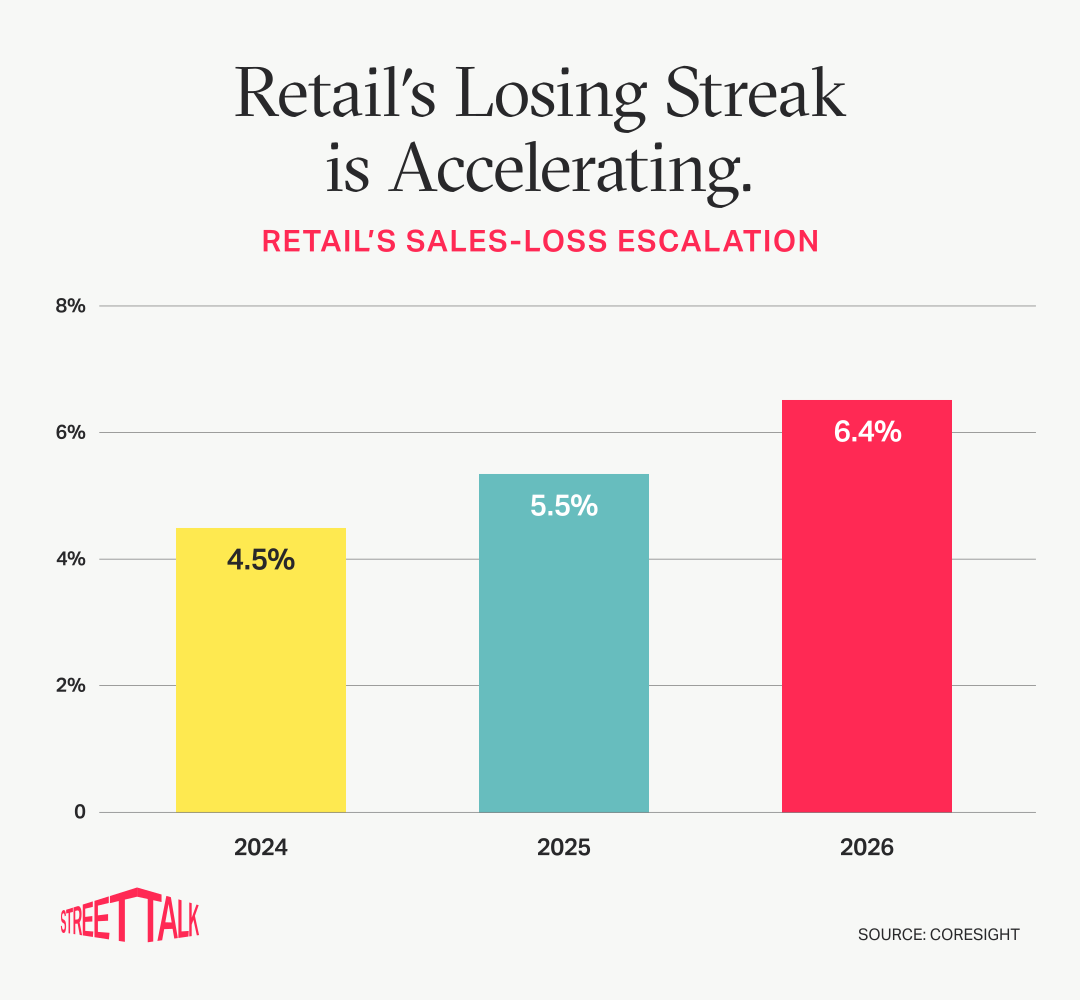
The research reveals that managing physical store operations remains a persistent hurdle, with 90 percent of surveyed retail decision-makers reporting operational challenges in 2026, which is up from 88 percent in 2025. More critically, the financial toll of these store inefficiencies has escalated dramatically. Retailers now report losing an average of 6.4 percent of their gross sales to store-level execution failures, which is a notable surge from 5.5 percent in 2025 and 4.5 percent in 2024.
Across the home improvement, drugstore, grocery, mass merchandise and warehouse club sectors, which are estimated to generate a cumulative $3.07 trillion in total sales in 2026, this operational leak represents a massive $196.4 billion financial opportunity.
While total revenues across these core retail sectors are projected to grow three percent year over year (from $2.96 trillion in 2025 to $3.07 trillion in 2026), sales lost directly to store inefficiencies are estimated to surge by 21 percent over the same period (from $162.7 billion to $196.4 billion). This disproportionate jump underscores how operational friction compounds over time when left unaddressed.
Profitability is taking a severe hit as well: an overwhelming 89 percent of U.S. retailers report losing at least five percent of their operating margins to store inefficiencies, up from 81 percent in 2025 and 75 percent in 2024.
The root cause of this expanding financial leak lies not in a lack of technology spending, but in a widespread failure of technology sequencing. Rather than building capability from the ground up starting at the physical shelf, many retailers are attempting to deploy downstream execution software on top of un-digitized store foundations.
How Far Has Retail Store Tech Adoption Scaled in 2026?
The retail industry has crossed a critical threshold in its technology adoption lifecycle. The era of isolated trial runs and cautious pilot programs has largely given way to scaled deployment. Based on a survey of 200 senior retail decision-makers at organizations generating at least $100 million in annual revenue, 60 percent of retailers report that their store intelligence solutions are either actively scaling or fully scaled across their networks. This marks an 18-percentage point increase compared to the previous year.
Physical stores remain the core economic foundation of the retail industry, accounting for an estimated 75.9 percent of total retail sales in 2026. As cross-channel boundaries blur, retail leaders increasingly recognize that real-time visibility at the shelf yields broad benefits across demand forecasting, supply chain execution, omnichannel fulfillment and retail media networks.
Reflecting this expansion, the global store intelligence technologies market, which covers inventory management, demand forecasting, merchandising and pricing optimization solutions, is projected to reach $9.3 billion in 2026 and expand to $12.6 billion by 2029, representing an 11 percent compound annual growth rate.
However, technology maturity remains tightly tied to organizational size. The survey demonstrates a direct link between company revenue and technology implementation maturity.
Seventy-three percent of large retailers generating over $5 billion in annual sales report having scaled or fully scaled store intelligence architectures. In contrast, 58 percent of mid-sized retailers generating between $1 billion and $5 billion and only 42 percent of smaller retailers generating under $1 billion, have reached similar scaling stages.
This widening digital divide leaves smaller and mid-sized merchants under severe pressure to accelerate their deployments to maintain long-term competitiveness.
Why Does More Store Tech Investment Lead to Higher Losses?
The report’s most unexpected revelation is a striking structural contradiction: higher technology adoption has not immediately yielded lower operational losses. Retailers categorized as scaling or fully scaled reported losing 7.6 percent of their gross sales to store inefficiencies, compared to 5.6 percent for retailers in the earlier pilot or implementation stages.
This counterintuitive trend stems from increased operational complexity, delayed realization of benefits, and misallocated investment sequencing. Store intelligence tools form an interconnected ecosystem that depends on a logical progression. Modern store execution relies on a chronological roadmap that begins with sensing the physical shelf through shelf digitization tools, analyzing data via analytics solutions, tracking stock through automated inventory software, planning assortment and allocation, executing pricing via dynamic software and collaborating with vendors through shared platforms. Real-time shelf visibility serves as the essential baseline powering all downstream business functions.
In practice, however, retailers are prioritizing immediate symptoms over foundational infrastructure.
Survey data shows that pricing and promotion execution has become the most challenging domain, with 92 percent of retailers citing it as a persistent hurdle and average mispricing rates rising to 13 percent, up from 10 percent in 2025 and 9 percent in 2024. In response, 43 percent of retailers are currently investing in pricing software, making it their highest investment priority.
Conversely, foundational shelf digitization ranks lowest in active merchant investment, with only 33 percent of retailers currently deploying it. This trails current investment levels in inventory management software at 41 percent, assortment planning tools at 38 percent, supplier collaboration tools at 36 percent, and data analytics solutions at 34 percent.
Attempting to automate pricing or inventory allocation without real-time, vision-driven shelf visibility creates an unstable setup, as downstream algorithms inevitably falter when fed incomplete or inaccurate shelf data.
What Results Are Retailers Seeing When Store Tech Is Sequenced Correctly?
Where store intelligence technologies are implemented effectively and holistically, retailers are securing substantial operational improvements and customer growth.
Asked about primary investment objectives, 34 percent of retail decision-makers highlighted improving operational efficiency through better store execution, while 26 percent cited unifying store data to improve business outcomes, and 25 percent cited driving top-line growth.
In addition, 40 percent of respondents reported investing to resolve three or more store inefficiencies simultaneously. When evaluating investment drivers, 42 percent cited increasing total revenue, 40 percent pointed to enabling new revenue streams such as retail media and 35 percent focused on cost reduction.
Leading national retailers illustrate the operational gains achievable through structured improvement programs. Home improvement giant Lowe’s incorporated store intelligence into its multiyear “Perpetual Productivity Improvement initiative.” By leveraging AI-powered real-time out-of-stock detection and shelf replenishment tools, Lowe’s removed duplicate associate tasks and expanded operating margins. These operational savings enabled the retailer to issue discretionary performance bonuses of $5,000 to associate store managers and between $150 and $700 to hourly frontline workers.
Similarly, BJ’s Wholesale Club expanded its use of Simbe shelf intelligence technology to create accurate digital twins of its club locations.
This real-time spatial visibility optimized associate picking paths for buy-online-pickup-in-store, curbside, and same-day delivery orders, improving picking efficiency by approximately 40 percent year over year. Meanwhile, grocery retailer Albertsons announced efforts to equip category merchants with AI-driven merchandising intelligence to automate pricing, promotion, and assortment decisions, targeting $1.5 billion in total productivity gains over three fiscal years.
Across all surveyed retailers, store intelligence tools drove an average 14 percent reduction in frontline labor hours allocated to routine operational tasks, with 86 percent of decision-makers reporting measurable labor savings. Reallocating associate time toward high-value shopper support has enhanced key customer metrics. Surveyed merchants reported notable gains, including a 50 percent improvement in conversion rates, a 48 percent increase in loyalty program enrollments, a 47 percent improvement in shopper reviews, and a 46 percent boost in customer satisfaction scores.
Crucially, store intelligence implementations generated an average 11 percent gain in customer lifetime value, with 56 percent of retailers achieving lifetime value gains of at least 10 percent.
What Should Retailers Prioritize Next in Store Technology?
As physical store networks continue to anchor modern omnichannel retail, success will depend less on the total volume of technology spending and more on how solutions are sequenced and integrated. Deploying disconnected software applications without real-time shelf visibility risks deepening operational friction and compounding financial losses. Long-term market advantage will belong to retailers that establish coherent technology roadmaps, grounding their entire digital ecosystem in real-time, shelf-level intelligence.
Related article: The LMS Is Out. Mobile Associate Platforms Are In. Here’s Who’s Leading.
Street Talk is the weekly newsletter for retail and fashion executives who want analysis, not noise. New issues every Thursday. Subscribe today.