


Economy
August 4 2026
Off-price retailers TJX, Ross and Burlington are outgrowing department stores because a K-shaped economy is pushing both wealthy and lower-income shoppers toward discount racks — wealthy shoppers by choice, lower-income shoppers by necessity. All three chains posted double-digit sales gains and raised full-year guidance, while Macy’s and Kohl’s continue losing market share. America’s consumer economy has bifurcated or split in
By Guest Writer: Antony Karabus

Off-price retailers TJX, Ross and Burlington are outgrowing department stores because a K-shaped economy is pushing both wealthy and lower-income shoppers toward discount racks — wealthy shoppers by choice, lower-income shoppers by necessity. All three chains posted double-digit sales gains and raised full-year guidance, while Macy’s and Kohl’s continue losing market share.
America’s consumer economy has bifurcated or split in two, and the divide is reshaping where and how people shop for clothes, cosmetics, beauty, shoes and home goods.
Economists call it the K-shaped economy: one branch of the “K” bending upward, as wealthy households ride sharply increased wealth, driven by record stock portfolios and rising home values into ever-greater spending (incredibly the top 1% of the richest families in the U.S. own 32% of U.S. total wealth (as per the Federal Reserve), while the other branch of the “K” bends downward, as lower- and middle-income families contend with stubborn inflation, slower wage growth, and thinner savings cushions. As set out by the Federal Reserve, the bottom 50% of the wealth of US families now only own 2.5% of U.S. total wealth
Federal Reserve and private-sector data both point to the same conclusion. The top of the wealth ladder is pulling away from everyone else, and by some measures the wealthiest 10% of American households now account for close to half of all consumer spending nationwide.
That divergence is no longer just an academic talking point on earnings calls — it is rewriting the retail map. And nowhere is the shift more visible than in the off-price sector, where TJX Cos. (the largest off-price chain), Ross Stores and Burlington Stores have turned economic anxiety into one of the most durable growth stories in American retail. However, as I’ve reported before, there are niche specialist retailers such as Five Below, RH and Dicks who are finding success by carving out a specific niche.
All three off-price chains have posted double-digit sales gains, continued market share growth, expanding profit margins and raised full-year guidance in recent months, even as traditional department stores and mid-tier apparel chains (a.k.a. the unremarkable and chains who stood for nothing in particular, as described by Steve Dennis) struggle to hold onto customers.
The pattern is consistent enough that Wall Street analysts have started describing off-price not as a defensive, recession-resistant afterthought, but as a primary growth engine benefiting from a structural change in how Americans shop. A leading Wall Street analyst, Simeon Siegel of Guggenheim has recently described off-price retailers as “having effectively become the new department store,” offering both tremendous value to consumers while also benefitting brands and vendors.
Is Off-Price Growth Coming from one Income Group or All of Them?
What makes the current moment different from prior downturns is that off-price retailers are not simply picking up low-income, frugal customers. They are gaining ground with shoppers up and down the income and wealth spectrum, for different reasons. Lower and middle-income households, squeezed by years of cumulative inflation in housing, groceries, utilities and gasoline, are shopping off-price out of necessity, seeking recognizable branded goods at much lower prices than at a department store (often at discounts as much as 60% off) and also the ubiquitous “Treasure Hunt” which is a hallmark of this retail sector.
Wealthier consumers (the same households driving strong spending at luxury retailers and travel companies) are trading down too, not because they have to, but because bargain-hunting itself has become a mainstream behavior, aided by better technology for comparing prices and by a change in what “value” signals about a shopper’s taste and sophistication.
Retail analysts noted that TJX’s growth is showing up broadly across income groups and geographies, with the retailer gaining share both from existing customers and from shoppers newly trading down from full-price stores. Industry commentators have gone further, suggesting that even shoppers of luxury retailers such as Saks and Neiman Marcus are not above a treasure-hunt run through a Marshalls or a Ross. It is telling that TJX’s own executives, when describing pricing strategy in recent earnings calls, characterize it as a “deal-by-deal, SKU-by-SKU, brand-by-brand” exercise — a level of granularity that reflects just how central precise value positioning has become to holding onto a customer base that spans both branches of the K.
Meanwhile, the traditional middle of American retail, the Macy’s, Kohl’s and Target-style mid-tier chains that once served a broad cross-section of the country, is the biggest casualty. Target has reported comparable sales declines as long-time middle- and upper-income shoppers pull back on discretionary apparel and home decor purchases, some of them decamping for Walmart’s grocery aisles and others heading to off-price retailers instead. Analysts have documented more than a decade of steady market share losses from department stores to off-price, and that trend shows no sign of slowing.
If anything, the widening of the K is accelerating this market share shift trend, because it is simultaneously squeezing the department stores’ price-sensitive customers and giving their more affluent customers a respectable, even fashionable, reason to shop the discount racks at the off-price sector instead.

What Do TJX, Ross and Burlington’s Latest Earnings Show?
The most recent quarterly results from the three major off-price chains illustrate just how much momentum the sector has built. TJX Cos., the parent of T.J. Maxx, Marshalls, HomeGoods, Sierra and Homesense, reported first-quarter fiscal 2027 net sales of $14.3 billion, a 9 percent increase over the prior year, with consolidated comparable sales climbing 6 percent. Pretax profit margin expanded to 12 percent, up 1.7 percentage points from a year earlier, and diluted earnings per share jumped 29 percent to $1.19, comfortably beating Wall Street’s expectations.
Every division contributed to the gain, with HomeGoods leading the way at a 9 percent comparable sales increase, followed by TJX Canada and the core Marmaxx division, which houses T.J. Maxx and Marshalls. Management described the results as driven by both higher transaction volumes and larger average baskets, a combination executives say reflects genuine demand rather than simply more cautious spending, as a result of the large shift in market share from the department stores in the traditional middle.
TJX raised its full-year outlook for comparable sales growth, profit margin, earnings per share, and share buybacks, and it expanded its buyback authorization to a range of $2.75 billion to $3 billion for the year. The company returned $1.1 billion to shareholders in the quarter alone through dividends and repurchases.
Meanwhile, Ross Stores posted even more dramatic growth. The company’s first-quarter sales rose 21 percent year over year to just over $6 billion, with comparable store sales surging 17 percent — a jump driven by an 11 percent increase in customer traffic and a 6 percent increase in average basket size. Net earnings climbed to $650 million from $479 million a year earlier, and diluted earnings per share rose 37 percent to $2.02, blowing past management’s own guidance of $1.60 to $1.67. Operating margin expanded to 13.4 percent from 12.2 percent, aided by improved merchandise margins and better leverage of occupancy and freight costs. Ross operates more than 2,280 stores across its Ross Dress for Less and dd’s Discounts banners and plans to open roughly 110 new locations this year. Management raised full-year earnings guidance to a range of $7.50 to $7.74 per share, implying growth of 13 percent to 17 percent over the prior year.
Burlington Stores, the smallest of the three by revenue but arguably the most aggressive in reinventing its store fleet, delivered its own strong quarter, with total sales up 14 percent and comparable store sales rising 6 percent, well ahead of the company’s own guidance. Adjusted earnings per share climbed 26 percent to $2.10, marking the 14th consecutive quarter of double-digit earnings growth for the chain. Operating margin expanded by 20 basis points, beating guidance by a full percentage point, aided by stronger merchandise margins and supply chain efficiencies.
Burlington raised its full-year earnings guidance to a range of $11.45 to $11.80 per share. Company executives point to a cumulative 34 percent expansion of the business over the past three years as evidence that the chain is systematically capturing market share from traditional retailers, even as it continues refining its operating model.
Taken together, the three chains added approximately $3 billion in combined topline revenue in a single quarter, a striking figure given that broader retail sales have been largely flat over the same period. That kind of outperformance, industry commentators note, has become something close to the new normal for the sector. And Wall Street is rewarding them.
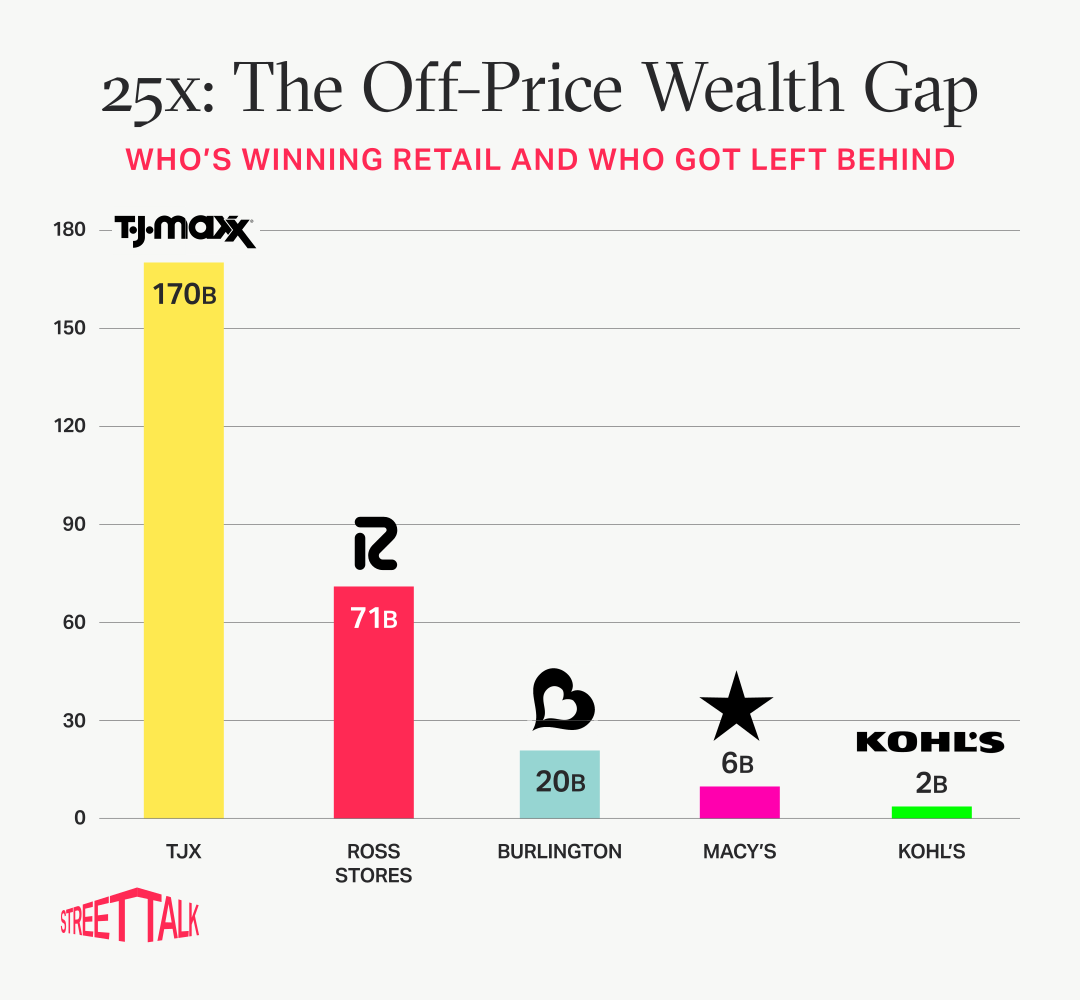
As of mid-July 2026, the market gap between off-price and traditional department store retailers remains stark. TJX Cos., carries a market capitalization of roughly $170 billion, making it by far the largest player in the space. Ross Stores follows at around $71 billion, while Burlington Stores checks in at about $20 billion. By comparison, Macy’s — the largest traditional department store chain still publicly traded — has a market cap of roughly $6 billion, and Kohl’s trails further behind at under $2 billion.
Combined, the three off-price retailers are worth more than 25 times what Macy’s and Kohl’s are worth together, underscoring how thoroughly value-focused, treasure-hunt retail has eclipsed the traditional department store model in investor eyes.
How are TJX, Ross and Burlington Each Competing for Market Share?
The off-price giants are not simply benefiting passively from macroeconomic conditions; each is deploying deliberate strategies to widen its share of the value-seeking consumer, and increasingly, to defend that share against each other as the segment itself grows large enough to invite internal competition.
Burlington’s most visible strategic shift has been physical: a multi-year overhaul of its store fleet toward smaller, more efficient formats, typically situated in productive strip-center locations rather than the much larger and less productive boxes the company inherited from its department-store-adjacent past.
More than 80 percent of Burlington’s store fleet has been opened, relocated, or downsized since 2019 as part of this transformation, part of a broader initiative the company calls “Burlington 2.0.” The payoff shows up directly in the numbers: sales productivity has reached approximately $350 per square foot, a 55 percent increase since 2019, a gain company executives attribute largely to the transition toward smaller, more efficient stores.
Burlington has paired the real estate overhaul with investments in localization technology, which allows individual stores to tailor assortments to regional weather patterns and demand signals, a capability executives credited with driving double-digit growth in warm-weather categories during a recent quarter when unusual weather patterns caught less nimble competitors flat-footed. The company aims to exceed 1,500 stores by 2028, continuing a buildout that has already produced 14 consecutive quarters of double-digit earnings growth.
Burlington’s CEO has been characteristically blunt about the underlying formula, describing it internally as sticking to “the basics of off-price: controlling liquidity, managing inventory, chasing the trend and delivering great value,” which is an unglamorous description for a strategy that has driven mid-teens earnings growth on top of 22 percent growth the year before and 34 percent the year before that.
TJX, by contrast, is leaning on scale and geographic diversification as its primary competitive weapons. The company has set a long-term target of roughly 7,000 stores globally, up from just over 5,200 today, with HomeGoods identified as the single biggest domestic growth opportunity; potentially nearly doubling that chain’s footprint over time. Internationally, TJX is pushing its T.K. Maxx banner into Spain for the first time and deepening its presence in Mexico and the Middle East through joint ventures, treating the value-shopping trend as a global phenomenon rather than a uniquely American response to inflation.
TJX’s buying organization, which sources close-out and off-season inventory opportunistically from thousands of vendors, remains the company’s core differentiator and the hardest part of the model for either traditional retailers or e-commerce platforms to replicate. A constantly rotating, treasure-hunt inventory does not translate well to online shopping, which insulates the format from a pressure that has hollowed out much of traditional apparel retail.
TJX executives have also emphasized hyper-vigilant, granular pricing discipline in the face of tariff-driven cost pressures, working deal by deal to preserve the price gap against full-price retailers that is the entire basis of the off-price value proposition.
Ross Stores has focused its strategy on unit growth combined with steady improvement in merchandise margin and inventory execution. The company opened new stores across both its Ross and dd’s Discounts banners in its most recent quarter and is targeting roughly 5 percent unit growth for the year, with plans to eventually grow the Ross banner to 2,900 locations and dd’s Discounts to 700. Executives have highlighted improving new-store productivity, guiding for new locations to open at 70 to 75 percent of the sales volume of mature stores, with some early results suggesting the potential to exceed that benchmark. Ross has also emphasized tight cost control in its supply chain, with declines in distribution and freight costs contributing to margin expansion alongside merchandise margin gains.
Beyond company-specific initiatives, all three chains share a broader strategic posture: aggressive, continued store expansion at a moment when many traditional retailers are closing locations. That expansion is explicitly aimed at capturing “transfer sales,” which is the off-price industry’s term for revenue shifted away from department stores and mid-tier apparel chains as those competitors lose foot traffic. TJX’s chief executive has told analysts the company intends to be “more aggressive than we’ve ever been” in pursuing that market share growth.
For commercial landlords, the off-price sector has become one of the most reliable categories of tenant precisely because these companies are still expanding into the mid-size retail boxes that other chains are vacating.
Will Off-Price Retailers Start Competing Against Each Other?
The one wrinkle in an otherwise uniformly upbeat sector narrative is the possibility that off-price growth eventually turns into off-price cannibalization. For most of the past decade, TJX, Ross, and Burlington have coexisted comfortably because they have skewed toward somewhat different customers — Burlington traditionally serving a more price-sensitive, lower-income shopper, and TJX drawing a broader middle- to upper-middle-income base. But as all three chains expand store counts simultaneously and increasingly compete for the same finite pool of quality closeout and off-season merchandise, some analysts see the conditions for a more direct clash forming. Evercore ISI analysts have flagged the potential for “intensifying market share shifts among off-price chains” even as the category as a whole continues to take share from traditional retail, and other Wall Street voices have raised the question of what happens to sourcing dynamics as all three chains scale up their buying simultaneously, competing not just for customers but for the inventory that makes the off-price model work in the first place.
For now, that internal competition remains a secondary concern compared to the shared opportunity of the K-shaped economy itself. Tax policy changes are expected to deliver outsized benefits to higher earners in the year ahead, while tighter eligibility rules for federal assistance programs are set to squeeze some lower-income households further, suggesting the structural conditions that have driven consumers of every income level toward value retail are unlikely to reverse anytime soon.
Whether shoppers are hunting for relief from rising grocery and gas prices or simply chasing a good deal on top of an otherwise comfortable financial picture, the off-price aisle has become one of the few places in American retail where both branches of the K currently meet.
Read the original report, HERE.
Related Article: Profitably Serving the Middle Has Become Much More Complex
The Street Talk newsletter delivers the sharpest fashion, beauty, and retail analysis every Thursday — straight from Arthur Zaczkiewicz, former Executive Editor at WWD. Subscribe today.