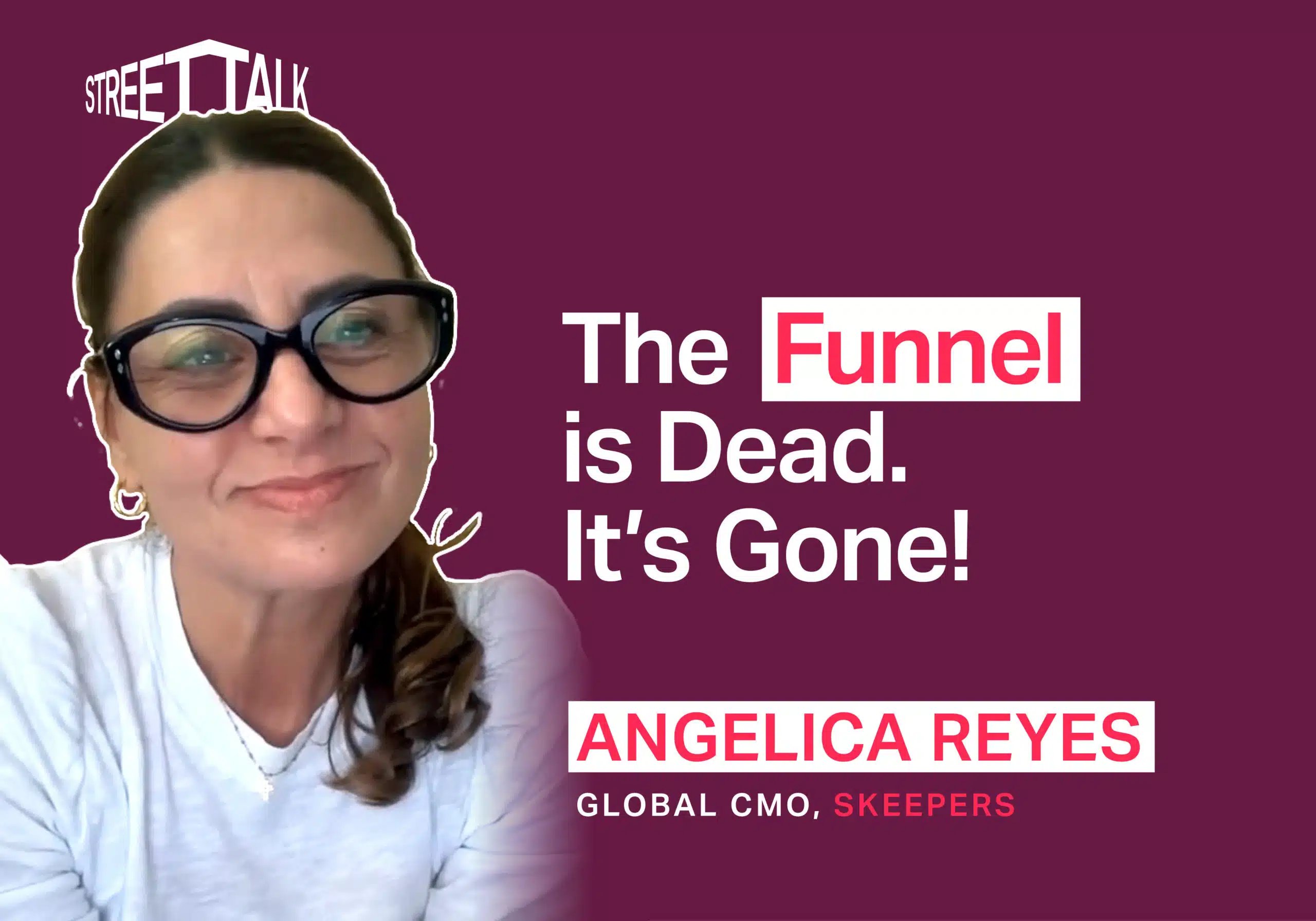
Angelica Reyes, Global CMO and US General Manager at Skeepers, explains how the collapse of the traditional purchase funnel has made user-generated content the primary mechanism for both discovery and conversion. With 70% of Gen Z using social as their search engine and UGC two to three times more trusted than brand content, retail marketers can no longer treat UGC as supplementary.
The Funnel isn’t Broken. What’s Replaced It?
For most retail brands, the assumption that consumers move through a predictable sequence of awareness, consideration, and purchase hasn’t just been disrupted — it’s been retired. Angelica Reyes has a clear-eyed view of what replaced it.
As Global CMO and US General Manager at Skeepers, Reyes works at the intersection of retail data and consumer trust — arguably the most contested terrain in modern marketing. Her platform helps brands collect, manage, and activate user-generated content at scale, and she’s watched UGC evolve from a content tactic to the actual infrastructure underpinning retail discovery. The numbers she brings to the conversation aren’t soft: over 70% of Gen Z now treats social media as its primary search engine; UGC is two to three times more trusted than brand-led messaging; TikTok Shop is growing north of 80% year-over-year; and more than 42% of Amazon’s incoming traffic originates on social platforms.
And Brands Winning Right Now?
The conversation moves into territory that should make any CMO uncomfortable: most organizations are still siloed in ways that prevent the voice-of-customer data living in their reviews and social posts from ever reaching the people who could act on it. Product teams, social teams, and e-commerce teams are operating with different data sets. The opportunity cost is substantial.
Reyes also makes a case that’s easy to underestimate — that the shift toward micro and nano influencers isn’t a retreat from scale, it’s a recognition that trust travels at smaller radii. The brands winning right now are building long-term creator relationships rather than one-off activations, and feeding the LLMs that are quietly rewriting how search works. Worth your hour.
Related episode: Ep. #019: David Dorf, Amazon Web Services
Newsletter signup CTA: Get the Street Talk newsletter — retail intelligence for C-suite decision-makers. Subscribe free.
Transcript
What is Skeepers, and how does UGC work at scale?
Arthur Zaczkiewicz: Hi, I’m Arthur Zaczkiewicz and welcome to Corner of Fifth Street Talk, where we share insights about fashion, apparel, retail, beauty, technology, retail real estate and more — while also answering this key question: what does fashion and retail mean to you? Today we welcome Angelica Reyes, who is the Global Chief Marketing Officer and US General Manager at Skeepers. Welcome. Thanks for taking time out today.Angelica Reyes: Hey Arthur, thank you so much for having me.Arthur Zaczkiewicz: Let’s start with Skeepers — tell us a little about what you do.Angelica Reyes: Sure. Before I talk about Skeepers, let me frame the market we’re part of. Think about how you discover and interact with brands today as a consumer. Chances are you’ll find a product through a social post, and the next thing you’ll do is check reviews. All of that is UGC — user-generated content. What we see is that brand-led messaging doesn’t cut it anymore. People are looking for those authentic signals to discover and trust a brand.That’s where we come in. We’re a UGC platform. We help brands collect, manage, and activate UGC at scale — because it’s not simple. There are millions of creators, there are many types of UGC: social posts, reviews, short-form video. We help brands manage all of that through our AI-powered platform.Why cutting through the noise is harder than most brands admit
Arthur Zaczkiewicz: You’re uniquely positioned at the intersection of retail data and consumer trust. From your perspective, what are the main challenges facing retailers and brands when they want to connect authentically with customers — and what does it take to overcome them?Angelica Reyes: The entire customer journey has changed enormously, and everything we’re seeing is only accelerating that shift. I’d identify three major challenges.The first is cutting through the noise. Over 70% of Gen Z now uses social media as their primary search engine — when a younger consumer wants to find a product or service, they go to TikTok. And beyond that, the acceleration of LLMs over the last year means they’re competing directly with traditional search engines. What feeds those LLM searches is UGC. So the first big question for any brand is: how do you become visible in a world where search has fundamentally shifted?How consumer trust shifted from brands to peers — and why UGC is now 2–3x more credible
Angelica Reyes: The second challenge is trust. We conduct a lot of consumer surveys, and the data is consistent: consumers are very sceptical of branded messaging. UGC is over two to three times more trusted than brand content. Think about your own behaviour — you’re going to trust your peers far more than what a brand has to say. And we see systematically that consumers check reviews before they click buy.So this isn’t just an acquisition question. It’s about how you drive conversion. UGC provides that voice of the customer that builds enough trust to take someone from discovery all the way to purchase.The third challenge is scale. You need to be producing authentic content on a regular basis. You need fresh reviews on product pages. And we’re seeing more and more brands repurposing that authentic content for paid campaigns and product pages. The problem is you can’t produce that kind of content in-house — you can’t manufacture authenticity. So brands are turning to solutions like ours to achieve that capacity at scale.What’s really driving the rise of micro and nano influencers
Arthur Zaczkiewicz: Is authenticity and trust what’s driving UGC growth? It used to be macro influencers, then micro — now it’s user-generated content. What’s fuelling that shift?Angelica Reyes: Trust is the primary driver. A few years ago, brands were relying heavily on macro influencers. What we’re seeing now is more and more brands moving toward smaller creators — micro and nano — because even though they have smaller audiences, those audiences trust them deeply. Engagement rates are very high.The shift in search is also important here. For CMOs and marketing teams, you need to ensure you have the signals that will feed LLMs. Those signals are trusted content: reviews, comments, people talking about you in forums like Reddit. Users talking about a brand are what’s going to surface that brand in searches. That’s why micro and nano influencers matter — not just for engagement, but because that content feeds the new infrastructure of discovery.How TikTok Shop collapsed the purchase funnel in real time
Angelica Reyes: We see that 71% of consumers say they buy a product after seeing a creator post on Meta or TikTok. With no surprise, this is why TikTok Shop in the US is booming — growing over 80% year-over-year, driving billions in sales. The funnel has completely collapsed: discovery and purchase happen in the same moment. Whether you buy directly on TikTok Shop or through the halo effect of creators driving traffic elsewhere, the signal is the same. Over 42% of the traffic driving Amazon sales is now coming from social media. And product pages that integrate authentic UGC content simply convert at higher rates than those that don’t.The Skeepers value proposition — for brands and consumers
Arthur Zaczkiewicz: Stepping back — how would you describe the overall value proposition of your platform, both for retailers and brands, and for consumers? Does it make the shopping experience easier?Angelica Reyes: Absolutely. Brands want to be where consumers are, and consumers need this trust signal — they want to see people like themselves trying a product before they buy. That’s what drives the decision.UGC comes in many forms: a creator post, a review, a short video. There are millions of creators out there — anyone can be a creator for a brand they love. The complexity for brands is identifying the right matches and then activating all of that UGC across product pages, paid campaigns, email, in-store screens, and retail media. That’s where we come in.We give brands full licensing rights, which matters when you’re repurposing content. And what makes us genuinely different is three things: first, AI — and for us it’s not a buzzword. We’ve been integrating agentic AI throughout the platform for productivity, creator matching, content moderation, and streamlining creator workflows. Second, we have a vetted community of over 150,000 micro and nano influencers that brands can tap into for product launches and campaigns. Third — and this is an important trend — we help brands build long-term creator relationships, not just one-off activations. If a creator is talking about your product today and your competitor’s tomorrow, that trust evaporates. The brands winning are the ones building sustained creator communities.Why most retailers are misusing the UGC data they already have
Arthur Zaczkiewicz: There’s a huge amount of data that retailers and brands have access to. Are they using it correctly? Is there a disconnect between the data they hold and its potential?Angelica Reyes: There’s a lot of misused data, yes. The core problem is that organisations are still very siloed. The voice of the customer exists in reviews and social posts, but the teams capturing that data aren’t necessarily connected to the product teams or service teams who could act on it. Social teams and e-commerce teams are operating in separate lanes.So there’s a significant amount of untapped insight sitting right there. We are seeing more brands become conscious of this and start working toward using that data to inform product innovation and new services. But the gap is still substantial.Where the shopping journey begins today — and why the answer is ‘anywhere’
Arthur Zaczkiewicz: You said at the start that the shopping journey has changed. Where does it begin now?Angelica Reyes: It can begin anywhere. Content is the funnel today. The shopping journey as we knew it — with a defined beginning, middle, and end — no longer exists. Today, you’re scrolling through Instagram or TikTok, you spot a creator whose content catches your attention, and you can buy immediately. That’s the opportunity for brands right now.What AI personalisation means for the next generation of retail
Arthur Zaczkiewicz: Last question — what does fashion, apparel, retail, and retail technology mean to you, both professionally and personally?Angelica Reyes: There’s a lot happening with AI where you can already see how a product would look on you without going in store. Brands like L’Oréal have been doing a lot of innovation in this space — and I think it’s genuinely exciting because it creates a much stronger connection between the brand and the consumer. The magic of it is the personalised experience you can deliver at scale. That’s a powerful driver of sales and loyalty.Arthur Zaczkiewicz: Thank you so much — I really appreciate you joining us today. We’ll see you next time.Angelica Reyes: Thank you, Arthur. Really enjoyed the conversation.