


Retail Report
September 29 2026
Four forces are shaping retail strategy in Q4 2026: a K-shaped consumer economy squeezing the mid-market, circular commerce becoming operating infrastructure, a format-specific recovery in physical retail, and trade policy volatility. Street Talk’s retail industry outlook 2026 finds each is already operating, and sets out six decisions retail leaders can execute within 90 days. Abstract As the retail industry absorbed
Corner of Fifth

Four forces are shaping retail strategy in Q4 2026: a K-shaped consumer economy squeezing the mid-market, circular commerce becoming operating infrastructure, a format-specific recovery in physical retail, and trade policy volatility. Street Talk’s retail industry outlook 2026 finds each is already operating, and sets out six decisions retail leaders can execute within 90 days.
Abstract
As the retail industry absorbed the implications of autonomous commerce and AI-driven operations catalogued in Street Talk’s May 2026 report, a second set of forces was quietly compounding in the background. Consumer balance sheets have deteriorated faster than headline spending data acknowledges. The circular economy has moved from aspiration to operational infrastructure — driven as much by regulation as by market demand.
Physical retail has staged a recovery that confounds the narrative of decline, but only in formats that have solved the experience equation. And trade policy, once a background variable, has become a primary input to sourcing strategy, margin planning and supply chain design.
This report synthesizes Street Talk’s reporting from June through September 2026 across four intersecting forces. The implications for retail and brand leadership — particularly for the capital allocation decisions that must be made in Q4 — are immediate and compounding.
1.0 The K-Shaped Consumer
1.1 Debt, Sentiment, and the Paycheck-to-Paycheck Reality
The headline numbers on U.S. retail continue to paint a picture of resilience. The National Retail Federation projects annual sales growth of over four percent. Consumer spending, measured in aggregate, remains positive. The aggregate is accurate — and it hides a split.
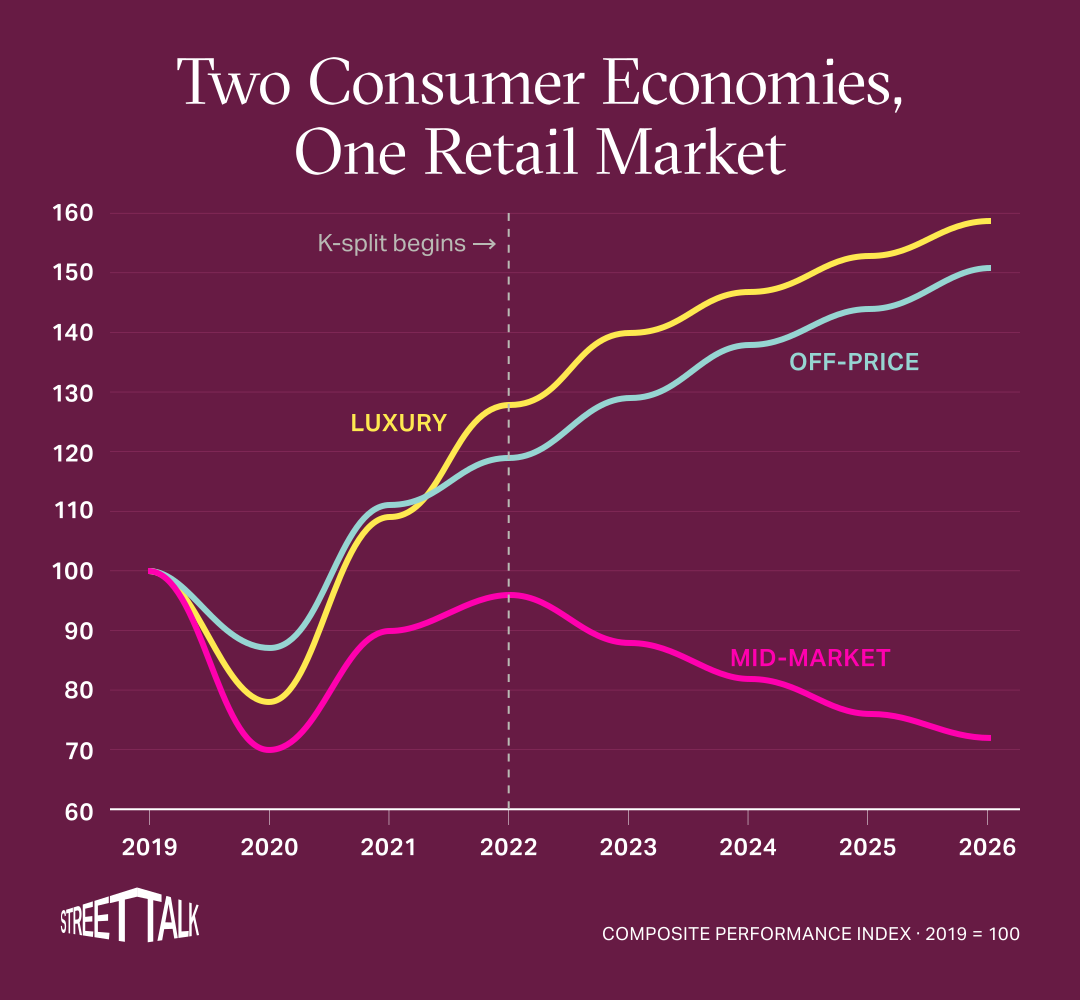
The aggregate masks a structural split that has now become the defining feature of the U.S. consumer economy. Total household debt stands at $18.8 trillion — distributed across mortgages, auto loans, credit cards, and student debt at levels that have left the mass-market consumer operating with no financial buffer. The University of Michigan’s Consumer Sentiment Index fell to 47.8 in September 2026, a 7.5 percent decline from August, marking its second consecutive monthly drop. That number sits at levels associated with recession-era consumer behavior.
The mechanism is not complicated.
Cumulative inflation from 2021 through 2025, compounding against nominal wages that never fully caught up, has erased purchasing power for a significant share of the working population. Monthly income is absorbed by fixed obligations — rent or mortgage, auto payments, minimum card balances, utilities — before discretionary spending enters the equation. The 53 percent of Americans who rely on revolving debt to cover basic living costs are not making consumption choices. They are managing a cash-flow constraint.
1.2 Consumer Bifurcation: Who Is Still Spending and Why
The growth in overall retail volume is being sustained almost entirely by higher-income households — those whose balance sheets are supported by asset appreciation in equities and real estate. For this cohort, 2026 has been a continuation of the post-pandemic spending expansion. For the median household, it has been a year of contraction dressed as stability.
Simon-Kucher’s New American Dream Study — 5,000 respondents surveyed across all demographic cohorts in America’s 250th year — produced findings that challenge the prevailing narrative on both sides. The dream is alive across every generation. Every cohort believes its own generation has the best shot. That coexistence of aspiration and economic anxiety is not contradiction. It is the defining psychological feature of the bifurcated consumer economy.
Across discretionary categories — apparel, home furnishings, food delivery, leisure — net spending intentions have turned negative for mass-market consumers. Value retailer traffic is up. Promotional calendars are more critical than they have been in years. The consumer who once traded between channels is now trading down categories.
1.3 The Consolidation at the Extremes
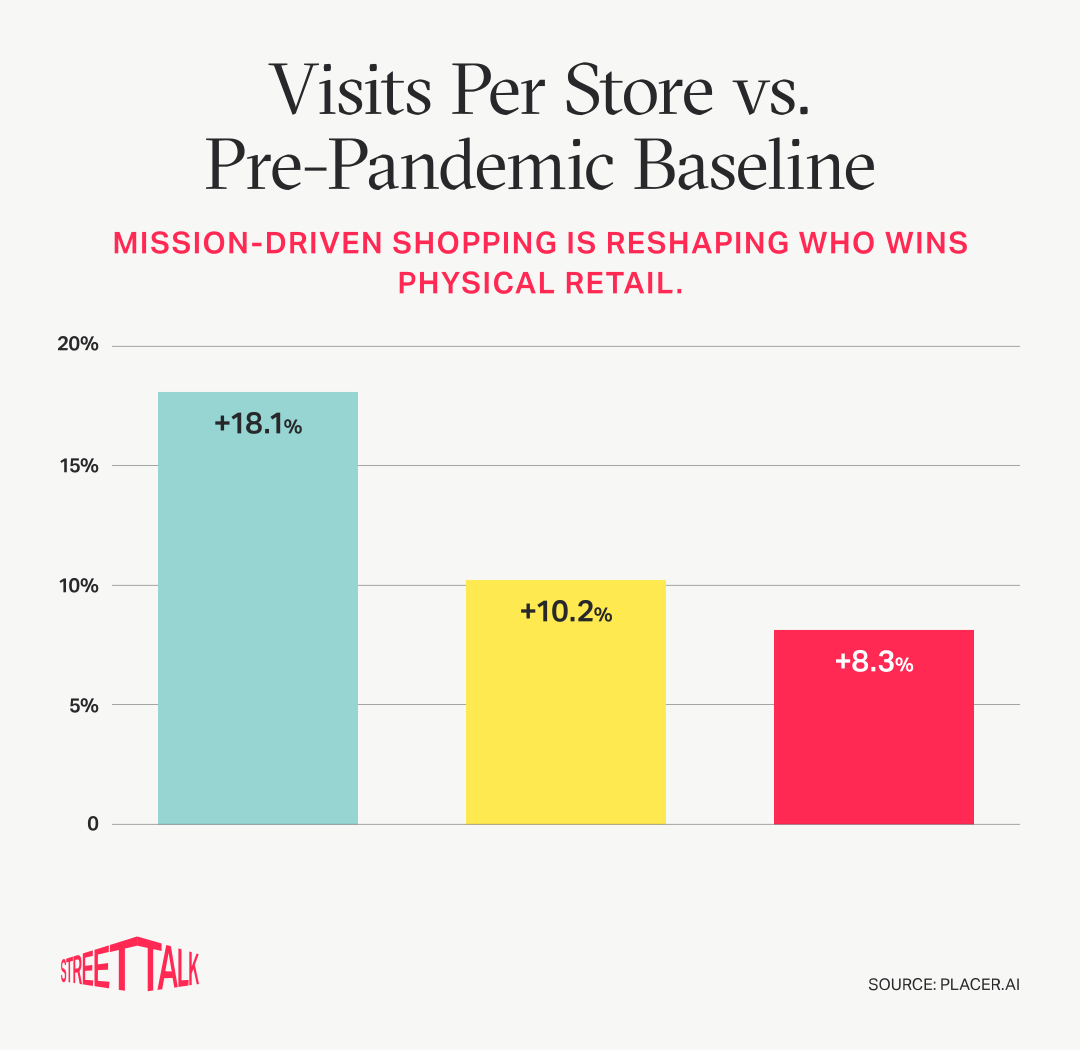
Walmart, Target, Costco and Dollar General collectively held 17.5 percent of all U.S. brick-and-mortar traffic in Q1 2026, up from 16.8 percent in 2019 (Placer.ai). These four operators share one characteristic: mission clarity. Each serves a distinct shopping occasion without ambiguity. The casualty is the mid-market — retailers positioned between the value end the mass-market consumer is trading toward, and the quality end the high-income consumer is trading up to. That squeeze is structural, not cyclical. The retailers that will navigate this environment are those that have made an explicit choice about which end of the bifurcation they are serving.
“Ninety percent of American shave changed their behavior because of inflation. The American Dream is not dead — but the
barriers to it are steeper than they have been in decades.”
— Shikha Jain, Lead Partner Consumer & Retail, Simon-Kucher
Talking on the Street Talk podcast episode 029:
‘Is the American Dream Still Alive?’
Implications For Retailers And Brands
01 Segment the consumer, not just the product. Aggregate data is masking opposite realities. Decisions made on average consumer behavior are decisions for a consumer that no longer statistically exists.
02 Promotional strategy is not optional for mass-market operators. The consumer waiting for a promotional event is managing a genuine cash-flow constraint. Meeting them there is the strategy, not a margin concession.
03 Mission clarity is the differentiator at both ends. The mid-market squeeze will not resolve. Operators without a clear answer to “which consumer are we serving?” are competing for a shrinking segment from an ambiguous position.
2.0 The Circular Economy’s Commercial Moment
2.1 From Aspiration to Infrastructure
For most of the past decade, circular fashion operated on a single proposition: it was better for the planet. That built awareness. It did not build durable business models. The second half of 2026 marks a structural shift. Three forces are converting circular commerce from a brand value into an operating infrastructure: the returns economy’s cost has made the status quo economically untenable; a new generation of companies has built the operational layer to make circularity financially viable; and European regulation has eliminated the option of ignoring it.
2.2 The Returns Problem — $849.9 Billion and Counting
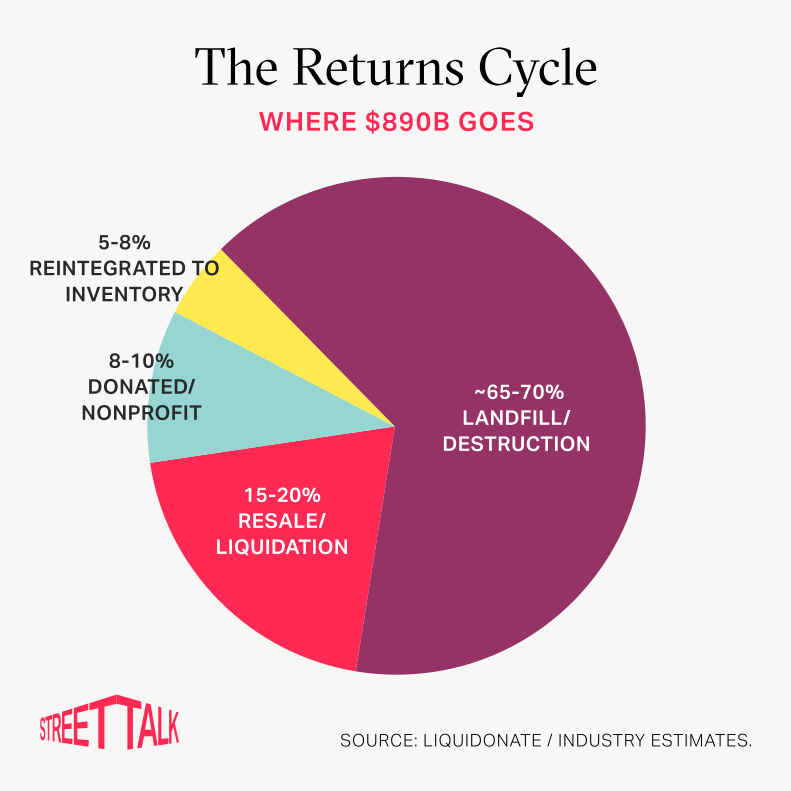
$849.9B / annual U.S. retail returns, 2025 (NRF) — encompassing processing costs, markdown losses,
and disposal.
The operational responses are bifurcating. The upstream layer solves fit and sizing to prevent the return. TrueFit’s network spans 91,000 brands and hundreds of millions of shopper profiles, now connecting fit data directly into AI shopping agents via MCP. The downstream layer addresses what happens after. LiquiDonate reroutes unsellable returns to over 4,700 nonprofits, cutting shipping distance by 90 percent and total cost by 60 percent — reframed explicitly as a cost-saving tool first, sustainability story second.
2.3 The Post-Purchase Layer and the Rental Marketplace
Alternew embeds repair and tailoring directly into brand post-purchase infrastructure. Clients including Primark, Coach, and Levi’s are integrating these services as a retention and margin-recovery tool, not a sustainability initiative.
Pickle’s peer-to-peer rental marketplace, now live in all 50 states, has converted everyday wardrobes into income streams — one top lender earned $50,000 in a single month. The critical insight is not the rental mechanic but the proof that circularity requires a financial incentive, not a moral argument. The platforms that have understood this have found adoption. The ones leading with the sustainability story have not.
2.4 Regulatory Acceleration
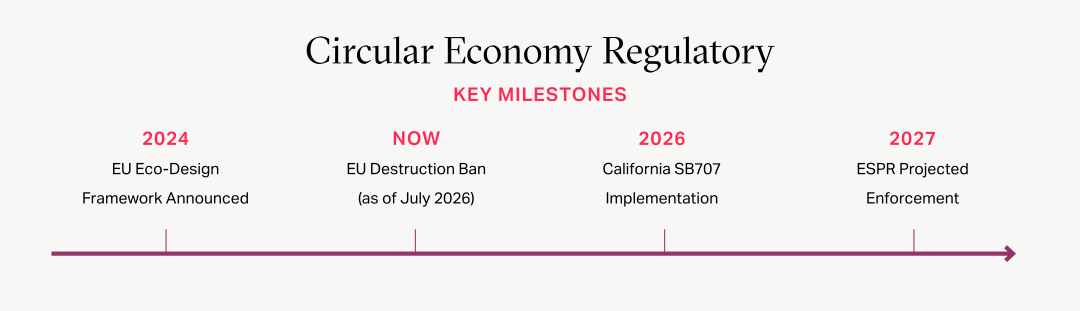
In July 2026, the EU implemented a ban prohibiting large companies from destroying unsold apparel, accessories, and footwear — forcing surplus inventory into the global circular economy. The downstream effect for U.S. brands with European operations: a structural increase in circular supply that will reshape secondary market dynamics they have been managing domestically. In the United States, California’s SB707 and Extended Producer Responsibility frameworks are in implementation. Brands without governance frameworks for circular inventory are accumulating regulatory exposure in real time.
“If our only value proposition were sustainability, it would be much harder to get people to adopt the platform. The environmental benefit is the cherry on top of an economic case that already works on its own.”
— Julia O’Mara, Co-Founder & COO, PickleTalking on the Street Talk podcast episode 031: ‘Access Over Ownership’
Implications For Retailers And Brands
01 The returns P&L is a strategic priority, not an ops problem. Quantify the full cost of current returns infrastructure against prevention and intelligent routing. The economics of the status quo are almost certainly worse than they appear.
02 Post-purchase is a revenue category, not a cost center. Repair and care services embedded in the brand relationship generate repeat engagement and extend product lifecycle.
03 EU regulation has already changed U.S. supply chain math. Model the downstream effects of the EU destruction ban on domestic resale and off-price positioning before the supply wave arrives.
04 Circularity requires a financial case, not a moral one. The models gaining adoption lead with economic incentive and treat sustainability as an additive benefit. Reverse that order and adoption stalls.
3.0 Physical Retail Reimagined
3.1 The Experience Economy Gets Data-Driven
Physical retail is not dead — boring retail is dead. But that truism is not an operational framework. The gap between acknowledging the experience imperative and building the infrastructure to execute on it is where most traditional retailers currently sit, and where competitive differentiation over the next three years will be determined.
The second generation of experience retail is operational and data-driven: it uses store intelligence to eliminate friction that makes in-store shopping inferior to digital, and deploys that recovered margin into the experience layer that makes in-store shopping irreplaceable.
3.2 The Queue as a Revenue Opportunity
Keith Carpentier of QBuster has reframed one of retail’s most persistent cost assumptions. The queue — at checkout, the fitting room, the service desk — has been treated as an operational failure to minimize. QBuster’s data suggests it should be treated as a revenue opportunity to manage. A customer in a well-managed queue is a captive audience in the highest-intent moment of their purchase journey.
3.3 Store Intelligence: The $196 Billion Gap
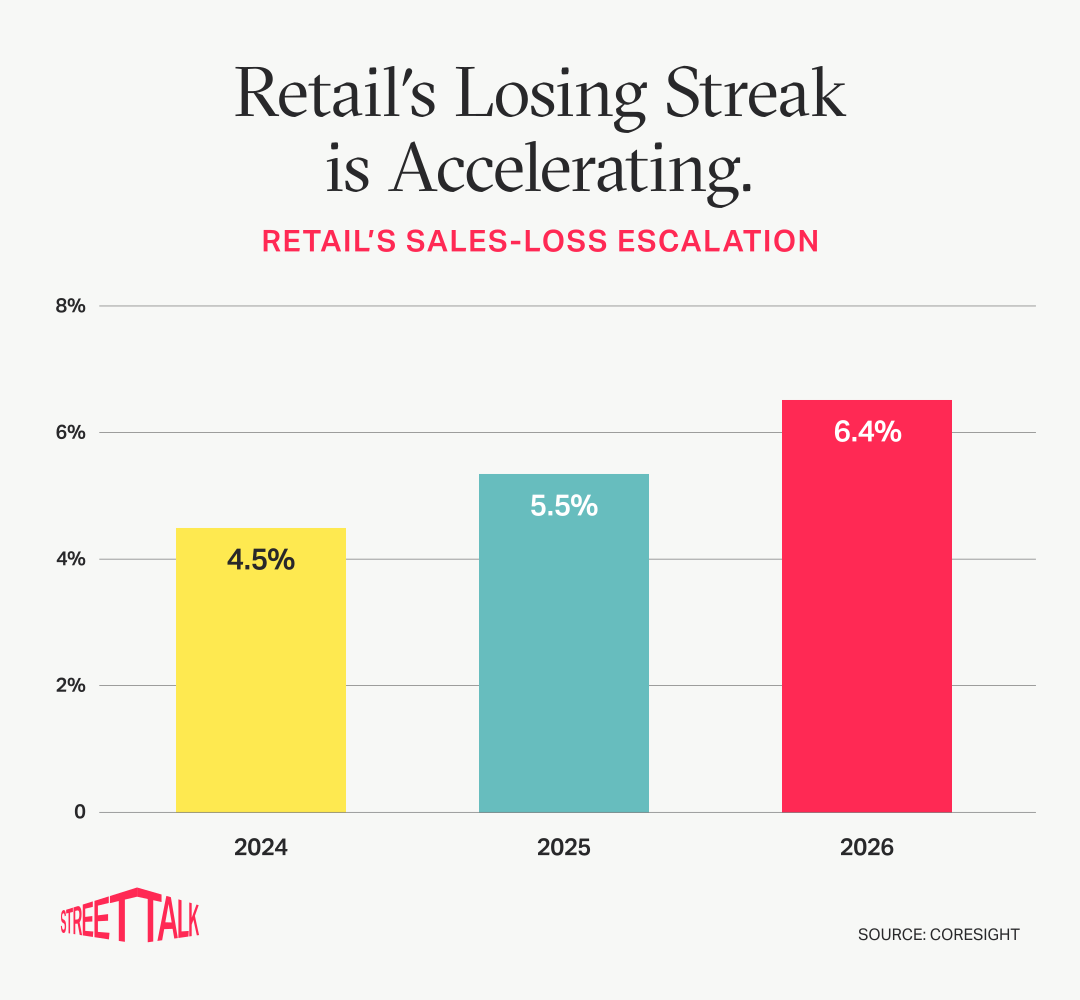
A 2026 analysis by Coresight Research with Simbe and RELEX quantified the gap between the promise of store intelligence technology and its execution at scale: $196 billion annually in operational losses, mispricing errors, and revenue leakage. Ninety percent of surveyed retail decision-makers reported operational challenges in 2026, up from 88 percent in 2025, despite accelerating investment. The tools work; they just don’t talk to each other. Retailers deploy AI-powered tools in isolation — and the accumulated intelligence is not flowing into the operational decisions it was purchased to inform.
3.4 Mall Recovery and What the August Data Tells Us
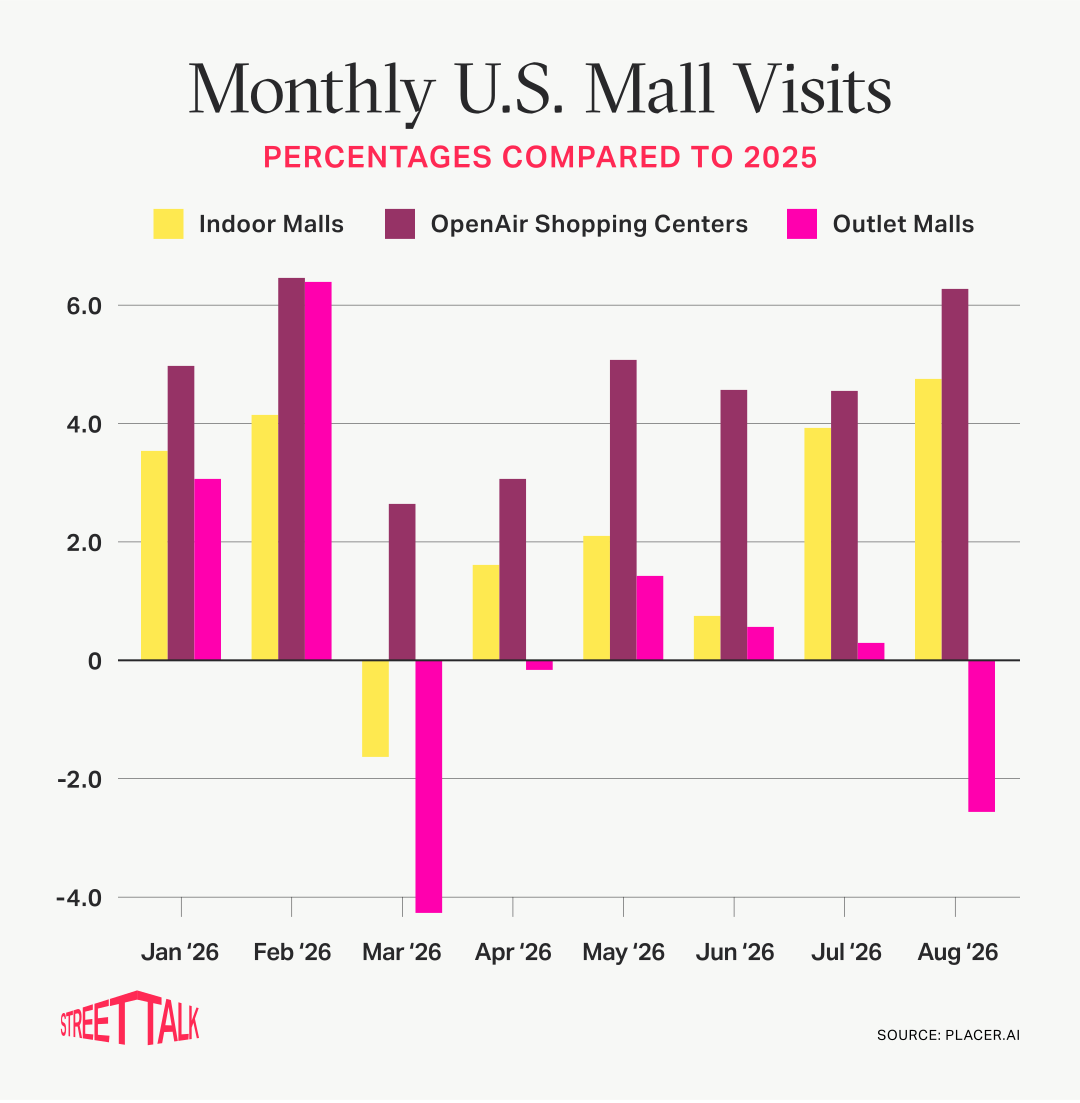
August 2026 mall foot traffic from Placer.ai recorded the highest single-month readings of the year: open-air malls up 6.6 percent, enclosed malls up 5 percent, fuelled by a record $43.3 billion back-to-school season. The recovery is concentrated in formats that have solved the experience equation — open-air mixed-use developments, destination malls anchored by entertainment and food, and specialty retail clusters that create genuine discovery. Operators who have not built something unavailable online into their physical experience are not capturing the recovery.
“The queue is not a cost. It is the highest-intent moment in the customer’s journey. Most retailers are spending money to eliminate it instead of monetizing it.”
— Keith Carpentier, CEO, QBuster Talking on the Street Talk podcast episode 032: ‘The Line That Pays
Implications For Retailers And Brands
01 Store intelligence requires integration infrastructure first. The $196B loss is a data connectivity deficit, not a technology deficit. Audit whether existing tools connect to the operational decisions they were purchased to inform before adding new capability.
02 The experience layer must be operationally funded. The competitive question is not whether you have a beautiful store. It is whether the store eliminates friction fast enough to fund the experience that makes it worth visiting.
03 Mall recovery is format-specific, not category-wide. Traffic recovery is concentrated in open-air mixed-use and destination formats. Real estate strategy should be calibrated against format performance, not aggregate mall data.
4.0 Trade Policy as Operating Variable
4.1 Tariffs: The Aftermath
Five decades of data across 150 countries produce a consistent finding: broad-based tariffs do not deliver sustained trade rebalancing. They deliver inflation, supply chain disruption and a redistribution of cost from importers to consumers. The relevant question for retail and fashion executives is no longer whether tariffs work as policy. It is how to manage sourcing, pricing, and inventory strategy in an environment where trade policy has become permanently unpredictable.
The tactical responses separating high-performing operators in 2025–2026 were speed and optionality. Brands that diversified sourcing geographies ahead of tariff announcements had options when levies hit. Brands that understood the IEEPA tariff refund mechanisms available through the federal CAPE portal were recovering capital that competitors had written off — one major DTC brand in home essentials confirmed recovering $1 million through this mechanism alone.
4.2 Regulatory Waves from Europe
The EU’s July 2026 ban on the destruction of unsold apparel, accessories, and footwear is the most consequential single regulatory development in fashion since REACH — not just for the brands it directly affects, but for the secondary market dynamics it will reshape globally. A 2026 study ranking 100 countries on digital infrastructure resilience adds a second layer: the regulatory compliance burden of EU digital frameworks falls differently on brands operating in markets with lower internet resilience scores.
4.3 The Compliance Advantage
There is a category of retailer for which compliance investment is generating genuine competitive advantage. Regulatory frameworks create barriers to entry that disadvantage competitors, then accelerate innovation in organizations that get ahead of them. California’s SB707, the EU Eco-Design for Sustainable Products Regulation, and emerging Extended Producer Responsibility frameworks are creating exactly this dynamic. The brands building compliance infrastructure now are establishing operational capabilities that will be structural competitive advantages once regulation makes them table stakes for all operators.
“We need more companies focused on the business aspect of the problem — making it cheaper and easier to use a circular solution than to do what retailers are doing today.”
— Disney Petit, Founder & CEO, LiquiDonate
‘Ep. #027: ‘How to Solve a “Really Stupid Problem”’ — Disney Petit, LiquiDonate
Closing
The Retail Pressure Map Is Not a Warning. It Is a Work Order.
The four forces mapped in this report are not coming. They are already operating. The retail organizations treating them as future risks to be monitored are already behind the ones treating them as current operating conditions to be managed.
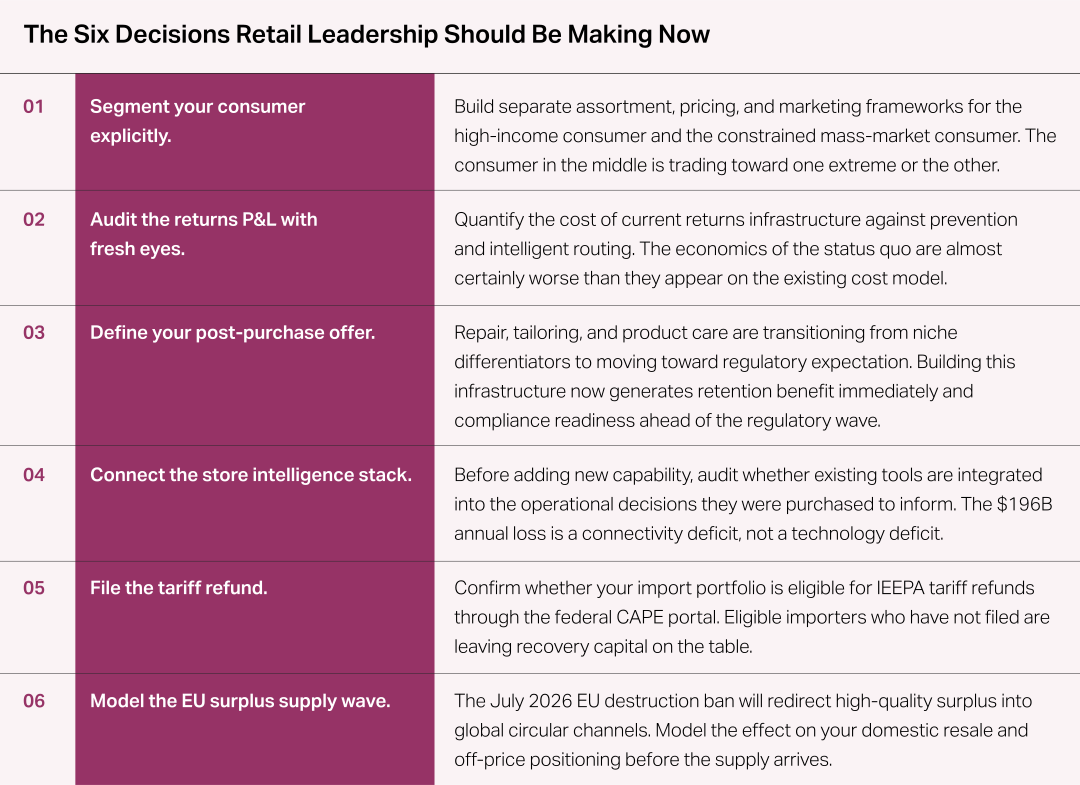
The leaders of the retail market in Q4 2026 are building infrastructure, making decisions, and accumulating institutional knowledge that compounds. The gap between those organizations and the ones waiting for conditions to stabilize grows with every quarter of deferral. The six decisions below are all executable in the next 90 days.
Data Sources & Methodology
All editorial analysis is drawn from Street Talk reporting published between June and September 2026.
Written by Arthur Zaczkiewicz. Additional writing by Antony Karabus, Cass Spencer.
External data referenced includes:
Placer.ai — Physical Retail in 2026: How the Giants Are Winning; mall foot traffic August 2026
Simon-Kucher & Partners — New American Dream Study, 5,000 respondents, 2026
Coresight Research / Simbe / RELEX — Store Intelligence Report, 2026
Federal Reserve / NY Fed — Household Debt and Credit, Q2 2026
University of Michigan — Consumer Sentiment Index, September 2026
National Retail Federation — 2026 retail sales forecast
European Union — Eco-Design for Sustainable Products Regulation; July 2026 destruction ban
Practitioner perspectives are drawn from Street Talk podcast episodes as cited throughout.
Practitioner Voices Referenced in this report
Jessica Murphy — Co-Founder & CEO, TrueFit | Ep. 026
Disney Petit — Founder & CEO, LiquiDonate | Ep. 027
Shikha Jain — Lead Partner Consumer & Retail, Simon-Kucher | Ep. 029
Nancy Rhodes — Founder & CEO, Alternew | Ep. 030
Julia O’Mara— Co-Founder & COO, Pickle | Ep. 031
Keith Carpentier — CEO, QBuster | Ep. 032
Related Report: The Autonomous Commerce Transformation
The Street Talk newsletter delivers the sharpest fashion, beauty, and retail analysis every Thursday — straight from Arthur Zaczkiewicz, former Executive Editor at WWD. Subscribe today.